
Where necessary, take:
- Planck’s constant, h = 6.63 × 10⁻³⁴Js
- mass of electron, me = 9.11 × 10⁻³¹kg
- charge on electron, e = 1.6 × 10⁻¹⁹ C
- speed of light in a vacuum, c = 3.0 × 10⁸ ms−1
1. Define the following:
(a) Photoelectric effect.
(b) Work function.
(c) Threshold frequency.
2. A clean zinc plate was charged and then placed on the cap of a positively charged electroscope as in the figure below.

(a) State the charge on the plate before it was placed on the cap of the electroscope.
(b) What would happen to the leaf of the electroscope if ultraviolet light was made to fall on the zinc plate?
(c) Why is the zinc plate cleaned?
3. Two metals X and Y are found to emit electrons when irradiated in turn with a light beam A, while only metal X emits electrons when irradiated with a second light beam B.
(a) What are the possible distinctions between:
(i) light A and light B.
(ii) metal X and metal Y.
(b) What would be the effect of using on metal X:
(i) a light beam of the same colour but greater intensity.
(ii) light of shorter wavelength.
4.(a) How does the kinetic energy of a photo-electron depend on the frequency of the incident radiation?
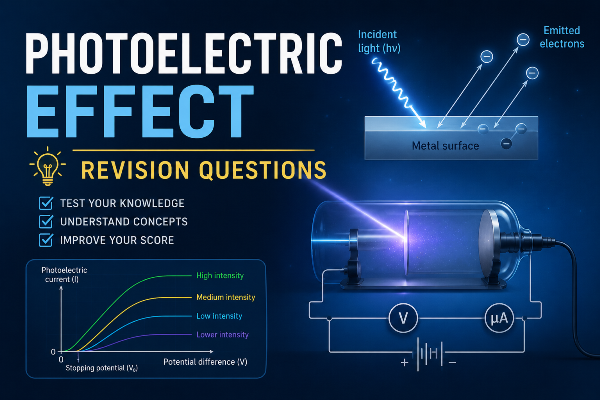
(b) The figure shows the plots of current versus corresponding potential difference between the plates of a photocell when various beams of light are directed to its cathode, one at a time. Which of the beams has the lowest wavelength?

5.
(a) A graph of kinetic energy of photoelectrons emitted by metal surface against the frequency of radiation used is shown in the figure below.

The graph is extrapolated to intersect the K.E. axis.
(i) From the graph, state the relationship between KE and frequency.
(ii) What is the significance of the gradient of the graph?
(iii) What is the significance of OX from the graph?
(b) The experiment is repeated with a photocell of a metal surface B which has a lower work function than metal A. Sketch on the same axes the expected graph if metal surface B photocell were used.
6. The minimum frequency of light which will cause photoelectric emission from a metal surface is 5.0 × 10¹⁴ Hz. If the surface is illuminated by light of frequency 6.5 × 10¹⁴ Hz, calculate:
(a) the work function of the metal surface.
(b) the maximum K.E. (in eV) of the electrons emitted.
(c) the maximum speed of the electrons.
7. The work function of a clean metal surface is 4.5 eV. Calculate:
(a) the minimum frequency of radiation that will cause the emission of electrons from the surface.
(b) the maximum energy of the electrons emitted when the surface is illuminated with a radiation of frequency 1.2 × 10¹⁵ Hz.
8. A sodium surface is illuminated by light of wavelength 3.0 × 10⁻⁷ m. The work function for sodium metal is 2.46 eV. Find:
(a) the kinetic energy of the ejected photoelectrons.
(b) the cut-off frequency for sodium.
9.
The table below shows the stopping potential and the corresponding frequencies for a certain photocell:
| Stopping potential Vs(V) | 0.2 | 0.6 | 1.10 | 1.42 | 1.83 |
|---|---|---|---|---|---|
| Frequency f (×1014 Hz) | 4.0 | 5.0 | 6.0 | 7.0 | 8.0 |
Plot a graph of stopping potential V<sub>s</sub> (y-axis) against frequency and from the graph, determine:
(a) the threshold wavelength.
(b) Planck’s constant.
(c) the work function of the metal.
10. Sodium has work function of 2.3 eV. Calculate:
(a) its threshold frequency.
(b) the maximum velocity of the photo-electron produced when its surface is illuminated by light of wavelength 5.0 × 10⁻⁷ m.
(c) the stopping potential of this energy.
11. A metal surface has work function of 4.92 eV.
(a) Find the maximum wavelength of radiation that will cause the emission of photoelectrons from the metal.
(b) Calculate the maximum kinetic energy in joules of the electrons emitted when the metal is irradiated with ultraviolet light of frequency 1.8 × 10¹⁵ Hz.
(c) What is the stopping potential of this metal?
12. (a) What is meant by threshold wavelength?
(b) The maximum kinetic energy of the photoelectrons emitted from a metal is 1.8 × 10⁻¹⁹ J when the frequency of the incident radiation is 8.5 × 10¹⁴Hz. Calculate the maximum wavelength of the radiation that can just emit an electron from the metal.
13. When light of wavelength 1.0 μm is radiated onto a metal, it ejects an electron with a velocity of 3.0 × 10⁵ ms−1. Calculate the:
(a) work function of the metal.
(b) threshold frequency of the metal.
14. (a) Describe a simple experiment which can be used to explain Quantum Theory.
(b) One would suffer from skin burn when a photon of energy of about 3.0 eV is radiated to our bodies. Find the wavelength of this radiation.
Leave a Reply