Tag: focal length

  • Focal length from lens formula

    Focal length from lens formula

    Determining Focal length from lens formula involves doing experiments to find different positions of image while adjusting object positions.

    Focal length of a lens can be determined by investigating relationship between image distance and object distance by obtaining image distances from varying object distances.

    The mirror formula describes the relationship that exists between the focal length, image distance and the object distance. Using the mirror formula derived earlier, We describe the experiment here and explains how to extract the the focal length from the relationship.

    The mirror describes the relationship that exists between the focal length, image distance and the object distance.

    The unknown Focal length of a lens can be determined experimentally by use of lens formula derived earlier. We describe the experiment here and explains how to extract the the focal length from the relationship.

    We draw the graph of the of reciprocal values of image distance against the reciprocal values of object distance. The intercept of the graph is used to estimate the focal length of the lens used.

    Apparatus

    • Metre rule
    • lens and a lens holder
    • source of light
    • screen
    • cardboard with a cross wire

    procedure

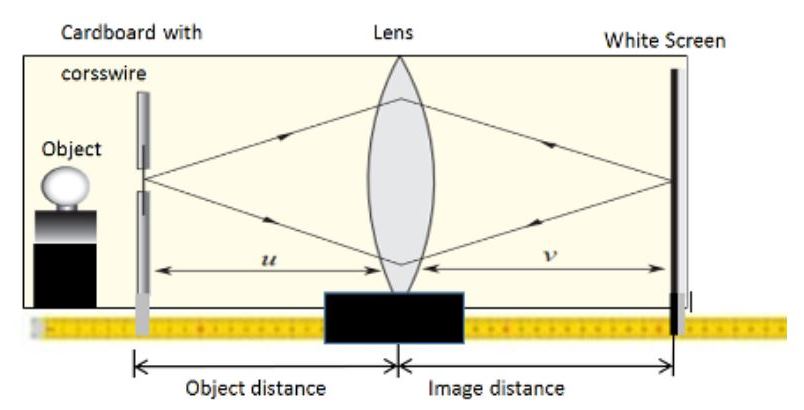
    • set the apparatus as shown
    lens screen and object arrangement to determine focal length by use of lenses formula
    • You place the object at the zero centimeter mark
    • set the object distance by placing the lens at a reasonable distance from the object like 80cm from the object.
    • Adjust the screen to observe a sharp image on the screen.
    • Record a distance between the screen and the lens where you spot a sharp image on the screen is the image distance.
    • Record the image and the object distance
    • Reduce the object distance u by about 5 cm then adjust the screen until you see another sharp image on the screen.
    • reduce the distances distance again by 5 cm and repeat the procedure above.
    • Fill the table as shown below
    a table showing variation of image against variation of object distance

    From the data obtain a graph of 1/u against 1/v by plotting.

    A typical graph will be as shown:

    The graph of 1/v against 1/u used to determine focal length from lens formula

    Graphical analysis of the Lens formula

    The lens formula is stated as:

    1f=1u+1v

    From the above formula, one can see that the sum of reciprocals of the image length from the lens and the reciprocal of the image distances equals reciprocal of the focal length.

    At the (1/v) intercept the value of (1/u)= 0. The lens formular becomes:

    1f=0+1v

    We eliminated 1/u from the formula after it become zero such that:

    1f=1v

    The value of f-1 (1/f) is equal to 1/v meaning that we can approximate the reciprocal of f as the reciprocal of the image distance v read at the intercept.

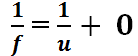
    At the (1/u) intercept, the the value of (1/v) =0. The lens formula becomes

    1f=1u+0

    The formular is reduced to be as follow:

    1f=1u

    Determining the Focal length from lens formula

    as a process of Determining Focal length from lens formula, from the graph, we can deduce that 1/u and 1/v gives reciprocal of the Focal length 1/f at the intercepts.

    we can get two values of f from the 1/v and 1/u intercepts such that:

    f1=(1V)−1andf2=(1U)−1

    The focal length f is the average of f1 and f2 such that:

    f=f1+f22

    Question for practice

    The table below shows values of object distance u and corresponding value of image distances a for a convex lens.

    object distance u(cm)101520253035
    image distance v(cm)40.017.113.111.810.910.4

    a table showing relationship between image distance and object distance

    plot a suitable graph and from the graph determine the focal length of the lens.

    References:

    • Secondary Physics Student’s Book Four. 3rd ed., Kenya Literature Bureau, 2012. pp. 1-42.
    • Abbot A. F. (1980), Ordinary Level Physics, 3rd Edition, Heinemann Books International,
      London.
    • Nelkon M. and Parker P., (1987), Advanced Level Physics, Heinemann Educational
      Publishers, London.
    • Tom D., and Heather K. Cambridge IGCSE Physics. 3rd ed., Hodder Education, 2018, https://doi.org/978 1 4441 76421. pp. 106-142.

    Share this:

  • Using Lens formula to find focal length

    The mirror describes the relationship that exists between the focal length, image distance and the object distance. By use of mirror formula that had been derived earlier, the unknown focal length of a lens can be determined experimentally. We describe the experiment here and explains how to extract the the focal length from the relationship.

    Apparatus

    • Metre rule
    • lens and a lens holder
    • source of light
    • screen
    • cardboard with a cross wire
    procedure
    • set the apparatus as shown
    • You place the object at the zero centimetre mark
    • set the object distance by placing the lens at a reasonable distance from the object like 80cm from the object.
    • Adjust the screen until a sharp image is obtained
    • Record a distance between the screen and the lens when a sharp image is formed on the screen. That is the image distance.
    • Record the image and the object distance
    • Reduce the object distance u by about 5 cm and then adjust the screen until another sharp image is formed on the screen.
    • reduce the distances distance again by 5 cm and repeat the procedure above.
    • Fill the table as shown below

    From the data obtained, a graph of 1/u against 1/v can be plotted.

    A typical graph will be as shown:

    Now the lens formula is stated as:

    at the (1/v) intercept, the value of (1/u)= 0

    hence :

    and hence

    and therefore the value of f-1 (1/f) is equal to 1/v.

    similarly at the (1/u) intercept, the the value of (1/v) =0

    and so the lens formula becomes

    hence

    from the graph, we can deduce that 1/u and 1/v gives 1/f at the intercepts.

    we can get two values of f from the 1/v and 1/u intercepts such that:

    f1 = (1/v)-1 and f2 = (1/u)-1

    the focal length f is thus the average of f1 and f2 such that

    Related Topics


    References:
    • Secondary Physics Student’s Book Four. 3rd ed., Kenya Literature Bureau, 2012. pp. 1-42.
    • Abbot A. F. (1980), Ordinary Level Physics, 3rd Edition, Heinemann Books International,
      London.
    • Nelkon M. and Parker P., (1987), Advanced Level Physics, Heinemann Educational
      Publishers, London.
    • Tom D., and Heather K. Cambridge IGCSE Physics. 3rd ed., Hodder Education, 2018, https://doi.org/978 1 4441 76421. pp. 106-142.

    1. focal length by displacement

      focal length by displacement

      Ensure you have the following apparatus

      1. lens holder

      2. screen

      3. board with cross-wires

      4. source of light

      5. metre rule

      Procedure
      • Estimate the focal length of the lens by focusing a distance object
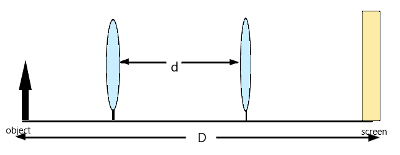
      • Set the apparatus as in figure below ensuring that the distance between the object and the screen is more than 4f where f is the focal length estimated above.
      • Obtain the image of the illuminated object on the screen when the lens is at position L1
      • Without changing the position of the object on the screen, move the lens to position L2 where another clear but diminished image is formed on the screen as shown below.
      • measure u and v for position L1 and the new distance u1 and v1 for position L2.
      • Determine the displacement d .
      workings

      from the diagram above,the distance between the point object and the screen is s. from the diagram, it is shown that the distance s is given by u+v.

      i. e. s = u+v ………………………………..(1)

      The distance between new and original position of the lens will be given by

      d=u’-u where u’ is the new object distance and u the original object distance

      d can also be obtained from v-v’ which is the original image distance and image distance when the lens is displaced by distance d.

      i.e d=u’-u and d = v-v’

      but u’=v and v’=u

      and therefore:

      d=v-u………………………………….(2)

      adding (1) and (2);

      hence s+ d= u + v + v –u

      and so: s + d = 2v and hence

      similarly we can subtract equation 2 from 1 as shown:

      hence s- d = u + v –v + u

      therefore : s- d = 2u and hence

      from the lens formulae:

      we can substitute values of u and v in terms of s and d as obtained in the expressions above. And hence;

      finding the lcm of the denominator, we obtain;

      and simplifying the above equation in the numerator:

      and finding the reciprocal so that we can get f;

      from the above equation: s2-d2 = 4fs

      a plot of s2-d2 against s results to a straight line through the origin with a slope equal to 4f.

      different values of s are obtained by changing distance between the object and the screen and then calculating the corresponding distance d.

      The two positions L1 and L2 that represents different positions of the lens are known as the conjugate points.

      Related topics


    2. The equation of a circle

      The equation of a circle

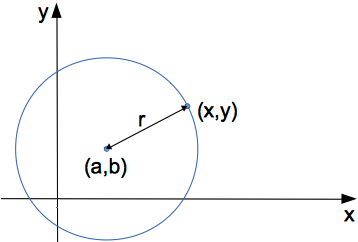
      Consider a circle of radius r on a Cartesian plane centered at point o(a,b) as shown in figure below. A point p on the circumference of the circle has an arbitrary point (x, y).

      line OQ an QP makes a right angle triangle with the radius r of the circle such OP=r, OQ = x-a and QP=y-b.

      using Pythagoras’ theorem: (x-a)2 + (y-b)2 = r2.

      Hence the general equation of a circle is given as:

      (x-a)2 + (y-b)2 = r2.

      where:

      • r is the radius of the circle
      • (a, b) are the coordinates at the center of the circle
      • (x,y) is an arbitrary point on the circumference of the circle.

      Example

      Find the equation of a circle centered at (4, 5) and with radius of 3 units.

      Solution

      Recall the equation: (x-a)2 + (y-b)2 = r2

      a=4, b=5, r=3

      hence (x-4)2+(y-5)2 = 32

      =x2– 4x- 4x+ 16+ y2– 5y- 5y + 25= 9

      x2-8x + 16 + y2 – 10y + 25 = 9

      x2– 8x + y2– 10y+ 41=9

      x2 – 8x + y2 – 10y + 32=0


      Related posts

    3. How Determine the center of curvature of a concave mirror

      How Determine the center of curvature of a concave mirror

      Apparatus

      • White screen with a hole covered with cross-wire
      • Concave mirror on a mirror holder
      • A candle

      Procedure

      The candle is placed behind the cross-wire on the screen as shown

      One should ensure the candle is at the center of the cross-wire hole.

      Arrange the apparatus as shown below

      The concave mirror is placed in-front of the screen with cross wire and the distance between them adjusted until a sharp image of the cross wire is formed next to the cross-wire on the screen as shown in figure below. The object is one labelled O and image is the one labelled I.

      The object cross-wires O and Image I are coinciding at that position

      At that position where the image of cross-wire coincides exactly with the cross-wire object, the distance between the mirror and the image I is the radius of curvature of the mirror. So the image is formed is at the center of curvature of the mirror.

      But the focal length is half of the radius of curvature. That is, R=2f.

      Therefore Focal length f=R/2.

      Related Pages

    4. Deriving The lens Formula

      Deriving The lens Formula

      The lens formula is an equation that shows the relationship between the focal length of the mirror, the image distance and the object distance.

      The object distance usually determines the image distance but the lens formula also suggests that, focal length determines what image should formed on the screen. The focal length is proportional to the the thickness of a convex lens. The thicker the convex lens, the shorter the focal length.

      Thick lens means rays of light are refracted more quickly compared to when the lens is thin.

      The lens formula is stated as:

      If we can describe the lens formula in a verbatim form, then we can say that, reciprocal of the focal length is equivalent to sum of the reciprocals of object distance and image distance.

      Deriving Lens Formula

      PO = image distance u

      PI = image distance v

      PF = focal length f

      OB = PH

      Triangles POB and PIM are similar hence;

      triangle PFH and FIM are similar and therefore.

      where f = PF

      FI = PI-PF = v – f

      hence;

      and so

      cross multiplying the above equation we obtain the following expression;

      u(v-f)=vf

      and expanding the bracket we get;

      uv-uf=vf

      and making uv the subject;

      uv = vf + uf

      factoring out f we get:

      uv = f(v+u)

      and then dividing by f on both sides of the equation;

      dividing by uv on both side to get:

      where

      and therefore:

      The formula holds true for both convex and concave lens.

      However, sign-convection is adopted where virtual image and focal length are given negative sign and considered positive if real.

      Example

      An object of height 20 cm is placed 25 cm in-front of a convex lens of focal length 18 cm. calculate image distance, image height and magnification.

      solution

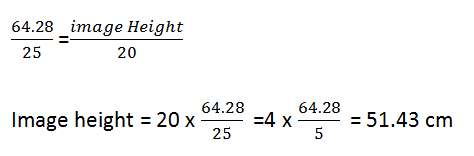
      Magnification M = (64.28)/25 = 2.57

      so the image is real and magnified. it is real because it’s image distance has a positive value and it is magnified because it has M greater than 1.

      Example

      An object of height 3 cm is placed 8 cm infront of a convex lens of focal length 15 cm. Find the position, nature and magnification of the image.

      Example

      solution

      (a)

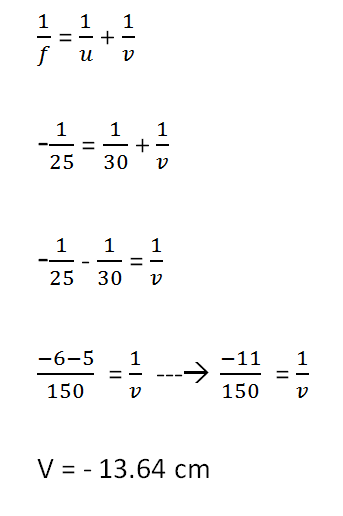
      f=-25 cm (negative because concave lens have unreal focal point.

      u = 30 cm

      (b)

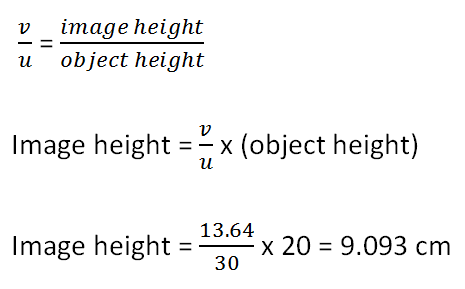
      (c)

      Practice Problem

      A lens forms an image that is 6 times the size of the object on a screen. The distance between the object and the screen is 120 cm when the image is sharply focused.

      (a) State with reason what type of lens was used

      (b) Calculate the focal length of the lens

      Related Topics


    5. Vocabulary used in Thin Lenses

      In summary

      Thin lenses have their own vocabulary mostly that describes various parts of the lens. This parts includes:

      • Center of curvature C
      • Radius of curvature R
      • Principal axis P
      • optical center O
      • Principle Focus F
      • Focal Length f
      • Focal plane

      We will discuss all the highlighted parts in this lesson

      Center of Curvature C

      It is defined as the center of the sphere of which the surface of the lens is part.

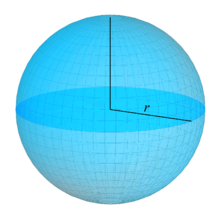
      We consider the lens to have been cut off from a transparent sphere of radius R. In other word, the lens is part of a curved surface of a certain sphere as illustrated below.

      For bi-convex lens, the lens is considered to come from two pieces cut from two different spheres and combined at the inner side. Consider the illustration below where we extract service1 and service2 from two spheres.

      sphere for surface1
      sphere for surface2

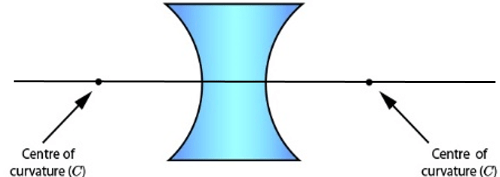
      Because the bi-convex comes from two spheres, it will have two centers of curvature which will be opposite to each other.

      similarly the bi-concave lens is derived from two spheres as illustrated.

      Different parts from spheres will be joined two have a concave lens that has two centers of curvature as shown below

      Radius of curvature

      It can be defined as the radius of the sphere from which the surface of the lens is part.

      It can also be defined as the distance between the Center of curvature and the optical center o of the lens.

      Principal axis

      It is an imaginary line passing through the centers of curvature and is perpendicular to the plane of the lens.

      principal axis thumb

      Optical center

      It is the geometric center of the lenses where a ray incident to the lens passes on undeviated.

      Principal focus

      Sometimes also referred to as the focal point. It is a point on the principal axis where rays parallel and close to the principal axis converge after refraction by a convex lens or where the rays parallel and close to the principal axis seems to diverge from after refraction by a concave lens.

      The figure below illustrates convergence of parallel rays of light at principal focus after refraction.

      showing a principal focus of a convex lens

      The virtual principal focus of a concave lens is as illustrated below

      A lens has two principal foci, and they are on either side of the lens.

      The principal focus of converging lens is said to be real because their actual meeting of rays of light there.

      The principal axis of diverging lens is said to be virtual (imaginary) because rays of light do not actually meet there.

      Rays that are parallel and close to the principal axis or almost parallel to the principal axis are referred to us paraxial rays.

      Rays parallel but far from the principal axis are referred to as marginal rays or axial rays.

      Focal length f

      It is the distance between the optical center of the lens and it’s principal focus.

      By Convection, focal length of converging lens is considered real while that of diverging is considered virtual.

      Focal plane

      It is an imaginary plane that passes through the focal point and is perpendicular to the principal axis.

      Focal plane is illustrated below

      rays of light that are not parallel to the principal axis converges at a point on a focal plane or will appear to diverge from there after refraction

      Conclusion

      In this lesson we have seen that lens are pictured as being extracted from a sphere and the radius of the said sphere plays and important role in description of the lens. A lens converge or diverges rays parallel to the principal axis at the focal point.

      Related Topics


      References

      • IGCSE Physics, third edition(Tom Duncan & Heather Kennet, 2014)
      • High school physics(OpenStax University, 2020)