
The characteristics of a wave motion can be explained with reference to the oscillatory motion of mass attached to a spring or by use of a bob on a swinging pendulum.
The figure below shows a mass that is attached to a spring and one end and fixed on the other end as shown

Initially, the mass is at rest at the end of the spiral spring at position M. The mass is then depressed slightly to position L and released and is then observed that it oscillates up and down about the mean position M.
One complete oscillation occurs when the mass moves through positions N-M-L-M-N. That is, it makes one complete oscillation when it has returned to it’s starting position and is moving in the same direction. For example if the mass starts at M the move to M-N-M, it will not have moved a complete oscillation because although it has returned to it’s starting position, it is moving in the opposite direction.
Consider a swing pendulum shown below

For the pendulum, the bob makes a complete oscillation when after an initial displacement from position X, the pendulum swings through position X-Y-Z-Y-X. If the mass in the above diagram takes two seconds to make a complete oscillation, a sketch of it’s time-displacement graph for the motion will be as shown below.

As can be seen from the above diagram, the displacement time graph for an oscillatory motion is a sine curve similar to the transverse wave profile.
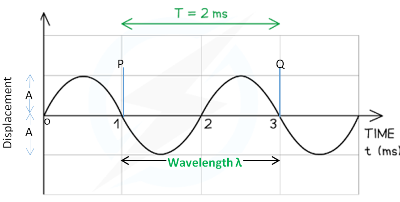
To describe the general characteristics of a wave motion, consider the motion-time graph representing a certain wave motion as shown below

The Displacement value A shows the maximum displacement A from the mean position o.
P and Q are said to be points in phase because the wave pattern is repeating itself at Q and P.
The distance between two points in phase is called the wavelength λ. The distance between P and Q represents on wavelength.
The wave starts repeating itself at P before repeating itself again at Q. Hence when the wave moves from P to Q, it is said to make one complete oscillation.
The time taken to complete one oscillation is known as the Periodic time T. In the motion-time graph above, the periodic time is two milliseconds(ms) as it has taken 2ms to make one complete oscillation.
Two points in a wave are said to be in phase, if they are in the same position, relative to the wave profile. P and Q are in phase.
The number of oscillations that can be made by a wave motion in one second is called the frequency f of the wave and is usually the reciprocal of the periodic time.
from the above diagram, it takes 2ms to make one complete revolution which is equivalent to (2/1000)s = 0.002 Seconds.
The frequency of the wave can then be determined as follow:

It can be shown that:

Where T is the periodic time and f the frequency of a given wave