
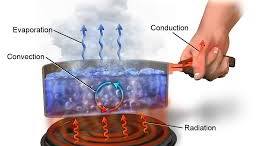
Tag: Heat energy

  • Heat conduction

    Heat conduction

    Heat conduction is a process by which heat moves in solids by means of vibrations of it’s molecules.

    If you put one end of iron on fire, soon it the other end will be hot, sometimes too hot to handle. The heat energy entering the iron from the hot end increases the vibrations of atoms in that end which then collides with their neighbouring atoms, increasing vibrations of the neighbour atoms and hence passing the heat energy along.

    Metals have free electrons which travels throughout the body freely and randomly. Heat energy injected at the hot end of a metal increases vibrations of the particles at that end causing the free electrons in that region to gain more kinetic energy and because they are moving freely, they carry energy to other parts of the metal making heat conduction in metal faster than in other forms of matter.

    Different solids conducts heat differently, where some solids like aluminium conducts heats very fast whereas rate of heat transfer in wood and rubber is extremely slow, almost zero.

    to compare heat conduction of various materials, consider an experiment with the following materials:

    • Rods of aluminium
    • iron
    • rubber
    • glass
    • wood
    • source of heat
    • thermal conductivity tank

    The materials listed should be of the same length and thickness.

    procedure

    • setup the apparatus as shown ensuring that the rods are firmly held before poring boiling water into the water bath.
    • observe the order in which was of solid fat fixed at the end of the materials will melt and fall from the rod it is fixed.
    observations

    The wax on end of copper rod melts before any other, then it was followed with the one on aluminium and the one on iron was third.

    This shows that copper conducts heat faster compared to aluminium and aluminium conducts heat faster compared to iron.

    wax on glass will melt after sometimes but the one on wood and rubber will not melt. In fact the boiling water will cold before they melt.

    Explanations

    Different materials have different thermal conductivity with metals being generally good conductors of heat and non metals being poor conductors of heat.

    solids that are poor conductors of heat only conducts heat by vibrations of atoms which can be slow and don’t have free electrons to move heat faster.

    poor conductors of heat are very useful because they are usually used as insulators where we need to prevent heat flow.

    Good conductors of heat are also very useful in making of cooking pots and heat sinks.

    Sometimes we need good conductors of heat and other times we need poor conductors when heat movement is not desirable. So both poor and good conductors are important to us. None is more important than the other.

    some of the good conductors of heat in decreasing rate of conduction includes:

    • silver
    • copper
    • aluminium
    • brass
    • zinc
    • iron
    • lead
    • mercury

    some of the poor conductors of heat in decreasing rate of conduction includes:

    • concrete
    • glass
    • brick
    • asbestos paper
    • rubber
    • wood
    • water
    • air

    Related topics


  • Heat Transfer

    Heat is a form of energy that flows as a result of temperature difference between two points or region where it passes from a body at higher temperature to the body at lower temperature.

    Heat can also be defined as the energy that flows from places of high temperature to places with low temperature.

    A body that receives heat has it’s temperature being increased and a body that looses heat has it’s temperature lowered.

    If two bodies are at different temperature in the same environment, heat flows from the body at high temperature to body at low temperature until the two bodies are at the same same temperature which is usually a temperature that is between the two initial temperatures. The two bodies are then said to be in thermal equilibrium.

    The SI unit for heat is joule(J).

    There is no instrument to measure heat directly but when we see a body rising in temperature, we know it has absorbed heat. However, we will expound more on how to measure heat in future lessons.

    Heat flow is responsible for the presence of wind in our environment.

    What is temperature?

    Temperature is the quantity that measures degree of hotness or coldness of a place or an object.

    When we talk about degree of hotness, we talks about the feeling. Not a very good way of describing a scientific phenomena. But a more technical definition of temperature is that temperature is the quantity that describes the average energy of particles in a material.

    A large heat can cause very little rise in temperature of a substance but also small absorption of heat can cause large increase of temperature. So heat is usually described as the total amount of energy that flows from a body at high temperature to a body at lower temperature.

    The temperature change caused by a given heat on a substance depends on the mass of the object and the internal molecular structure of the substance, which is usually known as the heat capacity of the substance.

    Heat is measured in joules( the unit for energy) but temperature is measured in Kelvin.

    Temperature is a basic physical quantity whereas heat is a derived quantity.

    Modes of heat transfer

    The common methods by which heat traves from one point to another includes:

    • Conduction
    • Convection
    • Radiation

    Conduction

    Heat conduction is a process where molecules that are close to the source of heat picks up the heat, vibrates faster and passes on the excess heat to their immediate neighbouring molecules.

    The neighboring molecules upon receiving energy from their neighbors increases their vibrations but with with a slower later than the molecules that gave the the energy since they got just a small part of the supplied energy. Therefore, temperature reduces along the material as one moves away from the source.

    Convection

    Convection is the transfer of heat by the actual movements of the molecules where molecules that receives heat becomes lighter and moves up to allow colder molecules to come to regions of heat.

    Convection is the most important means by which heat is transferred in liquids and gases.

    Convection can be described as the continuous flow of liquid and gas particles in a complete loop due to a difference in temperature.

    Radiation

    It is a method of heat transfer by means of electromagnetic radiation.

    Electromagnetic radiation are waves that does not need material medium to transfer.

    Electromagnetic waves moves the same way, heat from the sun reaches the earth service as it travels without aid of any medium.

    Related topics