
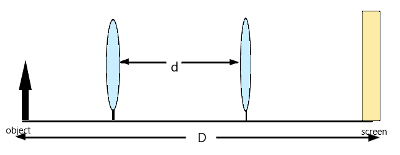
The lens formula is an equation that shows the relationship between the focal length of the mirror, the image distance and the object distance.
The object distance usually determines the image distance but the lens formula also suggests that, focal length determines what image should formed on the screen. The focal length is proportional to the the thickness of a convex lens. The thicker the convex lens, the shorter the focal length.
Thick lens means rays of light are refracted more quickly compared to when the lens is thin.
The lens formula is stated as:

If we can describe the lens formula in a verbatim form, then we can say that, reciprocal of the focal length is equivalent to sum of the reciprocals of object distance and image distance.
Deriving Lens Formula
consider a an object O of height OB placed between 2F and F. Using the first two rays to obtain it’s image ; The two rays of right, object height and image height together forms triangles that can be used to describe geometrical relationship in the diagram that can results to lens formula.

PO = image distance u
PI = image distance v
PF = focal length f
OB = PH
Triangles POB and PIM are similar hence;

triangle PFH and FIM are similar and therefore.

where f = PF
FI = PI-PF = v – f
hence;

and so

cross multiplying the above equation we obtain the following expression;
u(v-f)=vf
and expanding the bracket we get;
uv-uf=vf
and making uv the subject;
uv = vf + uf
factoring out f we get:
uv = f(v+u)
and then dividing by f on both sides of the equation;

dividing by uv on both side to get:

where

and therefore:

The formula holds true for both convex and concave lens.
However, sign-convection is adopted where virtual image and focal length are given negative sign and considered positive if real.
Example
An object of height 20 cm is placed 25 cm in-front of a convex lens of focal length 18 cm. calculate image distance, image height and magnification.
solution

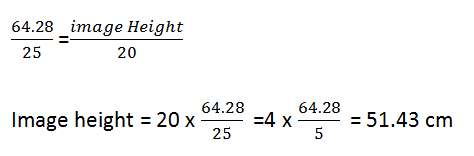
Magnification M = (64.28)/25 = 2.57
so the image is real and magnified. it is real because it’s image distance has a positive value and it is magnified because it has M greater than 1.
Example
An object of height 3 cm is placed 8 cm infront of a convex lens of focal length 15 cm. Find the position, nature and magnification of the image.

Example
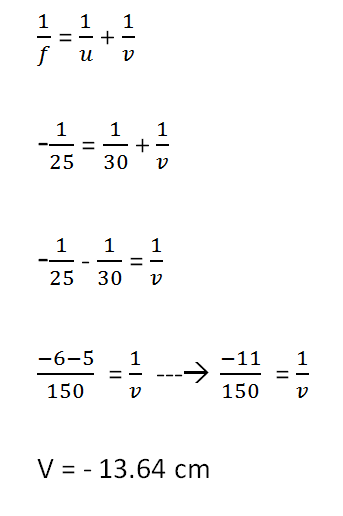
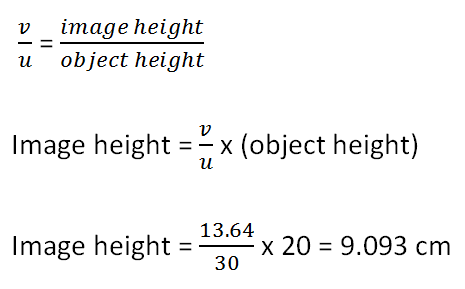
An object of height 20cm is placed 30 cm infront concave lens of focal length 25 cm from the lens. Determine:
(a) The image distance
(b) height of the image
(c) magnification
solution
(a)
f=-25 cm (negative because concave lens have unreal focal point.
u = 30 cm
(b)
(c)

Practice Problem
A lens forms an image that is 6 times the size of the object on a screen. The distance between the object and the screen is 120 cm when the image is sharply focused.
(a) State with reason what type of lens was used
(b) Calculate the focal length of the lens
Related Topics
- Introduction to thin lenses
- image formation by thin lenses
- characteristics of images formed by thin lenses
- Linear magnification

