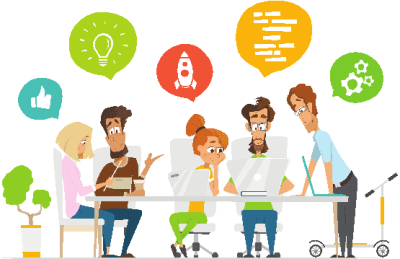
This is a type of learning where a group of learners works together on a learning task that may involves solving problem, complete a task or discuss a new concept. It is an approach that engages students such that they are able to explore information deeply beyond knowledge level. By participating in a common task, students will defend their point of view, rephrase their ideas, listen keenly to understand other student’s point of view therefore enhance understanding and retention of the knowledge gained.
Cooperative learning
It is an teaching and learning strategy where small groups of students works together on a common assignment where each participants contributes to a specific part of the task and then the individual tasks are compiled to make one complete solution to the task at hand.
In cooperative learning, students are usually responsible for their part or role in the whole assignment but the overall success of the group depends on each and every individual effort such that failure of one means failure of the whole group. Therefore each member of the group must do the best in their assigned part of the task. Members of the group will have chance to scrutinize each others work hence learning from each other.
The role of each member is predefined and then their is a group leader that will coordinate group tasks and facilitates intergration of the individual tasks.
Collaborative and cooperative learning is not limited to classrooms but is widely used in industries where stuffs works together to accomplish a task. For example in software engineering, each individual software developer is assigned a small part of the project to work on, learn about it and devise the best solution. Engineers can collaborate together to learn a new technology and dissect a new machine . Doctors can work together to understand a surgery task or research on a new disease.
This kind of learning is very useful to our modern world has many benefits.
i. Develop leadership skills
individuals learn how to organize themselves and others, how to manage relationships meant to accomplish a serious task and how to work on high-level ideas with others.
ii. Increased skills and knowledge
There is more learning and retention of knowledge in collaborative learning unlike in individual study and classroom lectures because learners really engage with knowledge and learning by doing which is powerful way to learn.
Students are able to learn from others and also reinforces what they know by teaching it to others in the group.
ii. Improves relationships
It increases opportunities for members in the organization to interact in a team work which would have been otherwise impossible if they were to work from their normal desk, departments and offices. Individuals are directed to form new connections and find ways of working together with people they would have found it difficult to interact with otherwise. It is also a way of bringing remote workers closer together through online collaboration and cooperation.
iv. Improved knowledge acquisition and retention
Studies has shown that much more learning takes place by doing and students participating in active learning activities unlike when involved in passive reception of knowledge. collaborative learning facilitates more participation in learning hence increasing retention of knowledge.
It allows participants achieve higher levels of thinking as they think on how to present their ideas to the group
v. Improves employees retention
in work environment where there is collaboration in completing tasks, their is level of friendliness that is created that creates sense of belonging and feeling of being needed. Productivity increases and people are eased pressure of being evaluated individually but develops a sense of corporate responsibility. This causes members of stuff want to stay. According to Hawthorne study, people are more productive and efficient when working in a group as opposed to working alone.
Individual benefits of collaborative learning
i. makes learning very active
to represent their ideas to the group, individual must give more thoughts to the idea, strive to organize their thoughts, find ways to support their points and develop convincing arguments that will be accepted by their peers.
ii Promotes learning from others
An individual is exposed to more viewpoints that may challenge his own views and learn from people that comes from background different from his own
iii. Individuals learn how to think critically
Individuals examines other people’s response, finding gaps in their own thoughts and adjusting their thinking when they learn from other people’s strength and weaknesses. When they are listening to others talking, they adjust their ideas as they get more insight while listening to others.
iv. promotes listening to criticism and advice
Individual will learn how to take criticisms without offence as they will learn how to argue constructively and also learn to look at issues from different perspectives and not sticking to their ways of seeing things alone.
v. Develop public speaking and active listening skills
Individuals learn to speak while others are keenly listening from their peers and learn to challenge ideas without offence and build a framework of ideas in conjunction with others. This helps individual develop social life with ease and hence better relationships at work and outside work life
vi. Improves cooperation
learners engaging in thoughtful discussions with each other improves their understanding and self esteem as they are likely to reinforce each others thought and ideas.
Related topics
- Introduction to social psychology
- Importance of social psychology
- History of social psychology
- Communication Theory
- Introduction to Communication