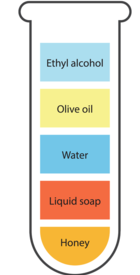
The table below shows density of some common substances.
Please note that density of water being 1.0gcm-3 can be used as a relative density to compare densities of other substances. For example , density of gold is 19.3 times that of water.
Density is mass of a substance contained it it’s unit volume.
Density is usually represented by rho (ρ)
The SI Unit of density is kilogram per cubic meter, that is; (kgm-3)
A common unit of density is grams per cubic centimeter (gcm-3) which is very common in day to day measurement of density.
Formula for density
we can use symbols alone to write expressions about density when solving problems involving density.
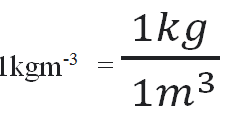
we should be able to convert densities expressed in Kilogram per cubic meter(kgm-3) into grams per cubic centimeter (gcm-3). In many cases, conversion from on unit of measurement to another is usually necessary. Let say we want to change 1kgm-3 into grams per cubic centimeter (gcm-3) . 1kgm-3 means that:
Now we convert 1 kg into grams remembering that, 1 kg =1000 grams and 1 cubic meter into cubic centimeters;
remembering that 1m3 = 1000000 cm3
hence 1 kgm-3 = 0.001 gcm-3
then dividing by 0.001 gcm-3 on both sides:
hence 1 gcm-3 is equivalent to 1000 kgm-3
Example
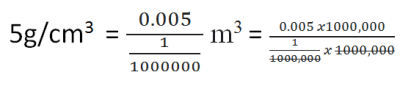
The density of a substance in a lab is expressed as 5g/cm3. Express it’s density in SI Unit.
solution
The SI unit of density is kilogram per cubic meter. We therefore change grams into kilograms and cubic centimeter into cubic meter.
expressing density in terms of grams and cubic centimeters:
1 000,000 cm3 = 1 m3 hence :
hence
=5000 kgm-3
Practice Questions
A glass block measures 180mm by 80 mm by 20 mm. It’s mass is 280 g. Determine it’s density in SI Units
A certain metal has it’s density given as 1.9gcm-3. If 50000 kg of such metal was purchased by a company. what volume did it occupy?
Mass is the quantity of matter in a substance. Matter is anything that occupies space.
The mass of an object depends on it’s size and the number of particles it contains.
The SI unit of mass is the Kilogram (Kg).
A kilogram is the mass of a piece of platinum-iridium metal kept at Sevres, near Paris,France at the International Office of Weights and measurements. That piece of metal kept in France is the standard with which all masses of the world are measured with the kilogram unit.
though kilogram is the SI unit, the most common unit of measuring mass is the gram.
The following table shows sub-units of gram and kilogram
Prefix
number of grams (g)
Kilogram (Kg)
1000 g
Hectogram (Hg)
100 g
Decagram (Dg)
10 g
decigram (dg)
(1/10) g
centigram (cg)
(1/100) g
milligram (mg)
(1/1000) g
microgram (µg)
(1/1000,000) g
nanogram (ng)
(1/100,000,000) g
picogram (pg)
(1/1000,000,000,000) g
tables of conversion of grams
1 kg = 1000 tonnes
other units used to measure mass includes:
1 pound (lb) = 0.4536 kg)
1 ounce(oz) = 0.02835kg
Though different weights are experienced depending on gravitational pull of a place, the mass of an object remains constant beacuse number of particles in an object will not change with change of location.
Instruments used to measure mass
Platform balance
Electronic balance
The object whose mass is to be measured is placed on the pan and its weight causes electronic circuit to develop current to display the mass on the digital display. It is a very accurate instrument and is useful in laboratories especially small masses.
Beam balance
works by the principles of moments.
The object whose mass is to be measured is balanced against a known standard mass on as equal arm lever. The beam balances when the mass of the object is equal to the standard mass.
Table balance
works under principles of moments
Spring balances
uses laws of gravitational pull
postal balance
Roman Steelyard Balance
Exercise
convert the following as instructed
1500 tonnes to kg
200000000000 mg into Kg.
256 g into tonnes
0.000000000000000000 567 tonne into pg
12.43 g into mg
Problems involving mass
Sheila went to the grocery store and bought a 3 watermelons that weighed 4.4 kilograms and a bunch of bananas that weighed 750 grams. She also bought a bottle of juice that contained 1.2 liters.
a) Convert the weight of the watermelon from kilograms to grams.
b) If Sarah bought 3 bottles of juice, how many grams of juice did she buy in total if density of juice is 1.25gcm-3?
c) If each banana weighs 125 grams, how many bananas did Sarah buy?
Contains information related to marketing campaigns of the user. These are shared with Google AdWords / Google Ads when the Google Ads and Google Analytics accounts are linked together.
90 days
__utma
ID used to identify users and sessions
2 years after last activity
__utmt
Used to monitor number of Google Analytics server requests
10 minutes
__utmb
Used to distinguish new sessions and visits. This cookie is set when the GA.js javascript library is loaded and there is no existing __utmb cookie. The cookie is updated every time data is sent to the Google Analytics server.
30 minutes after last activity
__utmc
Used only with old Urchin versions of Google Analytics and not with GA.js. Was used to distinguish between new sessions and visits at the end of a session.
End of session (browser)
__utmz
Contains information about the traffic source or campaign that directed user to the website. The cookie is set when the GA.js javascript is loaded and updated when data is sent to the Google Anaytics server
6 months after last activity
__utmv
Contains custom information set by the web developer via the _setCustomVar method in Google Analytics. This cookie is updated every time new data is sent to the Google Analytics server.
2 years after last activity
__utmx
Used to determine whether a user is included in an A / B or Multivariate test.
18 months
_ga
ID used to identify users
2 years
_gali
Used by Google Analytics to determine which links on a page are being clicked
30 seconds
_ga_
ID used to identify users
2 years
_gid
ID used to identify users for 24 hours after last activity
24 hours
_gat
Used to monitor number of Google Analytics server requests when using Google Tag Manager