
Tag: Periodic Time

  • Phase and Phase Difference

    Phase and Phase Difference

    The word phase in normal usage means any stage in a series of events or in a process of development.

    cambridge University dictionary defines phase as one of the stages or points in a repeating process measured from a specific starting point.

    Two Waves can be of the same amplitude but with the different frequencies as shown in figure below.

    The wave profile P makes it’s one complete oscillations before wave Q. Wave P has shorter wavelength compared to Q and hence P has higher frequency.

    We can also see that P has smaller period as waves with shorter wavelength has smaller period.

    Wave P completes it’s first cycle at A while Q finishes it’s first oscillation at B. We can say that P is leading Q. The maximum displacement of the two waves is the same hence they are operating at the same amplitude but different frequency. The two waves are said to be out of phase.Think about two radio receivers tuned to two different stations but with equal volume.

    waves can also be of the same frequency but different amplitudes. Think of when we tune in our two radio receivers to the same station and then set them at different volumes

    The figure below illustrates two waves operating at same frequency but at different amplitudes.

    As can be seen from the diagram, one wave is having more displacement than the other one but they are arriving at the same horizontal position simultaneously. We say they are in phase.

    Pendulum bobs in phase

    To further illustrate the concept of phase and out of phase oscillations, consider two identical pendulums with bobs P and Q below.

    The two masses, P and Q are set in oscillation by giving them some displacement on the left and then releasing them simultaneously. Because they have equal displacement and released at the same time , they will pass through the lowest point Y at the same time as they move on to the opposite direction.. They attain displacement together at Z and swing back together to complete the oscillation at x.

    At any particular moment, the two masses will be moving in the same direction and at the same level of displacement in their oscillations.The masses are said to be oscillating in phase.

    Particles in a wave motion which happens to be oscillating in the same direction and at the same level of displacement in their oscillation are said to be in phase.

    The diagram below have highlighted two positions of particles A and B. The particles are in the same displacement level from the reference line and they are both facing the same direction as indicated by the arrows. The particles A and B are said to be in phase and their distance apart is the wavelength λ of the wave motion whereas time taken to move from A to B is the periodic time T.

    Particles in a wave motion can be in phase even if they have different amplitude.

    In our previous pendulum oscillation of mass P and Q ; If P is Initially given a larger displacement than Q, the two will oscillate i n phase even though P will always be at a larger magnitude of displacement than Q.

    A typical displacement time graph for two wave motions in phase with different amplitudes is shown below.

    two waves in phase at different amplitude.

    Oscillations out of phase

    Consider two masses P and Q displaced from opposite directions from each other as in figure below.

    When released simultaneously, they pass through the rest position at the same time as they move in the opposite direction and they reach a point of maximum displacement at the same time but their maximum displacement is in opposite direction to each other.

    180o out of phase

    The two objects above are always at the opposite levels of displacement and their oscillations opposite direction to each other and they are said to be in opposite phase.

    Wave motions that have same displacement and makes complete oscillations at the same time with their maximum displacements in exact opposite to each other are said to be in 180o phase difference (180o out of phase).

    The figure below shows two wave motions at 180o phase difference.

    90o out of phase

    suppose in our pendulum oscillations we displaces the objects P and Q to X ; we release Q before P and then we release p when Q is exactly at Y. The angle of oscillation between P and Q will be 90o in difference and the resulting oscillation will be 90o out of phase.

    The displacement time graph for waves 90o out of phase is illustrated below.

    two waves can be out of phase at any angle. We are likely to see that in our future lessons

    Related Topics


  • Characteristics of Wave Motion

    Characteristics of Wave Motion

    The characteristics of a wave motion can be explained with reference to the oscillatory motion of mass attached to a spring or by use of a bob on a swinging pendulum.

    The figure below shows a mass that is attached to a spring and one end and fixed on the other end as shown

    illustrating mass oscillating on a spring
    illustrating mass oscillating on a spring

    Initially, the mass is at rest at the end of the spiral spring at position M. The mass is then depressed slightly to position L and released and is then observed that it oscillates up and down about the mean position M.

    One complete oscillation occurs when the mass moves through positions N-M-L-M-N. That is, it makes one complete oscillation when it has returned to it’s starting position and is moving in the same direction. For example if the mass starts at M the move to M-N-M, it will not have moved a complete oscillation because although it has returned to it’s starting position, it is moving in the opposite direction.

    Consider a swing pendulum shown below

    illustrating swinging pendulum
    illustrating swinging pendulum

    For the pendulum, the bob makes a complete oscillation when after an initial displacement from position X, the pendulum swings through position X-Y-Z-Y-X. If the mass in the above diagram takes two seconds to make a complete oscillation, a sketch of it’s time-displacement graph for the motion will be as shown below.

    Displacement time graph for a swinging pendulum
    Displacement time graph for a swinging pendulum

    As can be seen from the above diagram, the displacement time graph for an oscillatory motion is a sine curve similar to the transverse wave profile.

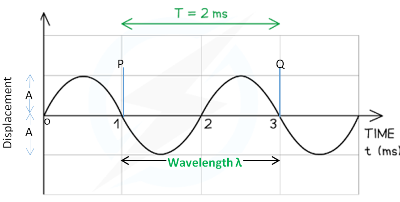
    To describe the general characteristics of a wave motion, consider the motion-time graph representing a certain wave motion as shown below

    To illustrate wave characteristics

    The Displacement value A shows the maximum displacement A from the mean position o.

    P and Q are said to be points in phase because the wave pattern is repeating itself at Q and P.

    The distance between two points in phase is called the wavelength λ. The distance between P and Q represents on wavelength.

    The wave starts repeating itself at P before repeating itself again at Q. Hence when the wave moves from P to Q, it is said to make one complete oscillation.

    The time taken to complete one oscillation is known as the Periodic time T. In the motion-time graph above, the periodic time is two milliseconds(ms) as it has taken 2ms to make one complete oscillation.

    Two points in a wave are said to be in phase, if they are in the same position, relative to the wave profile. P and Q are in phase.

    The number of oscillations that can be made by a wave motion in one second is called the frequency f of the wave and is usually the reciprocal of the periodic time.

    from the above diagram, it takes 2ms to make one complete revolution which is equivalent to (2/1000)s = 0.002 Seconds.

    The frequency of the wave can then be determined as follow:

    It can be shown that:

    Where T is the periodic time and f the frequency of a given wave

    Related Topics


  • Angular Velocity w

    Angular Velocity w

    Angular velocity is defined as the rate of change of angular displacement with time.

    we can shorten the equation by using symbols alone:

    The SI Units of angular velocity is radians per second (rads-1)

    Consider the equation that relates angular displacement in radians with the arc length made by the object:

    to get the rate of change of speed, we divide both sides with t as they both represent displacement of the object.

    but distance s when divided by time gives velocity. That is;

    where v is the linear velocity representing the velocity of the object along the circular path.

    Hence the equation above becomes:

    hence, the angular velocity can be expressed in terms of linear velocity and radius as show in equation below:

    similarly, linear velocity can be expressed in terms of angular velocity as v=ωr.

    An object in circular motion has both linear and angular velocity. The time taken to make one complete circle is called the periodic (T) and is given by T= circumstances/speed.

    Let us now consider the time taken for a body to make one complete circle in a circular path. At that one circle, it will have covered the circumference of a circle and the time taken to complete such one revolution is called periodic time (T).

    from the equation time = distance / speed

    and circumference = 2πr, hence

    Example question

    A metallic ball is whiled in a horizontal circle making 5 revolution s per second.Determine:

    • Period T
    • angular velocity and
    • linear speed v

    Related Topics