The candle is placed behind the cross-wire on the screen as shown
One should ensure the candle is at the center of the cross-wire hole.
Arrange the apparatus as shown below
The concave mirror is placed in-front of the screen with cross wire and the distance between them adjusted until a sharp image of the cross wire is formed next to the cross-wire on the screen as shown in figure below. The object is one labelled O and image is the one labelled I.
The object cross-wires O and Image I are coinciding at that position
At that position where the image of cross-wire coincides exactly with the cross-wire object, the distance between the mirror and the image I is the radius of curvature of the mirror. So the image is formed is at the center of curvature of the mirror.
But the focal length is half of the radius of curvature. That is, R=2f.
Thin lenses have their own vocabulary mostly that describes various parts of the lens. This parts includes:
Center of curvature C
Radius of curvature R
Principal axis P
optical center O
Principle Focus F
Focal Length f
Focal plane
We will discuss all the highlighted parts in this lesson
Center of Curvature C
It is defined as the center of the sphere of which the surface of the lens is part.
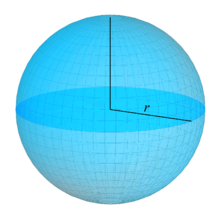
We consider the lens to have been cut off from a transparent sphere of radius R. In other word, the lens is part of a curved surface of a certain sphere as illustrated below.
For bi-convex lens, the lens is considered to come from two pieces cut from two different spheres and combined at the inner side. Consider the illustration below where we extract service1 and service2 from two spheres.
sphere for surface1
sphere for surface2
Because the bi-convex comes from two spheres, it will have two centers of curvature which will be opposite to each other.
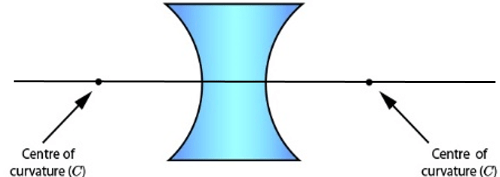
similarly the bi-concave lens is derived from two spheres as illustrated.
Different parts from spheres will be joined two have a concave lens that has two centers of curvature as shown below
Radius of curvature
It can be defined as the radius of the sphere from which the surface of the lens is part.
It can also be defined as the distance between the Center of curvature and the optical center o of the lens.
Principal axis
It is an imaginary line passing through the centers of curvature and is perpendicular to the plane of the lens.
Optical center
It is the geometric center of the lenses where a ray incident to the lens passes on undeviated.
Principal focus
Sometimes also referred to as the focal point. It is a point on the principal axis where rays parallel and close to the principal axis converge after refraction by a convex lens or where the rays parallel and close to the principal axis seems to diverge from after refraction by a concave lens.
The figure below illustrates convergence of parallel rays of light at principal focus after refraction.
showing a principal focus of a convex lens
The virtual principal focus of a concave lens is as illustrated below
A lens has two principal foci, and they are on either side of the lens.
The principal focus of converging lens is said to be real because their actual meeting of rays of light there.
The principal axis of diverging lens is said to be virtual (imaginary) because rays of light do not actually meet there.
Rays that are parallel and close to the principal axis or almost parallel to the principal axis are referred to us paraxial rays.
Rays parallel but far from the principal axis are referred to as marginal rays or axial rays.
Focal length f
It is the distance between the optical center of the lens and it’s principal focus.
By Convection, focal length of converging lens is considered real while that of diverging is considered virtual.
Focal plane
It is an imaginary plane that passes through the focal point and is perpendicular to the principal axis.
Focal plane is illustrated below
rays of light that are not parallel to the principal axis converges at a point on a focal plane or will appear to diverge from there after refraction
Conclusion
In this lesson we have seen that lens are pictured as being extracted from a sphere and the radius of the said sphere plays and important role in description of the lens. A lens converge or diverges rays parallel to the principal axis at the focal point.
Contains information related to marketing campaigns of the user. These are shared with Google AdWords / Google Ads when the Google Ads and Google Analytics accounts are linked together.
90 days
__utma
ID used to identify users and sessions
2 years after last activity
__utmt
Used to monitor number of Google Analytics server requests
10 minutes
__utmb
Used to distinguish new sessions and visits. This cookie is set when the GA.js javascript library is loaded and there is no existing __utmb cookie. The cookie is updated every time data is sent to the Google Analytics server.
30 minutes after last activity
__utmc
Used only with old Urchin versions of Google Analytics and not with GA.js. Was used to distinguish between new sessions and visits at the end of a session.
End of session (browser)
__utmz
Contains information about the traffic source or campaign that directed user to the website. The cookie is set when the GA.js javascript is loaded and updated when data is sent to the Google Anaytics server
6 months after last activity
__utmv
Contains custom information set by the web developer via the _setCustomVar method in Google Analytics. This cookie is updated every time new data is sent to the Google Analytics server.
2 years after last activity
__utmx
Used to determine whether a user is included in an A / B or Multivariate test.
18 months
_ga
ID used to identify users
2 years
_gali
Used by Google Analytics to determine which links on a page are being clicked
30 seconds
_ga_
ID used to identify users
2 years
_gid
ID used to identify users for 24 hours after last activity
24 hours
_gat
Used to monitor number of Google Analytics server requests when using Google Tag Manager