

Tag: SI Units
-
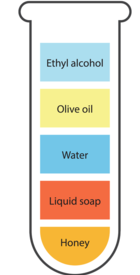
Density of some substances
The table below shows density of some common substances.
Please note that density of water being 1.0gcm-3 can be used as a relative density to compare densities of other substances. For example , density of gold is 19.3 times that of water.

Related Topics
- Physical Quantities
- Length
- Reading a meter rule
- Measuring with a meter rule
- Area
- Area of irregularly shaped surfaces
- Volume
- Volume of regularly shaped objects
- Measuring volume of liquids
- Volume of irregular solids
- Measuring Mass
- Density
- Densities of some substances
- Questions on Measurements
-
Questions on measurements
- Distinguish between basic and derived quantity. Give two examples in each case. (4mk
2. Complete the table below. (7mks)
Quantity SI Units Symbols of SI Units Luminous Intensity Ampere K Kilograms s Mole Length table about basic physical quantities 3. Draw a burette filled with water to a volume of 28cm3. (2mks)
4. 60 drops fell from a burette. The first and final readings were 28cm3 and 42cm3 respectively. What is the average volume of one drop. (3mks)
5. Determine the density in SI Units of a solid of mass 40g with dimensions 30cm by 4cm by 3cm. (4mks
6. 1600cm3 of fresh water of density 1g/cm3 are mixed with1200cm3 of sea water of density 1.2g/cm3. Determine the density of the mixture. (4mks)
7. A sphere of diameter 6.0cm is molded into a thin uniform wire of diameter 0.2mm. Calculate the length of the wire in metres. ( Take π=22/7) (3mks)
8. Find the area of the shaded region in the figure 1 below (use π = 3 .14)(3mks)

9. A test-tube has a diameter of 3cm. how many turns would a piece of thread of length 90.42cm make round the test tube.(Take π=22/7) (3mks)
10. A cylindrical column of fat has diameter 17.5cm and height 10cm. Calculate the density in g/cm3 of fat if the column has a mass of 2kg. (3mks)
11. The following figure represents a piece of land . The two ends are semicircles of radius 70m each.

- Calculate
- The perimeter of the land (2mks)
- The area of the land in hectares (3mks)
Related Topics
- Physical Quantities
- Length
- Reading a meter rule
- Measuring with a meter rule
- Area
- Area of irregularly shaped surfaces
- Volume
- Volume of regularly shaped objects
- Measuring volume of liquids
- Volume of irregular solids
- Measuring Mass
- Density
- Densities of some substances
- Questions on Measurements
-
International System of Units (SI): Definition, Basic Quantities, and Derived Quantities
In order to measure we need to know or define the quantity to be measured and the units for measuring it. In 1971 in Paris France, a system known as the International System of Units (Systeme’ Internationale) with seven basic physical quantities and units were agreed upon as shown in table 1.1 below.
Basic quantity SI units Symbols Length Meter m Mass Kilogram kg Time Second s Electric current Ampere A Thermodynamic temperature Kelvin K Luminous intensity Candela Cd Amount of substance Mole mol table 1.1 the seven basic Physical quantities before the SI Units were developed, scientists were using different units of measurements depending on their immediate environment.
some of the earlier units of measurements used includes:
- inch which is equivalent to 0.0254 m
- mile which is equal to 1061m
- pint which is equal to 0.57 litres
- gallon which is equal to 4.55 litres
- pound which is equal to 0.45kg
- tonne which is equal to 1000kg
- acre which is equal to 0.41 Hectares
- grams
- centimeters
- seconds
Basic Physical quantities
A physical quantity is a property of a material or system that can be quantified by measurement.
Basic physical quantities are quantities whose property cannot be derived from any other quantity
Other quantities can be obtained from these basic quantities and are referred to as derived quantities.
Derived quantities
Derived quantities are quantities obtained by multiplication or division of basic physical quantities. derived quantities includes:
- Area
- volume
- density
- speed
- Force
- acceleration
- Magnetic flux density
- velocity
- weight
As an example, Area can be obtained from multiplying two lengths together. The rectangle below has its shorter length labelled w and it’s longer length labelled l. it’s area is obtained by multiplying l with w. that is, area= l x w

Area is derived quantity because two lengths are being multiplied together. As an example, consider Speed is defined as distance covered per unit time and is usually given as distance covered/time taken. distance is a length which is a basic quantity and so is the time hence speed is obtained by dividing two basic quantities together.
Related Topics
- Measuring Length
- Using meter rule
- Area
- Area of irregular surfaces
- Volume
- Volume of irregular solids
- Measuring mass
- Home
- Physics personalities
Related Pages