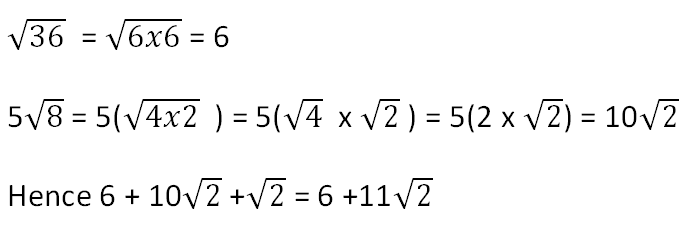
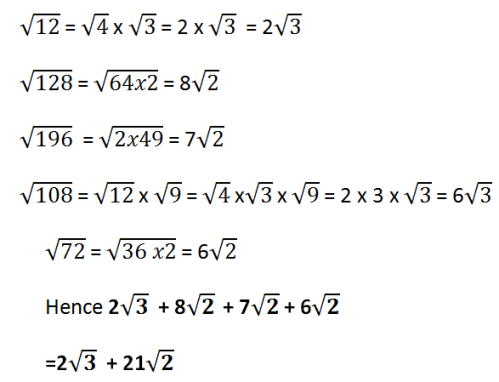
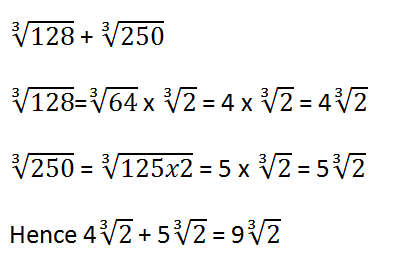
To simplify expressions involving surds, we simply add or subtract coefficient of irrational factors that are alike. thus
To simplify surds, you want to express them in their simplest form typically by factoring out any perfect square factors from the radicand (the number under the square root symbol).The steps to follow includes:
Identify the perfect square factors: Look for perfect square numbers that evenly divide into the number under the square root. For example, in √72, the perfect square factor is 36 because √36 equals 6.
Factor out the perfect square: Rewrite the surd using the perfect square factor outside the square root. For example, √72 becomes 6√2.
If possible, simplify further: Sometimes, you can simplify the expression even more. For instance, if you have √18, you can factor out √9 from it to get 3√2.
Repeat if necessary: If there are still perfect square factors remaining under the square root, repeat the process until you can no longer simplify.
Example
solution
(a)
(b)
The idea is to express 12 as products of two numbers. One number results to a rational number after the split. similarly, 128 can be expressed as a product of 64 and 2 such that square-root of 64 results to a rational number.
After expressing all the terms in a simplified for , then some of them will have same irrational factor and hence they can be added to make them simpler.
(c)
The idea is to express 128 into two factors such that it is possible to find the 3rd root of one of them and get a whole number. From quick inspection, 128 =64 x 2 and third-root of 64=4.
similarly we can express 250 as a product of 125 and 2. We can be able to deduce that 125 is cube of 5 and hence cube-root of 125 is a rational whole number.
A rational number is a number which can be written in the form p/q where p and q are integers and q should be greater than zero. P and q must not have a common factor between then except 1.
Examples of rational numbers is like 1/5, 3/7, 4/11, etc.
Irrational numbers
Irrational are numbers are numbers that cannot be written in the form p/q. Irrational numbers cannot be expressed as simple fraction.
Examples of irrational numbers includes:
π √2 √3 √7 etc.
when irrational numbers are expressed as decimals, the decimals continues without end and without recurring
for example √2 = 1.414213562……… and π =3.141592654…..
surds
The roots of rational numbers that gives irrational numbers are called surds.
numbers under square-root sign that will result to a whole number after square-root operations are NOT surds.
a surd is an irrational number of the form ±√x such that ±√x cannot be written as a/b where a, b ∈ ℤ and b ≠ 0.
for example ∛64 is not surd because it will evaluate to 4 which is a whole number.
Simplifying surds
In order to simplify surds, the number under the root sign should be expressed as a product of two factors such that one factor is a perfect root.
Examples:
simplify the following
(a) √12 (b) √32 (c) √(3/4) (d) ∛250
solution
(a) We first express 12 as a product of two values, where one value is a perfect square as shown
Then we separate the two values under the root sign to have two roots multiplied such as:
we know square root of 4 is 2, but squareroot of 3 is irrational, hence we write:
and finally we remove the multiplication sign X to have
(b) 32 can be expressed as a product of many factors:
2x 16
4 x 8
2 x 2 x 2 x 2 x 2 = 25
we write 24 x 21
24 is a perfect square and so we can it can be simplified when inside the square-root sign.
however, the shortest way is to get the root of 16 and root of 2 because root of 16 exists and square-root of 2 is irrational. hence we write
square-root of 16=4 and squareroot of 2 is irrational, hence we have:
(c) here were are looking for square-root of resultant quotient from dividing 3 and 4.
but we can as well get the same result by dividing root of 3 with root of 4 as shown:
and this can be simplified to:
(d) This problem requires us to find the cube-root of 250. There is no whole number that can be a cube-root of 250.
factors of 250 includes:
10 x 25
5 x 50
125 x 2
but 125 = 5 x 5 x 5 = 53
hence we can express cube-root of 250 as the cube-root of the product 2 x 125.
Contains information related to marketing campaigns of the user. These are shared with Google AdWords / Google Ads when the Google Ads and Google Analytics accounts are linked together.
90 days
__utma
ID used to identify users and sessions
2 years after last activity
__utmt
Used to monitor number of Google Analytics server requests
10 minutes
__utmb
Used to distinguish new sessions and visits. This cookie is set when the GA.js javascript library is loaded and there is no existing __utmb cookie. The cookie is updated every time data is sent to the Google Analytics server.
30 minutes after last activity
__utmc
Used only with old Urchin versions of Google Analytics and not with GA.js. Was used to distinguish between new sessions and visits at the end of a session.
End of session (browser)
__utmz
Contains information about the traffic source or campaign that directed user to the website. The cookie is set when the GA.js javascript is loaded and updated when data is sent to the Google Anaytics server
6 months after last activity
__utmv
Contains custom information set by the web developer via the _setCustomVar method in Google Analytics. This cookie is updated every time new data is sent to the Google Analytics server.
2 years after last activity
__utmx
Used to determine whether a user is included in an A / B or Multivariate test.
18 months
_ga
ID used to identify users
2 years
_gali
Used by Google Analytics to determine which links on a page are being clicked
30 seconds
_ga_
ID used to identify users
2 years
_gid
ID used to identify users for 24 hours after last activity
24 hours
_gat
Used to monitor number of Google Analytics server requests when using Google Tag Manager