Tag: Surds

  • Rationalizing denominators

    Rationalizing denominators

    When a surd of order two is squared, a rational product is obtained. For example:

    When we have a fraction with surds in the denominator,we can remove the surd in the denominator by multiplying it with a surd that will make the irrational denominator become rational.

    The process of multiplying an irrational denominator with another irrational denominator to make it rational is known as rationalizing the denominator.

    For example:

    please not that multiplying by

    is by multiplying by 1. Hence the value has not changed in the fraction.

    Multiplying a number by one does not change it’s value.


    To rationalize the denominator of a fraction containing a surd (a radical expression), you want to eliminate the surd from the denominator or express it in a form where the denominator does not contain a radical. The steps includes:

    i. Identify the surd in the denominator:

    Look for the square root or other radical expression in the denominators

    This expression should eliminate the radical from the denominator. To do this, multiply by the conjugate of the denominator, which is the same as the denominator but with the sign between the terms flipped.

    For example, if the denominator is √a + b, then its conjugate is √a – b.

    Multiply the terms in the numerator and denominator and combine like terms if possible.

    Sometimes, after rationalizing the denominator, you may be able to simplify the resulting expression further by factoring or simplifying.

    Example

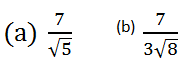
    Rationalize the denominators in
    solution

    (a)
    (b)

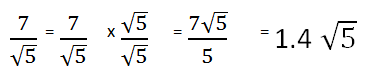
    Note: as you can see from the above workings, the irrational value in the denominator has been removed. Hence, we have rationalized the denominator.

    Expanding the product

    as shown above, the product of the two irrational sums have resulted to a relational number a-b.

    that is :

    A conjugate in surds is a surd with an expression such that the product of the two expressions results into a rational number.

    One important application of conjugates is in removing of surds in denominators of surds expressions that have fractions. A denominator in the fraction is multiplied by it’s conjugate. A conjugate of a surd expression is usually the same operands whose operators has changed to the opposite sign of the other operands.

    When we have removed surd expressions in the denominator, we say that we have rationalized the denominator.

    Example

    Rational the denominators of the following surds:

    Solution

    (a)

    (b)

    Practice Problem

    Given that √3 =m, √5 and √13 =p, rationalize the denominator and express your answer in terms of n, m and p.
    Related Topics


  • Simplifying Surds

    Simplifying Surds

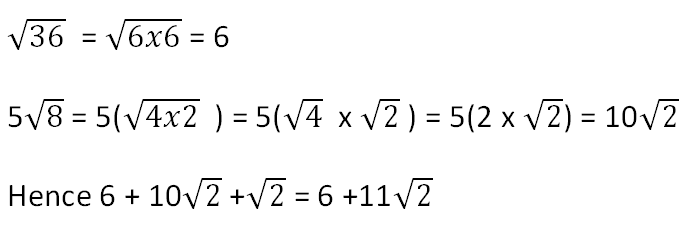
    To simplify expressions involving surds, we simply add or subtract coefficient of irrational factors that are alike. thus

    To simplify surds, you want to express them in their simplest form typically by factoring out any perfect square factors from the radicand (the number under the square root symbol).The steps to follow includes:

    • Identify the perfect square factors: Look for perfect square numbers that evenly divide into the number under the square root. For example, in √72, the perfect square factor is 36 because √36 equals 6.
    • Factor out the perfect square: Rewrite the surd using the perfect square factor outside the square root. For example, √72 becomes 6√2.
    • If possible, simplify further: Sometimes, you can simplify the expression even more. For instance, if you have √18, you can factor out √9 from it to get 3√2.
    • Repeat if necessary: If there are still perfect square factors remaining under the square root, repeat the process until you can no longer simplify.

    Example

    solution

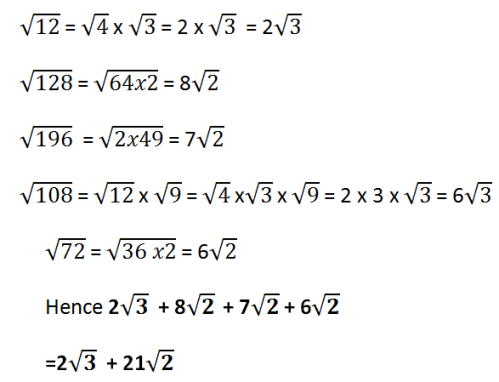
    (a)

    (b)

    The idea is to express 12 as products of two numbers. One number results to a rational number after the split. similarly, 128 can be expressed as a product of 64 and 2 such that square-root of 64 results to a rational number.

    After expressing all the terms in a simplified for , then some of them will have same irrational factor and hence they can be added to make them simpler.

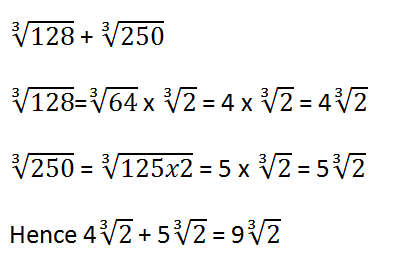
    (c)

    The idea is to express 128 into two factors such that it is possible to find the 3rd root of one of them and get a whole number. From quick inspection, 128 =64 x 2 and third-root of 64=4.

    similarly we can express 250 as a product of 125 and 2. We can be able to deduce that 125 is cube of 5 and hence cube-root of 125 is a rational whole number.

    Related topics


  • Order of surds

    The order of surd is the index of it’s root.

    √5    √7  √11 are examples of surds of second order.

    ∛5  ∛7  ∛11 are examples of surds of order three.

    Example

    Example

    Arrange the following surds in ascending order.

    solution

    The solution will involve changing the surds so that they can be of the same order. Then we can compare their values from inside the root.

    Like and unlike surds

    Surds are alike if they have the same irrational factor, otherwise they are unlike surds.

    Example

    Solution

    27 and 12 can be simplified such that they become a product of both rational and irrational numbers.

    like 27 is a product of 9 and 3. and when we get the squareroot of 9, we gat a rational number 3.

    similarly, 12 is a product of 4 and 3 and when we write 4 under square-root, it results to 2 which is rational. now both 12 and 27 and 1/3 when simplified will have the same irrational number as shown below

    To simplify expressions involving surds, we simply add or subtract coefficient of irrational factors that are alike. thus

    Related Topics