
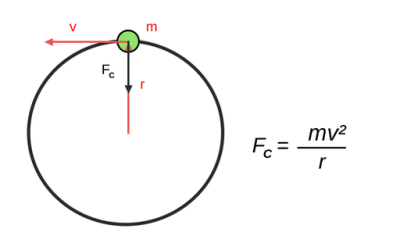
Consider on object m held by a cord om positioned at A. The Object is whirled in a circular motion and after some time Δt, the object is at position B. The velocity of the object in linear direction changes from VA to VB. If there was no force acting on the body, the object will not change directions but will go in a straight line. There must be a force that maintain the body at a constant distance distance from the center o.

Centripetal force Fc refers to the force that keeps a body in circular motion. A body in a circular motion is accelerating and from newton’s second law of motion, there must be a force acting on it to cause acceleration. Centripetal force is usually directed towards the center of the circular path. The Centripetal force is the force responsible for the constant change of direction otherwise the body would naturally follow a straight line if there was no force acting to keep the body in circular motion.
The value of the centripetal force is derived from newton’s second law of motion which states that: the rate of change of momentum of a body is directly proportional to the resultant force in the direction of force.
Momentum means mass multiplied by velocity.
Because velocity of a body in circular motion is changing, it’s momentum must also be changing.
The newton’s second law can be described as F=ma, where a = acceleration and m is the mass.
but the acceleration of the body of the body is given by a= v2/r, where v is the linear speed of the object while it is in circular motion. hence

From definition of angular velocity we had shown that, ω is given by v/r, and hence v=ωr.
it follows that Fc = m(ωr)2/r = mω2r2/r = mω2r .
Tension
If a body is attached to a string and swung around on a horizontal circle, the centripetal force that keeps the body in the circular orbit is kept as tension in the string. For the body to remain in circular motion, the centripetal force is equal to the tensional force.
From the equation Fc = mω2r , it shows that centripetal force is directly proportional to the angular velocity meaning that a larger force will be required to maintain the body in motion if it is swung faster.