
Tag: Thin lenses

  • Introduction to Thin Lens

    Introduction to Thin Lens

    A thin lens is a transparent piece of glass or plastic that is curved on one or both sides and is used to bend (refract) light rays. It is called thin because its thickness is very small compared to its radius of curvature. Thin lenses are commonly used in optical instruments such as Cameras, Microscopes, and Telescopes to form images of objects. When light passes through a thin lens, it changes direction and either converges to form a real image or diverges to form a virtual image depending on the type of lens. Thin lenses have their own language and vocabulary.

    Having the Language of thin lenses means that thin lenses have their own vocabulary mostly that describes various parts of the lens. This parts includes:

    • Center of curvature C
    • Radius of curvature R
    • Principal axis P
    • optical center O
    • Principle Focus F
    • Focal Length f
    • Focal plane

    We will discuss all the highlighted parts in this lesson

    Sub Topics

    Center of Curvature C

    It is defined as the center of the sphere of which the surface of the lens is part.

    We consider the lens to have been cut off from a transparent sphere of radius R. In other word, the lens is part of a curved surface of a certain sphere as illustrated below.

    For bi-convex lens, the lens is considered to come from two pieces cut from two different spheres and combined at the inner side. Consider the illustration below where we extract service1 and service2 from two spheres.

    sphere for surface1
    sphere for surface2

    Because the bi-convex comes from two spheres, it will have two centers of curvature which will be opposite to each other.

    similarly the bi-concave lens is derived from two spheres as illustrated.

    Different parts from spheres will be joined two have a concave lens that has two centers of curvature as shown below

    Radius of curvature

    It can be defined as the radius of the sphere from which the surface of the lens is part.

    It can also be defined as the distance between the Center of curvature and the optical center o of the lens.

    Principal axis

    It is an imaginary line passing through the centers of curvature and is perpendicular to the plane of the lens.

    principal axis thumb

    Optical center

    It is the geometric center of the lenses where a ray incident to the lens passes on undeviated.

    Principal focus

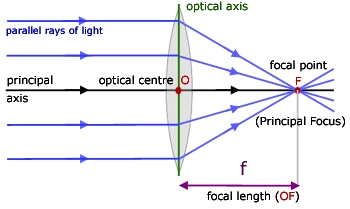
    Sometimes also referred to as the focal pointIt is a point on the principal axis where rays parallel and close to the principal axis converge after refraction by a convex lens or where the rays parallel and close to the principal axis seems to diverge from after refraction by a concave lens.

    The figure below illustrates convergence of parallel rays of light at principal focus after refraction.

    showing a principal focus of a convex lens

    The virtual principal focus of a concave lens is as illustrated below

    A lens has two principal foci, and they are on either side of the lens.

    The principal focus of converging lens is said to be real because their actual meeting of rays of light there.

    The principal axis of diverging lens is said to be virtual (imaginary) because rays of light do not actually meet there.

    Rays that are parallel and close to the principal axis or almost parallel to the principal axis are referred to us paraxial rays.

    Rays parallel but far from the principal axis are referred to as marginal rays or axial rays.

    Focal length f

    It is the distance between the optical center of the lens and it’s principal focus.

    By Convection, focal length of converging lens is considered real while that of diverging is considered virtual.

    Focal plane

    It is an imaginary plane that passes through the focal point and is perpendicular to the principal axis.

    Focal plane is illustrated below

    rays of light that are not parallel to the principal axis converges at a point on a focal plane or will appear to diverge from there after refraction

    Conclusion

    In this lesson we have seen that lens are pictured as being extracted from a sphere and the radius of the said sphere plays and important role in description of the lens. A lens converge or diverges rays parallel to the principal axis at the focal point.
    Related Topics


  • focal length by displacement

    focal length by displacement

    Ensure you have the following apparatus

    1. lens holder

    2. screen

    3. board with cross-wires

    4. source of light

    5. metre rule

    Procedure
    • Estimate the focal length of the lens by focusing a distance object
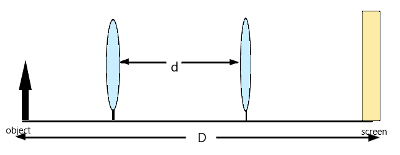
    • Set the apparatus as in figure below ensuring that the distance between the object and the screen is more than 4f where f is the focal length estimated above.
    • Obtain the image of the illuminated object on the screen when the lens is at position L1
    • Without changing the position of the object on the screen, move the lens to position L2 where another clear but diminished image is formed on the screen as shown below.
    • measure u and v for position L1 and the new distance u1 and v1 for position L2.
    • Determine the displacement d .
    workings

    from the diagram above,the distance between the point object and the screen is s. from the diagram, it is shown that the distance s is given by u+v.

    i. e. s = u+v ………………………………..(1)

    The distance between new and original position of the lens will be given by

    d=u’-u where u’ is the new object distance and u the original object distance

    d can also be obtained from v-v’ which is the original image distance and image distance when the lens is displaced by distance d.

    i.e d=u’-u and d = v-v’

    but u’=v and v’=u

    and therefore:

    d=v-u………………………………….(2)

    adding (1) and (2);

    hence s+ d= u + v + v –u

    and so: s + d = 2v and hence

    similarly we can subtract equation 2 from 1 as shown:

    hence s- d = u + v –v + u

    therefore : s- d = 2u and hence

    from the lens formulae:

    we can substitute values of u and v in terms of s and d as obtained in the expressions above. And hence;

    finding the lcm of the denominator, we obtain;

    and simplifying the above equation in the numerator:

    and finding the reciprocal so that we can get f;

    from the above equation: s2-d2 = 4fs

    a plot of s2-d2 against s results to a straight line through the origin with a slope equal to 4f.

    different values of s are obtained by changing distance between the object and the screen and then calculating the corresponding distance d.

    The two positions L1 and L2 that represents different positions of the lens are known as the conjugate points.

    Related topics


  • Introduction to thin lenses

    Other topics

    A lens can be defined as a piece of curved glass or plastic that makes things look larger, smaller or clearer when you look through it.

    In human eye, one component is a lens and so we can also define lens as the transparent part of the eye, behind the pupil, that focuses light so that you can see clearly.

    The idea behind lens operations is that when a light ray passes from air which is more optically denser than the lens material, it is refracted.

    When many rays passes through the lens, they all refracted the same way and so they meet at a common point. Sometimes they don’t meet but instead they are scattered after refraction but they are seemed to be spreading from a common point.

    Lenses are usually made of glass, transparent plastic or perspex.

    common application of lenses includes cameras, spectacles,telescopes, microscopes, film projectors and the human eye.

    eye glasses
    Types of lenses

    The basic two types of lenses are convex and concave lenses.

    Convex lenses are also called converging lenses as they cause the rays that passes through it to meet at a point. Convex lenses are thickest at the middle and they thin in as you move towards their edge.

    In this lesson we will be talking about biconvex lenses meaning that it is symmetrical if we cut it long it’s edges. Both sides of it’s services at the center are bulging outwards and the edges are curved inwards uniformly on both sides.see the figure below

    Bi convex lens
    showing symmetrical in bi-convex lens

    Concave lenses are also called diverging lenses as they cause the rays passing through them to be spreading from a common pint. Concave lenses are thinnest at the middle and they they become thicker as you move towards the edges.

    Illustrating concave lens
    illustrating bi-concave lens

    There are variations of convex and concave lenses as illustrated in figures below

    plano convex lens
    convex meniscus lens
    plano concave lens
    concave meniscus lens

    Effects of lenses on Parallel rays of light

    A cardboard with parallel slits is placed between the mirror and a bi-convex lens as in figure below

    The mirror is set such that it reflects the sun rays so that the rays passes through the slits before they reach the lens.

    After making observations, the bi-convex lens is replaced with a concave lens

    Observation

    when a convex lens is used, the rays are converged at a point on the paper and then diverge as they continue as shown.

    illustrations of parallel rays as they pass through a bi-convex lens

    When concave lens is used , the rays diverge as if they were from the focal point in front of the lens as shown.

    illustrations of parallel rays as they pass through a biconcave lens

    Investigating convergence and divergence of light using a ray box

    A ray box acts as a source of parallel beam. A spot light can also be used.

    A parallel beam is directed incident to the the lens as shown

    Parallel rays of light incident to a convex lens

    A white paper is placed on the other side of the lens and it’s position adjusted until a sharp point is observed.

    observation

    When a convex lens is used, the rays are converged at a point on the paper and then diverges as they continue as shown below

    Parallel beam after passing through a converging lens

    If convex lens was replaced with concave (diverging) lens, the rays will be observed diverging as if they are coming from a point on the other side of the lens. see the diagram below.

    Parallel beam incident to diverging lens

    Explanations

    Light is usually refracted when it passes through a glass prism. A lens can be considered as an assembly of many tiny prisms where each prism refracts light as in figure below.

    Illustrations of bi-convex lens as an assembly of prisms

    Please note that, the middle part of the prism is like a rectangular glass prism and a ray that is incident to it at a perpendicular angle passes through without being refracted. As we may see in other lessons, a ray of light that passes normally through the geometrical center of the lens, passes through undeviated.

    The figure below shows representation of concave lens as an assembly of prisms.

    illustrations of concave lens as an assembly of prisms

    conclusions

    Rays of light that passes through a lens converges at a fixed point from the lens if the lens is a converging lens or diverge from a common imaginary point if the lens is a diverging lens.

    The point at which the rays emerging from the lens converge or seems to diverge from is referred to as the principal focus.

    A convex lens has a real principal focus while a concave lens has a virtual (imaginary) principal focus.


    Related Topics


    References:
    • Secondary Physics Student’s Book Four. 3rd ed., Kenya Literature Bureau, 2012. pp. 1-42.
    • Abbot A. F. (1980), Ordinary Level Physics, 3rd Edition, Heinemann Books International,
      London.
    • Nelkon M. and Parker P., (1987), Advanced Level Physics, Heinemann Educational
      Publishers, London.
    • Tom D., and Heather K. Cambridge IGCSE Physics. 3rd ed., Hodder Education, 2018, https://doi.org/978 1 4441 76421. pp. 106-142.