
Tag: variance

  • Understanding Variance and Standard Deviation

    Understanding Variance and Standard Deviation

    Variance is the mean of the squared deviations from the mean.

    Instead of finding absolute deviation where we ignored negative signs obtained by subtracting mean from values, we square the difference from the mean. If we had deviation d from the mean, we get another column for d2.

    Consider the following set of data:

    42, 45, 39, 52, 48, 47, 50, 43, 36, 37

    The mean for the data is

    42 + 45 + 39 + 52 + 48 + 47 + 50 + 44 +

    36 + 37 =440

    The table below shows deviation from the mean of data representing some marks in a math test.

    from the table above, the sum of d2 is 268. That is Σd2 = 268.00

    the variance, sometimes written as σ2 is given as Σd2 divided by total frequency N. That is;

    In the example above:

    Standard deviation  σ

    It is also known as the root mean square deviation and is obtained by getting the square root of the variance. In the example above, The standard deviation, sometimes abbreviated as s.d will be given by:

    Standard Deviation For a grouped data

    standard deviation is useful for a large data.

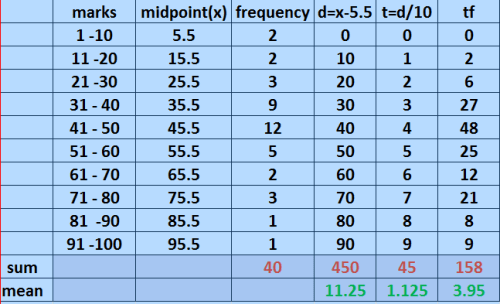
    consider the table below that contains marks distribution for some 40 students.

    We first calculate the mean for the data using the methods of getting mean for the grouped data.

    Here i use the assumed mean of 5.5. I choose this value because it has little value of midpoint and frequency, hence not likely to loose a lot of accuracy when it is reduced to zero
    Recall:

    From the table above:

     ∑ft/  ∑f = 3.95

    and  (∑ft/  ∑f) x 10= 39.5

    hence  (∑fd/  ∑f) = 39.5

    Mean is therefore 39.5 + 5.5 = 45

    Now that i have the mean, i will make a table that contains deviations from the mean and the squared deviation from the mean as shown.
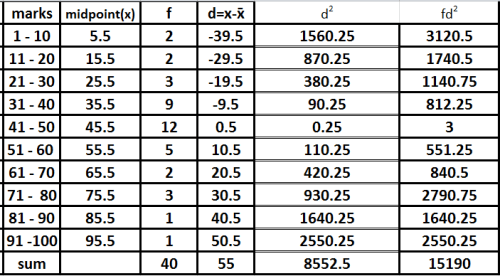
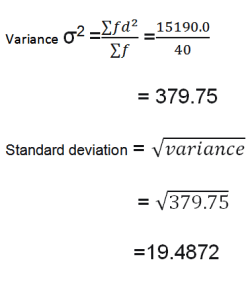
    The we will proceed to calculate the variance and get it’s squareroot to get the standard deviation.

    Related Topics


  • Measures of dispersion

    Measures of dispersion

    Sometimes measures of central tendency does not give the actual picture of the data in question. For example if we were to determine the average income per home of a certain country, we may obtain a high value and fail to deduce that majority of people have been living below poverty line but are dominated by few individuals that earns extremely high incomes. The few people earning very high income raises the average earning and the mean may wrongly be interpreted by assuming that the people living in such a country are wealth people.

    Dispersion can be used to measure how values are spread from the minimum value to the maximum value.

    Consider the table below

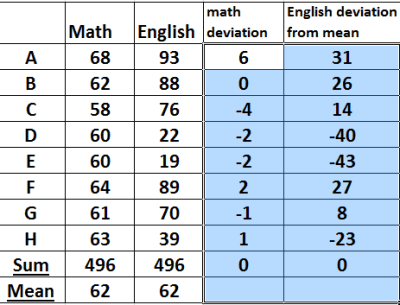
    The table shows scores of some students in a Math and English test.

    But a mean may fail to show that one class has extreme case of a bright student and of a not so bright one. The first data shows that all the students in class are of average ability.

    The data in math has a small range of 68-58=10 but English has a wide range of 93-19=74. Yet the two subjects have the same mean as their totals are the same but Marks in B are more spread out than in A.

    One measure of dispersion is the range which represents the difference between the highest and lowest value in the data set. However, a range may have limitations because it uses two extreme values that may have strayed from the true picture of actual observations.

    A county may have lower value for income per home but the quality of life is high because there are not cases of extreme poverty and the gap between rich and poor is not that wide like what happens in Africa.

    Inter-quartile range

    It is the difference between the lower and the upper quartile and consists of the 50% of the whole data that is usually close to the mean and other measures of central tendency.

    Semi inter-quartile range

    It is also called the quartile deviation and it represents the average between upper quartile and the lower quartile. It is usually obtained by adding lower quartile and upper quartile then dividing by two.

    Mean deviation

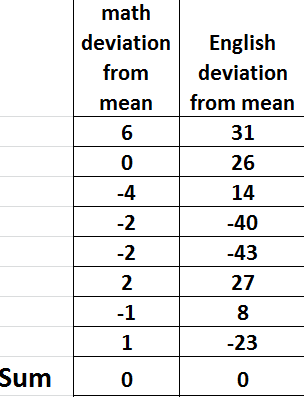
    Mean deviation is the difference between each value and the mean for the data. It is obtained by subtracting the mean from each value of the data set. The table below shows deviation from the mean of the math and English test shown above. please note that the sum of deviations from the mean is zero.

    Mean absolute deviation

    The sum of deviations from the mean sums up to 0. This is because mean is usually at the center of all values in the data set. Subtracting means from values left of the mean gives negatives deviation and those from right gives positive deviation. The table below shows that extract of columns of deviations from the mean of the previous data.

    To have a meaningful insights from the deviations from the mean, the negative values are ignored so that only positive values are considered. Hence we talk about the absolute values from the mean.

    The sum of the absolute deviations from the mean are summed up then divided by frequency to have the mean absolute deviation.

    Consider deviations from the mean from the previous data we have discussed. Now we have ignored the the negative sign and included only the number alone without considering it’s sign as shown.

    As can be seen from the table above, the mean value for math is only 2.25 whereas for English where the range is big, the mean is 26.5, which is much higher compared to math.

    Variance

    Instead of finding absolute values, we square each deviation so that each deviation results is made positive.

    Variance is the sum of the squared deviations from the mean, divided by the frequency.

    Related Topics