
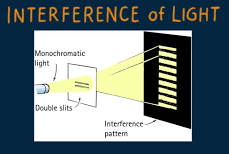
Interference of light waves is a phenomenon that occurs when two or more light waves overlap as they travel through the same medium. The study of interference provides strong evidence that light behaves as a wave and is clearly demonstrated in experiments such as Young’s double slit experiment, where alternating bright and dark fringes are formed on a screen.
Notes
- Interference occurs when two waves merge.
- According to the principle of superposition, the resultant effects of two waves travelling at a given point in the same medium which is the vector sum of their respective displacements.
- Suppose the amplitudes of the two wave pulses are and , when the pulses are travelling in the same direction, the amplitude of the resulting wave is given by:
where is the vector sum of and
- The amplitude of the resulting pulses is the sum of the individual amplitudes of the initial pulses.
- If the resulting pulse has zero amplitude, then the pulses are said to have undergone complete destructive interference.
- Constructive interference occurs when the amplitude of the resulting pulse is bigger than that of the individual pulses.
- In destructive interference, the amplitude of the resulting pulse is smaller than that of the individual pulses.
- Two waves interfere as shown.

The Young’s Double Slit Experiment

A single slit is placed in front of a monochromatic light source.
Because it is narrow, it diffracts light that falls on it, illuminating both slits and which are narrow, very close together and parallel to .
and diffract the light which once more spreads out, superposing in the shaded area.
A series of alternate bright and dark vertical bands are formed on the screen.
- The fringes are equally spaced and the light intensity at the bright fringe is maximum while at the dark fringe it is minimum.
How Interference Fringes are Formed
From the descriptions above, interference is a phenomenon which is exhibited by progressive waves and results from the interaction of wavetrains of same frequency and constant phase (coherent wave trains).
In an ordinary light source, light is produced as a result of electron transitions in the atoms of the source. The emitted bursts of waves last within 10-9 to 10-8 seconds and are out of phase with each other. Hence, two such light sources cannot be coherent owing to the random emission of light waves. They produce a uniform illumination instead of bright and dark fringes because the interference pattern that forms changes so rapidly.
In the two slits experiment, slits and are equidistant from . As a wavefront from reaches and , each slit is considered as a new light source, such that the two slits form two coherent source as shown:

- and are equidistant from .
- As a wavefront from S reaches and , each slit is irradiated as a new light source, such that the two slits form two coherent sources.
- A central bright fringe forms at when such that the path difference is zero.
- Moving outward on one side of the central bright fringe, the first bright forms at P where:
- For the dark fringe at R:
Comments
One response to “Interference of Light Waves”
good