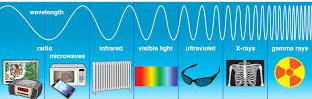
The electromagnetic (EM) spectrum is the range of all types of Electromagnetic radiation. Radiation is energy that travels and spreads out as it goes – the visible light that comes from a lamp in your house and the radio waves that come from a radio station are two types of electromagnetic radiation.
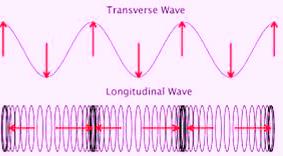
Electromagnetic waves are transverse waves which results from oscillating electric and magnetic fields at right angles to each other.
Electromagnetic spectra are arranged in order of their wavelength or frequency. This arrangement forms what is known as the electromagnetic spectrum.
A complete spectrum is shown below:
The figure below shows electromagnetic waves arranged in order of decreasing wavelengths
Properties of Electromagnetic waves
The Electromagnetic waves have the following common properties.
They travel through vacuum(space) with a speed of 3.0 x 10⁸ms-1 . This speed is usually referred to as the speed of light in vacuum and is usually denoted by c.
Do not require material medium for transmission
They are transverse in nature
Electromagnetic waves undergoes interference, reflection,refraction and polarisation effect
Posses energy in different amounts according to the relation E=hf where h is the Plank’s constant given as 6.63 x 10⁻³⁴ Js and f is the frequency
They carry no charge
They are not affected by electric or magnetic fields
Example: calculating energy of a wave
A certain electromagnetic radiation was found to be having a wavelength of 6.5 x 10⁻⁸ m. Calculate the energy it emits.
solution
To calculate the energy of a wave, you need to know its frequency. Then multiply the frequency by Planck’s constant.
Here we have only the wavelength, but we can get the frequency from the relation: v = fλ.
since it is an electromagnetic wave, it’s speed is 3.0 x 10⁻⁸ ms-1. and hence f=v/λ. that is:
=4.6154 x 10¹⁵ HZ
The energy of a wave was defined as E = hf where h (plank’s constant)= 6.63×10⁻³⁴ Js
hence E = 6.63 x 10-34 Js x 4.6154 x 1015 HZ≈ 3.06 x 10⁻²⁰J.
Electromagnetic waves are usually detected by devices or gadgets. The human eye can only detect only a small portion of this spectrum called visible light. A radio detects a different portion of the spectrum, and an x-ray machine uses yet another portion.
Gamma Rays
Detected by photographic plates and radiation detectors like Geiger Muller Tubes.
we need a gamma spectrometer to know the energy ranges of the γ photons emitted by a radioactive source. A gamma spectrometer generally consists of a scintillation detector or a semiconductor detector to convert the γ rays into visible light or electronic signals respectively. With a multi-channel analyser, a gamma spectrum depicting the number distribution of γ photons at different energy ranges can be obtained. The γ spectrum is like the “fingerprints” of nuclides which facilitate the identification of different nuclides in a radioactive source.
By counting the rate of charge pulses or voltage pulses or measuring the scintillation of the light emitted, the number and energy of gamma ray photon striking an ionisation detector or scintillation counter can be found.
Gamma spectrometer circuit
X-rays Detection
In X-ray detectors the energy transported by the radiation is converted into forms that can be recognized visually or electronically. Generally the photons are absorbed by the detector material and energy transfer takes place by ionization.
X-rays are usually detected by using a fluorescent screen or photographic film.
In hospitals, X-rays used to observe broken bones are detected by their actions on specially designed photographic emulsions. This high energy radiation may also be detected by its ability to ionise gas atoms producing a pulse of electric current in a gas placed between two electrodes.
Geiger Muller counter using the ionisation of gas atoms detects the presence of both X-rays and gamma rays.
X-ray detector
Detection of Ultraviolet Radiation
It is usually detected by photographic films, photocells, fluorescent materials like quinine and sulphate and a paper slightly smeared with vaseline.
Quinine, a substance found in tonic water is sensitive to UV light and can absorb UV light that we can’t see and then re-emit visible blue light that we can see in a process known as fluorescence
A fluorescent material is one that absorbs the energy of UltraViolet light and then re-emits it as visible light.
The inner surface of a fluorescent tube is coated with a fluorescent material .The tube is filled with a gas that emits UV light when made to conduct by a high voltage.
fluorescent lamps
Visible light
Common detectors of visible light are the eye, photographic film, charge-coupled devices (CCDs) and the photocell.
Photographic films detects light by the chemical changes it produces in light-sensitive chemicals such as silver halides. Light is also detected by the photoelectric effect in which its energy causes electrons to be emitted from metal surfaces.
By use of photoelectric effect, electrons are collected in a photomultiplier tube and the current they produce amplified to produce an electric signal.
Semiconductors are used to produce photovoltaic cells which generate a current when light falls on them and photoresistors in which incident light causes a change in electrical resistance.
Wave is a propagation of disturbances from place to place in a regular and organized way.
It can also be defined as a disturbance or variation that transfers energy progressively from point to point in a medium and that may take the form of an elastic deformation or of a variation of pressure, electric or magnetic intensity, electric potential, or temperature.
There are various ways we can categorize waves:
Electromagnetic waves
This are kind of waves that can travel in vacuum and do not require material medium for their transmission. They can also be explained as a form of radiation that travel though the universe and results from oscillation of electric and magnetic fields perpendicularly to each other.
Sun is a huge producer of electromagnetic waves.
Illustrations showing production of electromagnetic waves
Mechanical waves
They are waves that requires material medium for transmission where their transmission is determined by vibration of the particles in the medium. Mechanical waves can be either transverse or longitudinal
Mechanical waves are produced by a disturbance, such as a vibrating object, in a material medium and are transmitted by the particles of the medium vibrating to and fro. Such waves can be seen or felt and include waves on a rope or spring, water waves and sound waves in air or in other materials. The figure below shows a a helical spring vibrated to produce both longitudinal and transverse waves.
A helical spring used to produce longitudinal and transverse waves.
Transverse waves
This are waves whose transmission is such that the angle of vibration of the particles is at right angles to the direction of the wave progression.
A transverse wave can be sent along a rope (or a spring) by fixing one end and moving the other rapidly up and down such that The disturbance generated by the hand is passed on from one part of the rope to the next.
Consider the diagram below.
Illustrating formation of transverse wave
To further illustrate the formation of a transverse waves, consider a slinky spring stretched along a smooth bench while one of it’s end is attached to a rigid support while the other end is held by a hand. The end held by the hand is swung up and down at right angles to the spring or rope as in figure below;
illustrating transverse waves using a slinky spring
The wave created above is said to travel as a series of crests and troughs.
The displacement of an individual particle in relation to the direction of wave motion is as shown.
Particle displacement in a transverse wave
Longitudinal waves
In longitudinal wave that are progressive waves, the particles of the transmitting medium vibrate to and fro along the same line as that of wave travel. A longitudinal wave can be created along a spring by stretching out a slinky spring on a bench when it is fixed at one end and the free end repeatedly pushed and pulled continuously. see the figure below:
illustrating formation of longitudinal waves
Compressions and rarefactions are formed on a longitudinal waves.
Compressions(C)are where the coils are closer together and rarefactions (R) are where the coils are further apart along the spring.
In longitudinal waves , the vibration of particles are said to be in a parallel direction to the direction of wave travel.
A good example of longitudinal waves is the sound wave where particles of air vibrates in the same direction as the movement of sound energy.
Continous to and fro movements at one end results in the formation of sections of compression and alternating with rarefaction along the length of the string as shown.
illustrating longitudinal waves on a slinky spring
The displacement of a particle in a longitudinal wave in relation to the direction of wave motion is as shown
An illustration of a particle vibration in longitudinal wave
Individual particles in the slinky spring are set into periodic vibrations in line with the directions of the wave motion.
The wave motion affects the inner particle spacing where particles in the compression part are pushed closed together while particles in rarefaction part are pulled slightly further apart.
Variation in inter-particle separation is accompanied by variation in pressure such that sections under compression are at higher pressure while those under rarefaction are at low pressure. This pressure variation is the one causing the longitudinal wave motion.
Progressive waves
These are waves that moves continually away from the source.
Progressive waves are found in both longitudinal and transverse wave and they are described as waves that are continously moving forward from the source carrying energy of the vibration along as they move.
Consider a case when you drop a small stone on a surface of calm water; The impact of the stone creates water waves that moves outwards carrying the energy of the impact away from the source as shown.
Illustrating water waves
as illustrated in the above figure, the water waves moves away from the source and as they move that way, the energy is spread over an increasingly large area causing gradual increase in energy.
Pulses
A pulse is generated when a single vibration is sent through medium. A pulse can be generated for both transverse or longitudinal waves. A pulse from a transverse vibration is as shown below.
an illustration of transversal pulse
A pulse from a longitudinal vibration is as shown below
Illustration of a longitudinal pulse
Wave trains are generated as a result of continous vibrations at a constant rate in a medium where the medium is distorted into repeated patterns of crests that are alternating with troughs in a transverse wave .
For longitudinal waves, the medium is set into repeated patterns of compression sections that are alternating with rarefaction sections as shown.
Contains information related to marketing campaigns of the user. These are shared with Google AdWords / Google Ads when the Google Ads and Google Analytics accounts are linked together.
90 days
__utma
ID used to identify users and sessions
2 years after last activity
__utmt
Used to monitor number of Google Analytics server requests
10 minutes
__utmb
Used to distinguish new sessions and visits. This cookie is set when the GA.js javascript library is loaded and there is no existing __utmb cookie. The cookie is updated every time data is sent to the Google Analytics server.
30 minutes after last activity
__utmc
Used only with old Urchin versions of Google Analytics and not with GA.js. Was used to distinguish between new sessions and visits at the end of a session.
End of session (browser)
__utmz
Contains information about the traffic source or campaign that directed user to the website. The cookie is set when the GA.js javascript is loaded and updated when data is sent to the Google Anaytics server
6 months after last activity
__utmv
Contains custom information set by the web developer via the _setCustomVar method in Google Analytics. This cookie is updated every time new data is sent to the Google Analytics server.
2 years after last activity
__utmx
Used to determine whether a user is included in an A / B or Multivariate test.
18 months
_ga
ID used to identify users
2 years
_gali
Used by Google Analytics to determine which links on a page are being clicked
30 seconds
_ga_
ID used to identify users
2 years
_gid
ID used to identify users for 24 hours after last activity
24 hours
_gat
Used to monitor number of Google Analytics server requests when using Google Tag Manager