
What is a wave
Wave is a propagation of disturbances from place to place in a regular and organized way.
It can also be defined as a disturbance or variation that transfers energy progressively from point to point in a medium and that may take the form of an elastic deformation or of a variation of pressure, electric or magnetic intensity, electric potential, or temperature.
There are various ways we can categorize waves:
Electromagnetic waves
This are kind of waves that can travel in vacuum and do not require material medium for their transmission. They can also be explained as a form of radiation that travel though the universe and results from oscillation of electric and magnetic fields perpendicularly to each other.
Sun is a huge producer of electromagnetic waves.

Mechanical waves
They are waves that requires material medium for transmission where their transmission is determined by vibration of the particles in the medium. Mechanical waves can be either transverse or longitudinal
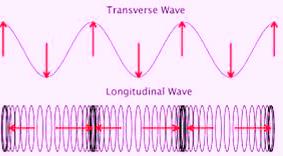
Mechanical waves are produced by a disturbance, such as a vibrating object, in a material medium and are transmitted by the particles of the medium vibrating to and fro. Such waves can be seen or felt and include waves on a rope or spring, water waves and sound waves in air or in other materials. The figure below shows a a helical spring vibrated to produce both longitudinal and transverse waves.

Transverse waves
This are waves whose transmission is such that the angle of vibration of the particles is at right angles to the direction of the wave progression.
A transverse wave can be sent along a rope (or a spring) by fixing one end and moving the other rapidly up and down such that The disturbance generated by the hand is passed on from one part of the rope to the next.
Consider the diagram below.

To further illustrate the formation of a transverse waves, consider a slinky spring stretched along a smooth bench while one of it’s end is attached to a rigid support while the other end is held by a hand. The end held by the hand is swung up and down at right angles to the spring or rope as in figure below;

The wave created above is said to travel as a series of crests and troughs.
The displacement of an individual particle in relation to the direction of wave motion is as shown.

Longitudinal waves
In longitudinal wave that are progressive waves, the particles of the transmitting medium vibrate to and fro along the same line as that of wave travel.
A longitudinal wave can be created along a spring by stretching out a slinky spring on a bench when it is fixed at one end and the free end repeatedly pushed and pulled continuously.
see the figure below:

Compressions and rarefactions are formed on a longitudinal waves.
Compressions(C)are where the coils are closer together and rarefactions
(R) are where the coils are further apart along the spring.
In longitudinal waves , the vibration of particles are said to be in a parallel direction to the direction of wave travel.
A good example of longitudinal waves is the sound wave where particles of air vibrates in the same direction as the movement of sound energy.
Continous to and fro movements at one end results in the formation of sections of compression and alternating with rarefaction along the length of the string as shown.

The displacement of a particle in a longitudinal wave in relation to the direction of wave motion is as shown

Individual particles in the slinky spring are set into periodic vibrations in line with the directions of the wave motion.
The wave motion affects the inner particle spacing where particles in the compression part are pushed closed together while particles in rarefaction part are pulled slightly further apart.
Variation in inter-particle separation is accompanied by variation in pressure such that sections under compression are at higher pressure while those under rarefaction are at low pressure. This pressure variation is the one causing the longitudinal wave motion.
Progressive waves
These are waves that moves continually away from the source.
Progressive waves are found in both longitudinal and transverse wave and they are described as waves that are continously moving forward from the source carrying energy of the vibration along as they move.
Consider a case when you drop a small stone on a surface of calm water; The impact of the stone creates water waves that moves outwards carrying the energy of the impact away from the source as shown.

as illustrated in the above figure, the water waves moves away from the source and as they move that way, the energy is spread over an increasingly large area causing gradual increase in energy.
Pulses
A pulse is generated when a single vibration is sent through medium. A pulse can be generated for both transverse or longitudinal waves. A pulse from a transverse vibration is as shown below.

A pulse from a longitudinal vibration is as shown below

Wave trains are generated as a result of continous vibrations at a constant rate in a medium where the medium is distorted into repeated patterns of crests that are alternating with troughs in a transverse wave .
For longitudinal waves, the medium is set into repeated patterns of compression sections that are alternating with rarefaction sections as shown.
