most of people don’t read metre rule correctly. A metre rule has 100cm and between two consecutive centimeter marks there are gaps. The gaps between centimeter marks can be reduced by dividing the gap into smaller sub units. When divided into 10 equal divisions, then each of such smaller division is called a millimeter because it will be dividing the metre length into 1000 divisions with each divisions being equal to 0.001m. Then the accuracy of the meter rule can be said to be equal to 1/1000 of a metre(0.001m). when the rule is calibrated into centimeter divisions alone, then the metre length is divided into 100 divisions with each divisions being equal to 0.01m. the accuracy of the measurements taken by such a rule is thus (1/100)m=0.01m).
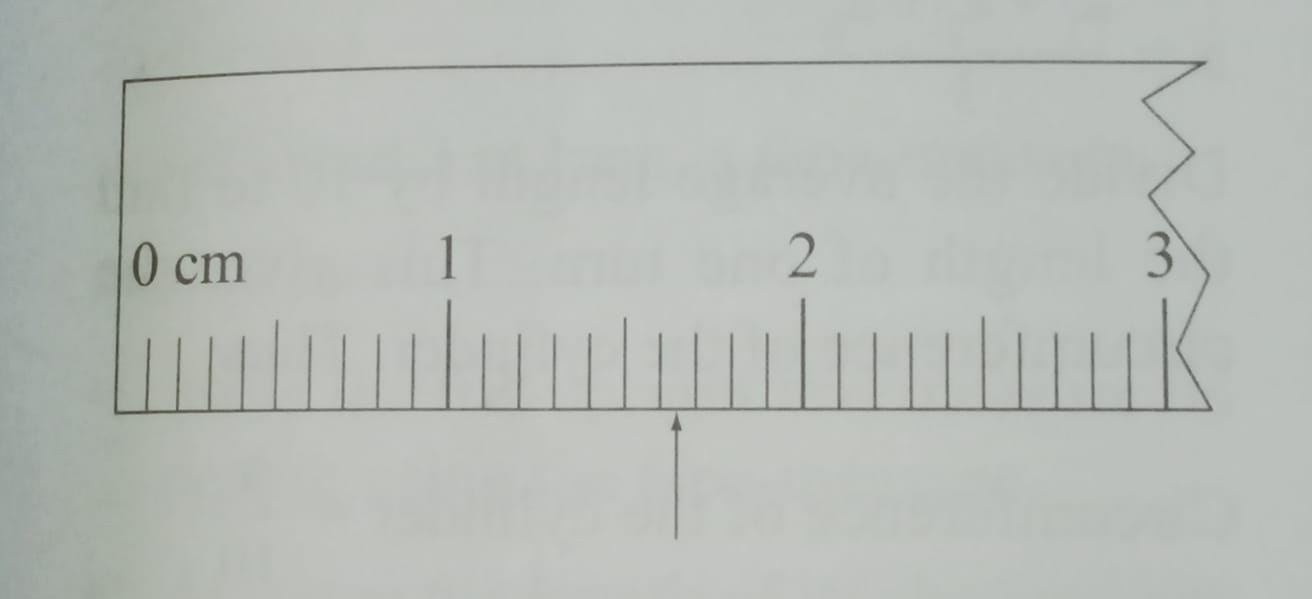
consider the reading shown by the arrow in figure below.

The reading above is more than 1.6 cm but less than 1.7 cm. The position of our point object is not lying on exact reading. we cannot precisely state what measurement it is because it is not indicated. there is an empty gap and we need to approximate that extra length beyond the 1.6 cm because it is not indicated. We can increase the accuracy of the meter rule by dividing the gap into smaller divisions. suppose we approximate the second decimal to be 1.65 cm, there is nothing that prevents us from stating it as 1.66 cm,1.67 cm or even 1.64 cm.
The second decimal place cannot be accurately determined. Nevertheless, the readings from a meter rule may be written up to the second decimal place of a centimeter.
A reading like 2.584 cm cannot be taken by a metre rule. In later lessons, we will discuss how to increase the decimal places in measurement of length using other special instruments like micrometer screw-gauge.
If the readings of 3.6 cm and 7 cm are taken with a meter rule, then they should be written as 3.60 cm and 7.00 cm respectively. This is because a meter rule is calibrated to an accuracy of 0.01 m (100 divisions).
Practice Question
Record the readings indicated by P1,P2 and P3 shown in the figure below.

Answer to practice question
- P1=69.50 cm (approximations done)
- P2=71.00cm
- p3=71.50cm
Practice Exercise
State the readings indicated by the arrows in the figures below