
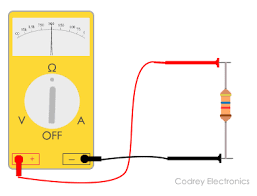
Electric resistance is one of the most important concepts in current electricity. Resistance determines how easily electric current flows through a conductor. In physics laboratories, several methods are used to measure resistance accurately, including the voltmeter-ammeter method, the Wheatstone bridge method, and the metre bridge method. These techniques form the foundation for understanding electrical circuits and practical electrical measurements.
The Voltmeter-Ammeter Method of Measuring Resistance in Electric Circuits
Aim of the Experiment
To determine the resistance of a resistor using a voltmeter and an ammeter.
Apparatus Required
- Two cells
- Switch
- Voltmeter
- Ammeter
- Variable resistor
- Resistor (R)
Circuit Arrangement for Measuring Resistance in Electric Circuits
In this method:
- The ammeter is connected in series with the resistor to measure current.
- The voltmeter is connected across the resistor to measure potential difference.
- A variable resistor is used to vary the current flowing through the circuit.


Procedure
- Set up the circuit as shown in the diagram.
- Keep the switch open and note the voltmeter reading (V) and the corresponding ammeter reading (I).
- Close the switch.
- Adjust the variable resistor and record several values of voltage and current.
- Calculate the value of (\frac{V}{I}) for each reading.
- Plot a graph of voltage (V) against current (I).
- Determine the slope (gradient) of the graph.
Observation
When the switch is open, no current flows through the resistor. Therefore:
- Ammeter reading = 0
- Voltmeter reading = 0
As current increases, the voltage across the resistor also increases.
According to Ohm’s law:
in other words; The resistance is obtained by dividing the voltage across the resistor by the current flowing through it.
Graph of Voltage Against Current
The graph of (V) against (I) is a straight line passing through the origin.
V=IR
The slope (gradient) of the graph gives the resistance of the resistor.
Limitation of the Method
This method is not perfectly accurate because the voltmeter draws a small amount of current. Therefore, not all the current measured by the ammeter passes through the resistor.
The Wheatstone Bridge Method
The Wheatstone bridge is a more accurate method of measuring resistance.
It consists of:
- Four resistors
- A galvanometer
- A cell


operation of the Wheatstone bridge
Wheatstone bridge operations involves making adjustments to one or two of the resistors until there is no deflection in the galvanometer. The four resisters K,L,M and N are joined as shown.

If K is the unknown resistance, the value of L, M and N must be known. Alternatively, the ratio of M to N must be known. A galvanometer G and a cell are connected as in figure above.
Variable resistor L(resistance box) is adjusted till there is no deflection in the galvanometer G. The bridge is then said to be balanced. At the state of balance, no current is flowing through G, hence the potential difference across BD is zero. When this happens, the potential difference across AB = potential difference across AD. The same current I1 flows through K and L and current I2 flows through M and N. then:
I1 = I3 and I2 = I4
I1k = I2M and I3L = I4N
As one can see, the currents are cancelling each other. hence when the bridge is balanced:


points to note
The four resistors are connected in a bridge arrangement.
When the galvanometer shows no deflection:
- The bridge is said to be balanced.
- No current flows through the galvanometer.
- This equation is used to determine an unknown resistance.
Wheatstone bridge is more accurate in measuring resistance compared to voltmeter-ammeter method because the value obtained does not depend on the accuracy of the current measuring instrument.
Advantages of the Wheatstone Bridge
- It gives more accurate measurements.
- The result does not depend greatly on the accuracy of the galvanometer.
- It is suitable for measuring small resistances precisely.
The Metre Bridge method of Measuring Resistance in Electric Circuits
The metre bridge is a practical form of the Wheatstone bridge.
It uses:
- A uniform wire one metre long
- Two resistors
- A galvanometer
- A jockey (movable contact)


Working Principle
A typical setup of the metre bridge is shown in the figure below:

The wire AC of uniform cross-section area and length 1 m with a resistance of several Ohm’s and made of an alloy such as constantan. The length AD represents resistor M while the length CD represents resistor N. The ratio of M to N is altered by changing the position D on the wire of the movable contact D called ‘jockey’.
The other arm of the bridge contains an unknown resistor K and a known resistor L. The copper strips of low resistance connect the various parts. The position of D is adjusted until there is no deflection in G. Then;
Since the wire is uniform cross-section, its resistance will be proportional to its length hence:
The resistor L should be chosen to give balance points near the centre of the wire. This gives a more accurate result. After obtaining the balance, K and L should be interchanged and a second pair of values for and obtained. This average of the value eliminates errors due to non-uniformity of the wire and end corrections. In finding the balance point, the cell key or switch should be closed before the jockey makes contact with the wire. This is necessary because of the effect known as ‘self-induction’ in which the currents in the circuit take a short time to grow to their steady values. A high resistance should always be joined in series with the galvanometer to protect it from damage whilst the balance is being sought.
Precautions in Using the Metre Bridge
- Choose balance points near the centre of the wire for greater accuracy.
- Close the switch before the jockey touches the wire.
- Use a high resistance in series with the galvanometer to protect it from damage.
Worked Example
In an experiment to determine the resistance of a nichrome wire using the metre bridge, the balance point was found to be at 38 cm mark. If the value of the resistance in the right hand gap needed to balance the bridge was 25 Ω, calculate the value of the unknown resistor.
solution
picture the setup to be as shown in the diagram below:

Since AB = 100 cm and AC = 38 cm, BC = 100 − 38 = 62 cm;
Resistors Connected in Series
When resistors are connected end to end, they form a series circuit.
Characteristics of series connection:
- The same current flows through all resistors.
- The total voltage equals the sum of individual voltages.


Using Ohm’s law:
[
V_T = V_1 + V_2 + V_3
]
The total resistance in series is:
genui{“math_block_widget_always_prefetch_v2”:{“content”:”R_T=R_1+R_2+R_3″}}
Conclusion
The measurement of resistance is an important practical skill in electricity. The voltmeter-ammeter method provides a simple way to determine resistance using Ohm’s law, while the Wheatstone bridge and metre bridge offer greater precision. Understanding these methods helps students appreciate how electrical measurements are carried out in laboratories and real-world electrical systems.
Related topics
- power consumption
- https://www.youtube.com/watch?v=IjZlPMUnUts