
Energy is measured in joules (J). Power is measured in watts (W). You will recall that power is the rate of energy transfer or power = energy ÷ time and that 1 W is the power when 1 J of energy is being transferred every second.
The amount of energy used by a consumer depends on:
(i) Power rating of appliances.
(ii) Time for which they have been used.
Therefore, it follows that the amount of energy consumed by a device (an electric lamp, for example) is equal to its power multiplied by the time for which it has been operating:
An alternative unit for energy is thus the watt-second (Ws) since 1 J = 1 W × 1 s.
In 10 seconds, a 100 watt light bulb consumes:
But watt-second is too small a unit for practical use. The unit used in practice is the kilowatt-hour (kWh). This is not an SI unit but is used all over the world.
One kWh is the amount of electrical energy used in one hour (3 600 s) at a power of 1 kW (1 000 W):
If we know the power rating of an appliance and the time for which it is used, the consumption in kWh is easily calculated.
Electricity companies charge by the kilowatt-hour for the use of the power they produce — they call 1 kWh a unit. So the cost of using an appliance for a certain length of time is worked out using total cost = number of kWh × cost per unit.
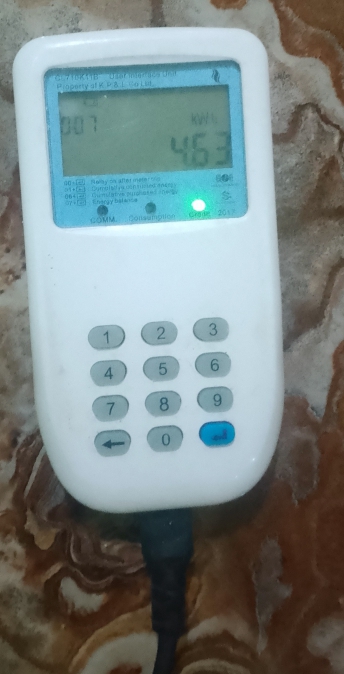
An electricity meter records the total number of units consumed on the premises where it is located.
An electricity meter reading units (kWh) is as illustrated below:

Example 5
A 1 200 W hair dryer is used for 15 mins. What is the energy used by the dryer?
Answer
Example 6
Two 40 W bulbs are left on for 6 hours. How much energy will they consume?
Answer
time in seconds = 6hours x 60min x 60secs = 21600 seconds
E = power x times
power = 40W x 2 = 80W
Energy(E) = 80 x 21600 = 2028000J
Example 7
An electric heater is used for 45 minutes. If it consumes 2 250 kJ of energy within this time, calculate its power rating.
Answer
Problems on mains electricity
Example 8
If one unit of electricity costs sh 3.5, calculate the cost of using:
a) a 60 W light bulb
b) a 1 kW heater
for 30 minutes each.
Answer
a)
Power = 60 W
Time = 30 min
Energy consumed
Cost = number of kWh × cost per unit
b)
Power = 1 kW
Time = 30 min
Energy consumed:
Cost = number of kWh × cost per unit
Example 9
A home has the following appliances:
a) A heater (5 kW)
b) Iron box (2.5 kW)
c) Home heater system (1 kW)
What fuse would be required for each appliance if the appliance draws power from 240 V mains supply?
Answers
a) 5 kW heater
Fuse should be 25 A.
b) 2.5 kW iron box
Fuse should be 15 A.
c) 1 kW home heater
Fuse should be 5A.
Example 4
A consumer has the following appliances operating in his house for the times indicated in one day:
| Appliance | Time |
|---|---|
| Two 40 W bulbs | 30 min |
| One 500 W fridge | 10 hrs |
| Four 75 W bulbs | 3 hrs |
| One 3 kW electrical heater | 45 min |
| One 100 W television | 5 hrs |
Calculate:
(a) the total power of the appliances used.
(b) the total electrical power consumed in kWh in 30 days, assuming that the power consumption per day is the same.
Solution
(a)
Total power=(2×40)+(1×500)+(4×75)+(1×3000)+(1×100) =3980W
(b)
Total energy consumed in one day equals the sum of energy consumed by each appliance.
Two 40 W bulbs for 30 minutes:
2×100040×6030 =0.04 kWh
One 500 W fridge for 10 hours:
=5 kWh
Four 75 W bulbs for 3 hours:
One 3 kW heater for 45 minutes:
One 100 W television for 5 hours:
Total energy consumed in one day:
Hence, the electrical energy used in 30 day will be given by:
8.69 x 30= shs 260.7