
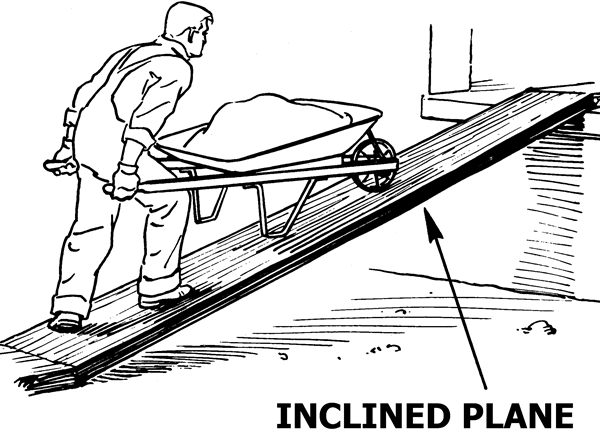
An inclined plane is one of the simplest yet most useful machines in everyday life. It is a flat surface set at an angle to help move heavy objects from a lower level to a higher level with less effort. Instead of lifting a load straight upward, an inclined plane allows force to be applied over a longer distance, making work easier and more efficient. Common examples include ramps, staircases, sloping roads, and playground slides. Inclined planes have been used since ancient times in construction, transportation, and engineering, and they continue to play an important role in modern technology and daily activities.
solving problems involving inclined plane
Consider an inclined sheet of metal placed to form a slope to ease the process of loading heavy luggage onto a truck as in the diagram below:

The velocity ratio of the inclined plane will be given by:
From trigonometric ratios:
substituting for h in the denominator:
Experiment To find the mechanical advantage of an inclined plane
Apparatus
- A pulley
- string
- two metre rules
- weighing balance
- flat plane
- five blocks of wood of different masses
- pan
- sand
Procedure of find the mechanical advantage of an inclined plane
- Fix the flat plane at an angle of inclination of about
- Place the load L in on an inclined plane and tie it with a string running over a pulley and attached to a pan, as in figure below:

- Add sand to the pan until the load moves steadily up the incline.
- Measure the load and the effort (pan + sand) using a weighing balance. Record the results on the table shown in table.
Table 2.1: Finding M.A. of an inclined plane
| Load L(N) | Effort E (N) | M.A = E/L |
|---|---|---|
- Repeat the experiment for other values of and .
- Calculate the M.A. for each pair of values.
Observation
The ratio of load to effort is found to be a constant, i.e.
Experiment To find the velocity ratio of an inclined plane
Apparatus
- A pulley
- two metre rules
- two blocks of wood
- one small and the other big
- pan
- sand.
Procedure of finding the velocity ratio of an inclined plane
- Fix a flat plane at an angle of inclination of 30∘.
- Place a block of wood on the plane and tie it with a string running over the pulley and attached to the pan, as shown in figure below:

- Add sand to the pan until the load moves steadily up the incline.
- When the load stops moving, record lengths and .
- Add more sand so that the effort (pan with sand) moves further down.
- Measure the DL and DE for the new positions.
- For each pair of values, calculate the velocity ratio, as shown below;
| Distance moved by effort DE(cm) | Distance moved by load DL(cm) | V.R = DE\DL |
|---|---|---|
Example 20
A man uses the inclined plane to lift a 50 kg load through a vertical height of 4.0 m. The inclined plane makes an angle of 30° with the horizontal. If the efficiency of the inclined plane is 72%, calculate:
(a)The effort needed to move the load up the inclined plane at a constant velocity.
(b) The work done against friction in raising the load through the height of 4.0 m.
Take: g = 10Nkg-1
solution
(a)
picture the setup as in the figure below:

/
(b)
Work done against friction = work input – work output
work output = mgh = 50 x 10 x 4 = 2000J
work input = effort x distance moved by effort
= 327.2 x AC
Therefore, the work done against friction = 2777.6 – 2000 = 777.6J