
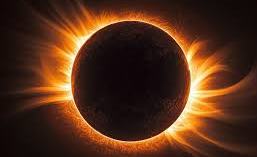
An eclipse occurs when one celestial body moves into the shadow of another celestial body. There are two main types of eclipses that people commonly observe from Earth:
- solar eclipses
- lunar eclipses.
Solar Eclipse
This happens when the Moon passes between the Earth and the Sun, blocking all or part of the Sun’s light. There are three types of solar eclipses: total, partial, and annular. During a total solar eclipse, the Moon completely covers the Sun, turning day into darkness for a brief period of time. A partial solar eclipse occurs when only a part of the Sun is obscured by the Moon. An annular solar eclipse happens when the Moon is too far away from the Earth to completely cover the Sun, leaving a ring of sunlight visible around the edges of the Moon.
Lunar Eclipse
This occurs when the Earth passes between the Sun and the Moon, causing the Earth’s shadow to fall on the Moon. Like solar eclipses, lunar eclipses also come in three varieties: total, partial, and penumbra. During a total lunar eclipse, the Earth’s shadow completely covers the Moon, giving it a reddish hue, often referred to as a “blood moon.” In a partial lunar eclipse, only a part of the Moon passes through the Earth’s shadow. A penumbra lunar eclipse happens when the Moon passes through the faint outer part of the Earth’s shadow, causing a subtle dimming of the Moon’s brightness.
Eclipses have fascinated people for centuries and have often been associated with myths, legends, and superstitions. They also provide valuable opportunities for scientific study, allowing researchers to learn more about the movements and interactions of celestial bodies in our solar system.
Related Topics
- Focal length by non-parallax method
- Estimating focal length
- focusing a distance object
- The lens formula
- Linear magnification
- Ray diagrams
- Image formation by thin lenses
- Introduction to thin lenses
- Finding focal length by displacement