
Consider the setup illustrated in the diagram below

When the magnet is moved towards the coil, the galvanometer deflects and when moved away, the deflection happens in the opposite direction. This shows that the direction of change of the magnetic flux linkage determines direction of the induced current.
Galvanometer deflection according to direction of current
We need to investigate how the current flows depending on the direction of the magnetic flux change and so we setup an experimental apparatus as shown.
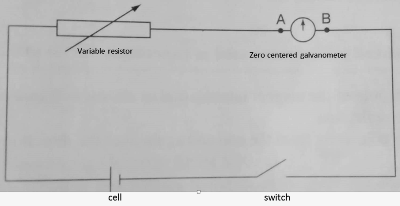
To investigate about current direction, we manipulate the apparatus in the following ways:
- Adjust the variable resistor to a high value in order to limit the current through the sensitive galvanometer.
- Close the switch and note the deflection on the galvanometer when current flows from A to B.
Observations
When current direction is from enter galvanometer through A and leave at B, The deflection on the galvanometer is to the right. From the diagram, the current leaves the cell towards A.
If the cell is reversed such that the current enters the galvanometer through B, the deflection happens to the left.
Determining direction of the induced current
Consider a coil of wire and a galvanometer connected as shown with a magnet being moved towards the coil.

observations
When the north pole of the magnet is moved towards the coil, the galvanometer deflects to the left indicating that the direction of the induced current is clockwise as in the direction DCBA.
When the north pole of the magnet is moved away from the coil, the pointer deflects to the right indicating that current flow is in the anticlockwise direction or direction DABC.
Explanations
As the north pole of the magnet moves towards the coil, the induced current flows in the coil in an attempt to form an electromagnet with a north pole at the end near the incoming magnetic pole. This is meant to resist movement of the incoming north pole. From the clock rule studied in magnetic Effect of electric current, The current flow in the conductor will be as illustrated below so that the end near the north pole forms an opposing north pole.

Remember the basic law of magnetism states that:
Like poles repel, unlike poles attract
When the North pole of the magnet is moved away from the coil, the induced current in the coil flows in such a way that a south pole is formed at the end of the coil near the leaving magnet so as to oppose movement of the receding magnet. Using the clock rule, the direction of induced current flow is as illustrated in the diagram below.

From the above experiments and observations, the direction of the induced current in a coil can be determined in Lenz’s law which states that:
The direction of the induced e.m.f is such that the induced current which it causes to flow produces a magnetic effect that opposes the change producing it.
Lenz’s law applies the principle the principle of conservation of energy. The mechanical energy used to move the magnet to the coil is converted to electrical energy in the form of an induced current. Work is done by the hard pushing the magnet towards the coil against the repulsive force from the induced pole of the coil if the current has to flow.
Related topics
- Factors affecting magnitude of the induced e.m.f
- Hans Oersted
- Calculus Integration
- Induced Electromotive force
- Magnetic effect to an electric current