Category: Communication Skills

  • Persuasive communication

    Persuasive communication

    This is kind of communication that attempts to convince an audience to listen or give attention to what you are saying and agree with the communicator .

    Persuasive communication uses a persuasive language which may be written, spoken or non-verbal to get others to agree with our facts, share our values, accept our arguments and even adopt our way of thinking.

    In your professional activities, the ability to persuade others to agree with your ideas and believe them in writing or in speaking is a potent communication skill.

    Some people are very convincing by the way they represent themselves in that they are attractive before they speak. This people understands that persuasion goes beyond words and may include:

    • Looking presentable
    • walk or sit in a manner that shows they are comfortable with who they are.(body posture)
    • display an inviting gestures like eye contacts , smiles , open arms or other body languages that invites people to them.
    • Keep a distance that is inviting instead of being aloof and repelling.

    From the above points, it is clear that non-verbal language is very vital in supplementing spoken word in our effort to communicate persuasively.

    We should also be able to persuade readers in our writings. This can be done by presenting good evidence that supports our arguments and conclusions, sticking to the topic of discussion, writing a well researched or useful information and eliminating grammatical and spelling mistakes by proofreading your work.

    Some of the ways to persuade people in your communication includes:

    • Presenting evidence
    • attacking and presenting opposing views as weaker
    • use of inclusive language with words like we, us, our that shows unity of purpose as opposed to words that shows individual opinions like and disconnect like i, you, them, they etc.
    • use of humour
    • showing cause and effect in your arguments
    • using formal language
    • use of specialized jargon that shows you are knowledgeable in the area you are arguing about and that you are professional.
    • use of imagery and metaphors
    • use of facts and expert opinions (quoting an authority in the field)
    • presenting evidence with statistical data
    • use of colloquial language that presents you as a down to earth and friendly person.
    • use attractive voice tone

    The tone of voice is a very handy tool in persuasive communication as it may attract or put off your audience.

    vocabulary used to describe a persuasive tone includes:

    • cheerful voice
    • reasonable
    • assuring
    • torelant
    • apologetic
    • wise
    • certain
    • persuasive
    • encouraging
    • respectful

    vocabulary that can be used to describe a tone that can put off your listeners includes:

    • angry voice
    • critical
    • resentful
    • judgemental
    • pessimistic
    • disappointed
    • biting
    • impatient
    • authoritative
    • disapproving

    Being Assertive

    Oxford dictionary defines assertive as an adjective of expressing opinions or desires strongly and with confidence, so that people can take notice.

    Assertiveness is the quality of being self-assured and confident. It is described as the ability to stand up against adversity or opposition in a calm and positive way without being aggressive or passive in accepting other people’s opinion or views.

    Assertiveness enables you express yourself in a clear, open and reasonable manner without undermining your own rights or those of others.

    Assertiveness means you can get your points across without upsetting others or getting yourself upset.

    Some of the characteristics of individuals who are not assertive includes:

    • They always agree with opinion of others
    • fear being judged and so avoid raising their voice over a matter
    • cannot stand up for themselves
    • find it hard to express what they feel

    Indicators of assertive behavior

    • Being prepared for meetings by seeking to know ahead of time the agendas and preparing on how to respond to them
    • Honesty and openness in expressing one’s thoughts,wishes,feelings and defending one’s rights and letting others be able to do the same.
    • Listening attentively to the views of others and responding appropriately even when you disagree with them.
    • Exercising self control
    • placing oneself at the safe level with others and not being authoritative
    • Owning self mistakes and apologizing and allowing others to do the same
    • Appreciating others regularly for their positive action
    • Accepting responsibility from others and being able to delegate to them as well

    Related Topics


  • Collaborative learning

    Collaborative learning

    This is a type of learning where a group of learners works together on a learning task that may involves solving problem, complete a task or discuss a new concept. It is an approach that engages students such that they are able to explore information deeply beyond knowledge level. By participating in a common task, students will defend their point of view, rephrase their ideas, listen keenly to understand other student’s point of view therefore enhance understanding and retention of the knowledge gained.

    Cooperative learning

    It is an teaching and learning strategy where small groups of students works together on a common assignment where each participants contributes to a specific part of the task and then the individual tasks are compiled to make one complete solution to the task at hand.

    In cooperative learning, students are usually responsible for their part or role in the whole assignment but the overall success of the group depends on each and every individual effort such that failure of one means failure of the whole group. Therefore each member of the group must do the best in their assigned part of the task. Members of the group will have chance to scrutinize each others work hence learning from each other.

    The role of each member is predefined and then their is a group leader that will coordinate group tasks and facilitates intergration of the individual tasks.

    Collaborative and cooperative learning is not limited to classrooms but is widely used in industries where stuffs works together to accomplish a task. For example in software engineering, each individual software developer is assigned a small part of the project to work on, learn about it and devise the best solution. Engineers can collaborate together to learn a new technology and dissect a new machine . Doctors can work together to understand a surgery task or research on a new disease.

    This kind of learning is very useful to our modern world has many benefits.

    i. Develop leadership skills

    individuals learn how to organize themselves and others, how to manage relationships meant to accomplish a serious task and how to work on high-level ideas with others.

    ii. Increased skills and knowledge

    There is more learning and retention of knowledge in collaborative learning unlike in individual study and classroom lectures because learners really engage with knowledge and learning by doing which is powerful way to learn.

    Students are able to learn from others and also reinforces what they know by teaching it to others in the group.

    ii. Improves relationships

    It increases opportunities for members in the organization to interact in a team work which would have been otherwise impossible if they were to work from their normal desk, departments and offices. Individuals are directed to form new connections and find ways of working together with people they would have found it difficult to interact with otherwise. It is also a way of bringing remote workers closer together through online collaboration and cooperation.

    iv. Improved knowledge acquisition and retention

    Studies has shown that much more learning takes place by doing and students participating in active learning activities unlike when involved in passive reception of knowledge. collaborative learning facilitates more participation in learning hence increasing retention of knowledge.

    It allows participants achieve higher levels of thinking as they think on how to present their ideas to the group

    v. Improves employees retention

    in work environment where there is collaboration in completing tasks, their is level of friendliness that is created that creates sense of belonging and feeling of being needed. Productivity increases and people are eased pressure of being evaluated individually but develops a sense of corporate responsibility. This causes members of stuff want to stay. According to Hawthorne study, people are more productive and efficient when working in a group as opposed to working alone.

    Individual benefits of collaborative learning

    i. makes learning very active

    to represent their ideas to the group, individual must give more thoughts to the idea, strive to organize their thoughts, find ways to support their points and develop convincing arguments that will be accepted by their peers.

    ii Promotes learning from others

    An individual is exposed to more viewpoints that may challenge his own views and learn from people that comes from background different from his own

    iii. Individuals learn how to think critically

    Individuals examines other people’s response, finding gaps in their own thoughts and adjusting their thinking when they learn from other people’s strength and weaknesses. When they are listening to others talking, they adjust their ideas as they get more insight while listening to others.

    iv. promotes listening to criticism and advice

    Individual will learn how to take criticisms without offence as they will learn how to argue constructively and also learn to look at issues from different perspectives and not sticking to their ways of seeing things alone.

    v. Develop public speaking and active listening skills

    Individuals learn to speak while others are keenly listening from their peers and learn to challenge ideas without offence and build a framework of ideas in conjunction with others. This helps individual develop social life with ease and hence better relationships at work and outside work life

    vi. Improves cooperation

    learners engaging in thoughtful discussions with each other improves their understanding and self esteem as they are likely to reinforce each others thought and ideas.

    Related topics

  • Nonverbal Communication

    Nonverbal Communication

    This is the kind of communication where messages are passed without word being spoken or being written. However, nonverbal communication has a great impact on the receivers interpretation of any message.

    In summary

    Nonverbal communications occurs in various forms that includes:

    • Body movements
    • Paralanguage
    • personal presentation
    • Proxemics
    • sign languages

    Body movements

    It is also known as the body language. Our body can send communication to other people without us uttering as a single word. kinesics is the field of study that deals with the ways people use their bodies to communicate or supplement their verbal communications. body movements may includes:

    • posture
    • gestures
    • facial expressions
    • eye contacts
    Posture

    posture refers to how your body is positioned. Your body position can send important messages to people and communicate a great deal about you. For example leaning forward in a conversation shows you r greatly interested and you are giving attention to what is being spoken. Leaning backward could mean disinterest or boredom. if you are standing and you reach a wall or a post for support can signify you are tired and no energy for talking.

    Gesture

    This includes movement of hands, fingers, arms or winking of eyes. For example when talking with your arms open wide can signify honesty and openness while talking when fingers interlocked can be interpreted as nervousness.

    Facial Expressions

    This includes arrangement of facial muscles to send a message. Our facial muscles are flexible and so can be rearranged to portray a certain image for communication purposes. We can stretch or relax our mouth, cheeks, eyes,eyelids, forehead, nose or chin to communicate a known symbol. For instance a folded face can show displeasure or a stretched mouth showing disapproval. Our face is the first point of contact when we meet people and hence likely to be the most observed part of our body. Our facial expressions can be read to decode and interpret our emotional feelings, telling whether we are happy, excited, sad, neutral etc.

    eye contacts

    eye contacts can be used to communicate different messages, for example direct eye contacts can communicate interests, intimacy or confident. diverted or downcast eyes may show intimidation or submission. People can avoid eye contacts with you if they are afraid or feel guilty about something they have done against you.

    Para-language

    This is how we speak like how is our pitch,speed of talking, how loud are we and quality of our voice. When we are frightened,anxious or excited, the pitch our voice can rise but it is lower when we sound more powerful or authoritative.

    Volume

    Refers to relative softness or loudness of our voice. Some people talks with loud voice and others in low tones. There are people that feels intimidated by people talking too loudly and others find it hand to concentrate on a speech given in low tones. Volume can be determined by the communication environment. Like in noisy places, even people that talks with low voices could be speaking with high voice because they are trying to raise their voice above the voices in the environment while in quite place, you feel to be in more control and hence you lower your voice.

    Rate

    Rate in speech could be used to mean how many words are given per unit time. People who thinks very fast tends to talk very fast but people who process information slowly will find it difficult following a fast talker.

    Voice quality

    some people has better and pleasant voices than others. A voice could be harsh, calm, strident, soothing etc.

    personal presentation

    How we groom ourselves can determine how we will be perceived by our audience especially when meeting them for the first time. If we appear dressed nicely, it can show we are resourceful, respectable, reliable and organized. If we dress shabbily, it can show we takes things casually or we lack seriousness with our things.

    Grooming habits communicates a great deal about who we are and how we want to be perceived. People can decode different messages based on our hair length, makeups, cologne and perfumes, length of our nails and how we have have painted them, how shiny is our shoes etc

    Touching

    social psychologists argues that touching is the most intimate form of nonverbal communication. Touching means how we use our hands towards the other person

    Proxemics

    It is the study of how we use space. It is attributed to the work of Edward hall in his book, “The Hidden dimension”. Edward argues that, taking a case of two people in a conversation, our personal space can be broken into four zones that includes:

    • Intimate distance(0-18 inches
    • personal distance(18 inches-12 feet)
    • social distance(4 feet – 12 feet)
    • public distance(12 feet – 25 feet)
    Intimate distance

    It is a distance reserved for intimate activities including love making, intimate or confidential conversations, hugging, kissing and snuggling.

    Only our most intimate relationships are permitted in this distance from us and if an invited person invades this space,we usually moves away slightly to maintain the distance. When a stranger invades this distance, we feel threatened and we develop flight or fighting instincts causing us to increase distance between us and them or try to push them away when we are not able to move.

    Personal distance

    It is the distance reserved for conversations with family, friends and close acquaintances. It is a distance that we allow people we feel comfortable with.

    Social distance

    It is the distance we are most comfortable when interacting with people in a way that is not intimate. It is the distance we maintain when interacting with people on a day to day basis for example when transacting business, having meetings, eating in hotels, sitting in bank halls, when talking to police etc.

    public distance

    it is the distance used for public ceremonies, speeches, large group meetings and class lectures. If the distance is greater than 25 feet, communication is characterized with shouting and exaggerated nonverbal gestures. The distance our ears can comfortably receive messages passing through air is quite limited and is subject to distortion from noise and other physical hindrance like diversion and absorption by physical objects.

    sign language

    It involves the use of hands to make symbolic gestures which have specific meanings. Sign language is a skill and a field of study taught in colleges in order to help the people with hearing impairments communicate with the world

    Functions of non-verbal communication
    • Message reinforcement or supplementation of verbal messages
    • negation of verbal messages
    • substitution of verbal messages (when talking is not possible or not allowed)
    • message accentuation (putting emphasis)
    • message regulation (controlling a conversation)

    Importance of nonverbal communication

    • have almost an instant effect because of quicker grasp by the receiver. Speed in conveyance and response makes non-verbal communications very useful in situations like traffic control by police
    • aids verbal communication. By use of nonverbal symbols, a large amount of complex data can be presented in a compact form so that large message can be communicated with just few non-verbal cues.
    • Response to visual symbols and images is usually more powerful than spoken language.
    • It is the best method to communicate with illiterate people or people that don’t understand your language. For example illiterate drivers can understand road signs and directives with non-verbal traffic signals.
    • Helps the hearing impaired communicate, learn and be able to work.
    related posts

  • What is communication

    What is communication

    Communication can be described as an active process of exchanging information between individuals using common system of symbols, signs and behavior (wilkinson,1984).

    There are various levels of communication that includes:

    • Intrapersonal level(internal monologue/reflection)
    • Interpersonal level
    • Group Communication
    • mass communication

    Intrapersonal level of Communication

    It is a communication that individuals do within themselves without releasing any message to a target audience outside themselves.

    It is also known as autocommunication or inner speech. It can be described as what you tell yourself.

    It constitutes our own imaginations and our inner thoughts. For example if am preparing for an interview, i would imagine some of the questions that would be asked. I would create a virtual interviewer and imagine them asking me the questions, then i would answer them within myself as if am answering to the panel. All this is intrapersonal because the the participants of the communication resides inside self and no external participants. If i called my sister and i ask her to pretend to be an interviewer, then that would be an interpersonal communication.

    Intrapersonal communication occurs, when you evaluate or examine the interaction that occurs between yourself and others. This form of communication occurs before and during other forms of communication as well. For instance, you might argue with yourself during a conversation in which someone asks you to do something you don’t really want to do and before you accept or decline, you mull over the alternatives in your mind. Intrapersonal communication also includes such activities as solving problems internally, resolving internal conflict, planning for the future, and evaluating yourself and your relationships with others.

    Interpersonal level of communication

    It refers to exchange of information between two or more people and it involves exchange of messages, ideas and information between individuals. It can involves some methods like face-to-face conversations, phone calls, text messages, sending emails, social media chats etc.

    Interpersonal communication can be described as the process of using messages to generate meaning between at least two people in a situation that allows mutual opportunities for both speaking and listening.

    With interpersonal communication, two or more individuals exchange messages using verbal and non-verbal cues.

    Group level Communication

    It refers to communication among three or more individuals with a common goal of sharing ideas and information collaborating on a project,resolving conflicts or negotiations.

    A group is a collection of people with specific goals or objectives.

    Group communication is used to take a collective decision on a problem, an issue or a matter of common interest. Participants involved in group communication takes an active part in communication to achieve a set of goals, develop social contacts or find the solution to a problem that concerns all members of the group.

    Public communication

    It is a communication that happens when a message sender is focused on transmitting a message to a specific group. In public communication, a person or a group of people share information to an audience or give presentation on a certain topic to deliver a certain message. Good examples of public communication is a classroom lecture, sermon or speech from public gatherings.

    People delivering public speech may allow their audience to respond to the message and ask crucial questions.

    Illustrating Communication

    Mass Communication

    It is the process of imparting and exchanging information through mass media to a large group of population using various forms of media technology like print media, radio broadcasting, television broadcasting etc.

    Mass communication focuses on using of a particular resource in transmitting information to various receivers.

    It can also be described as the transmission of messages to many recipients at a time.

    Through mass communication, information can be transmitted quickly to many people who do not necessarily stay near the source of information.

    Mass communications is usually done through various channels that includes:

    • Social networks
    • magazines
    • books
    • films
    • Internet
    • billboards
    • newspapers
    • Radio broadcasts
    • Televisions
    • websites

    components of communication

    There are various components that makes up a communication which includes the message sender, message receiver, the message, channel, feedback, context, barriers and effects.

    Communication is often seen as a transaction and interactive process such that it is a process of constructing meaning by taking into account the different perspectives of the participants.

    communication has three major functions no matter the context in which it is applied:

    • Assists individuals understand subject matter, their environment, job processes, themselves and others.
    • Persuasion and influence
    • Initiate and maintain human relations
    • It is a key to initiating and maintaining human relationships

    Apart from verbal communication where participants rely on the spoken and written words, we also communicate through behavior and by using non-verbal symbols and signs.

    Many a times, non-verbal communication is given more importance than verbal communication because it be more accurate than the verbal one.

    non-verbal communications includes:

    • Facial expressions
    • Gesture
    • Body movements
    • Posture
    • Appearance
    • Dressing
    • Space and distance
    • Tone of voice
    • Paralinguistic features
    • Time and artefacts.

    Paralinguistics encompasses voice elements such as the pitch, volume, tone, intonation, rhythm, and silence and non-voice elements such as facial expressions, body language, hand gestures, and eye contact.

    Related Topics


  • MODELS OF COMMUNICATION

    MODELS OF COMMUNICATION

    In order to communicate effectively, knowledge of the dynamics underlying the communication process is essential. One way to analyze communication is to present it in the form of a ‘model.’

    A model is a picture of human communication that effectively tells at a glance how it works. A model is defined as an abstracted representation of a reality. A good model comes as close to reality as possible; it discusses and explains the reality as clearly as possible.

    The Process of Communication

    The process of communication comprises a sender who has a message he / she transmits through some means (channel) to a receiver who responds. This process can be explained pictorially in form of a model as below:

    A simple model of communication process

    In the model, it is clear that in a communication process, there has to be a sender whose intention is to communicate a message.

    What to convey is his / her thinking process, how to communicate the message is his / her choice of channel and whom to convey the message is his / her job to decide.

    The sender needs to know the receiver’s response to the message as the feedback, whether or not it is being received as intended then only can the sender proceed further with the next act of communication and in this way it goes on and on. If no feedback is obtained, it may hinder the sender from sending any further message.

    The Lasswell Model

    Developed in 1948 by an American Political Scientist known as Harold D. Lasswell. It was initially formulated specifically for the analysis of mass communication like radio, television, and newspapers.

    Lasswell argues that the most convenient way to describe the communication process is to answer the questions; who?, what? through what channel?, to whom? and for what effect?

    The communication process according to Lasswell is as represented in the diagram below:

    The lasswell communication model

    Lasswell assumes that communication should be treated mainly as a persuasive process and that messages always have some effects mainly because of his background as a politician.

    The Lasswell model has tendency of exaggerating the effects of communication.

    Braddock, a communication researcher added two facets of the communication process in Lasswell model 1n 1958. These facets included the communication circumstances and with what purpose.

    Bradocck’s version of Lasswell model

    Braddock criticises Lasswell formula as misleading because of leading researchers to view elements in communication as distinct whereas in reality they are somehow interrelated.

    Lasswell model has also been criticized for emitting the element of feedback in the communication process. However, the model is a convenient way of introducing people to the study of communication process.

    Osgood’s and Schramm Model

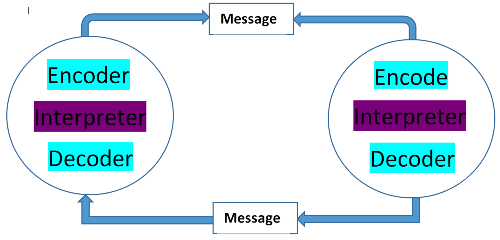
    Osgood describes communication as a dynamic process where there is continous sending of message and feedback. It is also known as a circular model because it indicates that the message keeps moving back and forth between two persons, each exchanging their role as a sender and as receiver interchangeably.

    This model originated from Charles Egerton Osgood, an american psychology professor at the university of illinois but was presented by Wilbur Schramm in 1954.

    The model describes the behavior of the main actors in the communication process and argues that both the message sender and message receiver fulfils the same function. The parties involved are described as having equal functions of encoding,decoding and interpreting messages being delivered. In other words, encoding function is similar to the transmitting and the decoding is similar to the receiving of messages.

    A communication event begins with receiving stimuli where each participant in the communication process sends as well as receives messages where they encodes, decodes and interprets and sends a message.

    Communication is thus dynamic because there is an interactive relationship between the source and the receiver.

    A person may be a source one moment and a receiver the next moment before becoming the source again. This is very common during interpersonal communication.

    The model is described as having a better representation of the communication process as communication is usually continous.

    The model is best suited in explaining interpersonal communication but may not explain communications without feedbacks such as mass communications.

    The shortcomings of this model is it’s argument that communication happens between equal parties because mostly communication is unbalanced based on communication resources, power and time given to each party to relay their messages.

    Schramm’s Model

    Was first published by Wilbur Schramm in 1954.

    Schramm has visualized communication essentially as a process of sharing experience and shaping and reshaping that experience.

    The source can encode and the destination can decode only in terms of
    experience each has had. If the circles have a large area in common, then
    communication is easy. If the circles do not meet, there has been no common experience and then communication is impossible.

    Shannon Model

    It was developed by a mathematician by name Claude Shannon in 1940s. He worked for the Bell telephone laboratory and his model was inspired by his work in the communication field where he dealt with questions like; which communication channel can bring through the maximum amount of signal and how much signal will be destroyed by noise while travelling from source to destination.

    The Shannon model can be described as a linear one way process that have five functions and one dysfunctional factor called noise. Represented graphically as shown.

    The first element of this model is the information source which produces a message or chain of messages to be communicated. The message is then transformed into signals by a transmitter which adapts it to the channel of communication so that it can lead it to the receiver. The receiver reconstructs the original message from the signal before handing it over to the destination.

    A communication signal may suffer interference from noise coming from other disturbances injected into the channel which may results to disparities between the sent message and the received message meaning that the message by the communicator and the one received by the target have different meanings.

    According to this model, the communicator has no way of determining that the sent message differs from the received one and so it is a common source of failed cummunication.

    In 1970, DeFleur added another set of components to the Shannon model to include feedback to the source of message giving it a way of adapting effectively to the communication channel. The Defleur model is as shown.

    It is worth noting that the sources get only limited or indirect feedback from the targets of communications in case of mass communication

    Related posts


    References:
    • Communication Models for the study of mass communication (Dennis McQuail & Sven Windhal, 1982, 1993).
    • Handbook of Communication and social skills (John O. Greene & Brant R. Burleson, 2003).
    • Handbook of Communication skills, third edition ( Owen Hargie, 2006).
    • https://en.wikipedia.org/wiki/Shannon%E2%80%93Weaver_model

  • COMMUNICATION THEORY

    COMMUNICATION THEORY

    Introduction

    As  a human  being,   you  have  to   communicate because human beings are social beings that needs constant communication and interacts with each other through communication. Communication  helps  you   to  relate effectively with other people and human  beings depend on their  communication skills to  help them  meet  their needs,  find happiness  and attain  personal fulfillment.In the course of our life, we  get involved  in  many types  of communication. A challenge with human communication is to communicate as  effectively as  possible and to build communication  skills so that communication works for  you and not against  you. Your  knowledge  of communication  theory  will  help you  understand better the different  ways of communicating  first as a human  being and secondly  as scholar.

    Defining Communication

    Different people have defined communication variously.   Gamble and Gamble (1993) define communication  as a desirable  or accidental transfer  of meaning.  

    The Oxford Dictionary defines communication as  the activity or process of expressing ideas and feelings or process of giving information to people

     Wilber Schramm  defines  communication as  a  mechanism  through  which  human relations exist and develop through sharing of experience on basis of commonness.

    Another meaning of communication according to Oxford dictionary is methods of sending information especially telephones, radio, computers or other media or through roads, railway and air.

    Communication is more  than mere transferring of ideas  or thoughts.  It is  not a static act as  some definitions suggest  but it  is a dynamic  process of  action and interaction towards  a desired  goal.   Recent  definitions look  at communication  as  a process  of sharing or exchange  of ideas, information,  knowledge, attitude or feeling  among two or more persons through certain signs, symbols and behavior.

    Communication Between two persons

    Elements of Communication

    In every act or encounter of communication, there are certain common elements that together help define the communication process. If you understand these elements they will help you to develop your own communication abilities.

    Communication involves the following elements:

    Source

    This refers to the communicator or originator of a message. This person is also called the sender. The sender at times becomes the receiver of a message. Source is where communication process is initiated.

     Context

    This refers to place and time communication takes place in some context or setting. The setting or environment influences the way you act towards others or determines the nature of communication encounter you share with them. For example, you can change your posture, manner of speaking or attire due to environment. The environment can reduce your confidence, blur your thinking or increase tension and confusion. In other hand, environment can encourage you to communicate effectively if it is friendly.

    Message

    message is what is being communicated.

    In every communication, we all send and receive both verbal and non-verbal
    messages. A message is the content of a communication act.

    Channel

    Channel is where message will pass through in order to move from the sender to the receiver. It refers to the medium of transmission like, voice and radio. Messages may be sent and received through both verbal and non-verbal channels. In effect, we are multi-channel communicators. For effective communication, use more than one channel at any given time.

     Receiver

    This is the target of the message relayed by the sender through the communication channel and is the one who is supposed to receive and comprehends the message. The receiver can understand or misunderstand the message in totality or part of it. This can distort the whole communication process and even lead to misuderstanding and possible conflicts. A lot of conflicts among people have resulted from misinterpretation of messages. A receiver at times in communication becomes a source or sender.

    Feedback

    This is the response a message sender receives from the target as the reaction of the message sent. When we communicate with one or more persons, we also receive information in return. Verbal or non-verbal cues that we perceive in reaction to our communication are feedback. Feedback tells us how we are progressing. Feedback can be positive or negative.

    Barriers

    Anything that interferes or distorts our ability to send or receive messages is called a barrier. It could be created by physical state, psychological state, intellectual ability and environment. Barriers to effective communication can therefore be grouped as follows:

    • Physical:- for example, size of room, position or location, gestures of speaker in case of verbal communication.
    • Psychological:– for example predisposition of receiver, attitude to subject, speaker, race, education level. etc.
    • Intellectual ability: – level of education, background and knowledge on the subject.
    • Physiological state:- for example, sickness, hungry, tired.
    • Linguistic: – Ability of the receiver of the communication to understand words and expressions used in the communication.

    FUNCTIONS OF COMMUNICATION

    Understanding And Insight

    We depend on communication to develop self-awareness. Communication helps us in understanding others and self.

    Meaningful Relationships

    It is through communication contacts that human beings basic physical and social needs are met. Psychology tells us that you need other people just as you need water, food and shelter. If you are cut from human contact, you become disoriented and maladjusted. Communication offers us the chance to satisfy our needs for inclusion, control and affection.

    Influence And Persuasion

    In every communication, people have ample chances to influence each other subtly and overtly. We spend much time trying to persuade one another to think as we think, do what we do, like what we like.

    Related Topics