
In order to communicate effectively, knowledge of the dynamics underlying the communication process is essential. One way to analyze communication is to present it in the form of a ‘model.’
A model is a picture of human communication that effectively tells at a glance how it works. A model is defined as an abstracted representation of a reality. A good model comes as close to reality as possible; it discusses and explains the reality as clearly as possible.
The Process of Communication
The process of communication comprises a sender who has a message he / she transmits through some means (channel) to a receiver who responds. This process can be explained pictorially in form of a model as below:

In the model, it is clear that in a communication process, there has to be a sender whose intention is to communicate a message.
What to convey is his / her thinking process, how to communicate the message is his / her choice of channel and whom to convey the message is his / her job to decide.
The sender needs to know the receiver’s response to the message as the feedback, whether or not it is being received as intended then only can the sender proceed further with the next act of communication and in this way it goes on and on. If no feedback is obtained, it may hinder the sender from sending any further message.
The Lasswell Model
Developed in 1948 by an American Political Scientist known as Harold D. Lasswell. It was initially formulated specifically for the analysis of mass communication like radio, television, and newspapers.
Lasswell argues that the most convenient way to describe the communication process is to answer the questions; who?, what? through what channel?, to whom? and for what effect?
The communication process according to Lasswell is as represented in the diagram below:

Lasswell assumes that communication should be treated mainly as a persuasive process and that messages always have some effects mainly because of his background as a politician.
The Lasswell model has tendency of exaggerating the effects of communication.
Braddock, a communication researcher added two facets of the communication process in Lasswell model 1n 1958. These facets included the communication circumstances and with what purpose.

Braddock criticises Lasswell formula as misleading because of leading researchers to view elements in communication as distinct whereas in reality they are somehow interrelated.
Lasswell model has also been criticized for emitting the element of feedback in the communication process. However, the model is a convenient way of introducing people to the study of communication process.
Osgood’s and Schramm Model
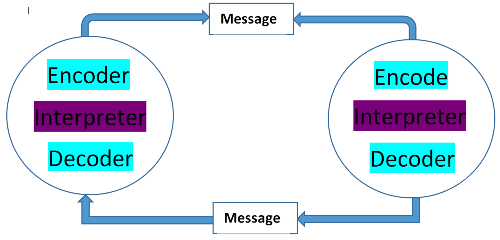
Osgood describes communication as a dynamic process where there is continous sending of message and feedback. It is also known as a circular model because it indicates that the message keeps moving back and forth between two persons, each exchanging their role as a sender and as receiver interchangeably.
This model originated from Charles Egerton Osgood, an american psychology professor at the university of illinois but was presented by Wilbur Schramm in 1954.
The model describes the behavior of the main actors in the communication process and argues that both the message sender and message receiver fulfils the same function. The parties involved are described as having equal functions of encoding,decoding and interpreting messages being delivered. In other words, encoding function is similar to the transmitting and the decoding is similar to the receiving of messages.
A communication event begins with receiving stimuli where each participant in the communication process sends as well as receives messages where they encodes, decodes and interprets and sends a message.
Communication is thus dynamic because there is an interactive relationship between the source and the receiver.
A person may be a source one moment and a receiver the next moment before becoming the source again. This is very common during interpersonal communication.

The model is described as having a better representation of the communication process as communication is usually continous.
The model is best suited in explaining interpersonal communication but may not explain communications without feedbacks such as mass communications.
The shortcomings of this model is it’s argument that communication happens between equal parties because mostly communication is unbalanced based on communication resources, power and time given to each party to relay their messages.
Schramm’s Model
Was first published by Wilbur Schramm in 1954.
Schramm has visualized communication essentially as a process of sharing experience and shaping and reshaping that experience.
The source can encode and the destination can decode only in terms of
experience each has had. If the circles have a large area in common, then
communication is easy. If the circles do not meet, there has been no common experience and then communication is impossible.

Shannon Model
It was developed by a mathematician by name Claude Shannon in 1940s. He worked for the Bell telephone laboratory and his model was inspired by his work in the communication field where he dealt with questions like; which communication channel can bring through the maximum amount of signal and how much signal will be destroyed by noise while travelling from source to destination.
The Shannon model can be described as a linear one way process that have five functions and one dysfunctional factor called noise. Represented graphically as shown.

The first element of this model is the information source which produces a message or chain of messages to be communicated. The message is then transformed into signals by a transmitter which adapts it to the channel of communication so that it can lead it to the receiver. The receiver reconstructs the original message from the signal before handing it over to the destination.
A communication signal may suffer interference from noise coming from other disturbances injected into the channel which may results to disparities between the sent message and the received message meaning that the message by the communicator and the one received by the target have different meanings.
According to this model, the communicator has no way of determining that the sent message differs from the received one and so it is a common source of failed cummunication.
In 1970, DeFleur added another set of components to the Shannon model to include feedback to the source of message giving it a way of adapting effectively to the communication channel. The Defleur model is as shown.

It is worth noting that the sources get only limited or indirect feedback from the targets of communications in case of mass communication
Related posts
- Elements of communications
- Introduction to Communication
- Communication Models
- Non-Verbal Communications
- Persuasive Communication
- The art of listening
- Levels of Listening
- The art of note taking
- The art of public speaking
- Organizing a speech
- supporting your speech
- Understanding team dynamics
- Information Literacy
- Rules and regulations
- The He Emotions
- Moments
References:
- Communication Models for the study of mass communication (Dennis McQuail & Sven Windhal, 1982, 1993).
- Handbook of Communication and social skills (John O. Greene & Brant R. Burleson, 2003).
- Handbook of Communication skills, third edition ( Owen Hargie, 2006).
- https://en.wikipedia.org/wiki/Shannon%E2%80%93Weaver_model