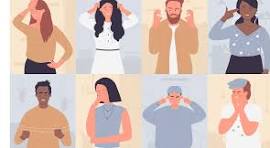
This is the kind of communication where messages are passed without word being spoken or being written. However, nonverbal communication has a great impact on the receivers interpretation of any message.
In summary
Nonverbal communications occurs in various forms that includes:
- Body movements
- Paralanguage
- personal presentation
- Proxemics
- sign languages
Body movements
It is also known as the body language. Our body can send communication to other people without us uttering as a single word. kinesics is the field of study that deals with the ways people use their bodies to communicate or supplement their verbal communications. body movements may includes:
- posture
- gestures
- facial expressions
- eye contacts
Posture
posture refers to how your body is positioned. Your body position can send important messages to people and communicate a great deal about you. For example leaning forward in a conversation shows you r greatly interested and you are giving attention to what is being spoken. Leaning backward could mean disinterest or boredom. if you are standing and you reach a wall or a post for support can signify you are tired and no energy for talking.
Gesture
This includes movement of hands, fingers, arms or winking of eyes. For example when talking with your arms open wide can signify honesty and openness while talking when fingers interlocked can be interpreted as nervousness.
Facial Expressions
This includes arrangement of facial muscles to send a message. Our facial muscles are flexible and so can be rearranged to portray a certain image for communication purposes. We can stretch or relax our mouth, cheeks, eyes,eyelids, forehead, nose or chin to communicate a known symbol. For instance a folded face can show displeasure or a stretched mouth showing disapproval. Our face is the first point of contact when we meet people and hence likely to be the most observed part of our body. Our facial expressions can be read to decode and interpret our emotional feelings, telling whether we are happy, excited, sad, neutral etc.
eye contacts
eye contacts can be used to communicate different messages, for example direct eye contacts can communicate interests, intimacy or confident. diverted or downcast eyes may show intimidation or submission. People can avoid eye contacts with you if they are afraid or feel guilty about something they have done against you.
Para-language
This is how we speak like how is our pitch,speed of talking, how loud are we and quality of our voice. When we are frightened,anxious or excited, the pitch our voice can rise but it is lower when we sound more powerful or authoritative.
Volume
Refers to relative softness or loudness of our voice. Some people talks with loud voice and others in low tones. There are people that feels intimidated by people talking too loudly and others find it hand to concentrate on a speech given in low tones. Volume can be determined by the communication environment. Like in noisy places, even people that talks with low voices could be speaking with high voice because they are trying to raise their voice above the voices in the environment while in quite place, you feel to be in more control and hence you lower your voice.
Rate
Rate in speech could be used to mean how many words are given per unit time. People who thinks very fast tends to talk very fast but people who process information slowly will find it difficult following a fast talker.
Voice quality
some people has better and pleasant voices than others. A voice could be harsh, calm, strident, soothing etc.
personal presentation
How we groom ourselves can determine how we will be perceived by our audience especially when meeting them for the first time. If we appear dressed nicely, it can show we are resourceful, respectable, reliable and organized. If we dress shabbily, it can show we takes things casually or we lack seriousness with our things.
Grooming habits communicates a great deal about who we are and how we want to be perceived. People can decode different messages based on our hair length, makeups, cologne and perfumes, length of our nails and how we have have painted them, how shiny is our shoes etc
Touching
social psychologists argues that touching is the most intimate form of nonverbal communication. Touching means how we use our hands towards the other person
Proxemics
It is the study of how we use space. It is attributed to the work of Edward hall in his book, “The Hidden dimension”. Edward argues that, taking a case of two people in a conversation, our personal space can be broken into four zones that includes:
- Intimate distance(0-18 inches
- personal distance(18 inches-12 feet)
- social distance(4 feet – 12 feet)
- public distance(12 feet – 25 feet)
Intimate distance
It is a distance reserved for intimate activities including love making, intimate or confidential conversations, hugging, kissing and snuggling.
Only our most intimate relationships are permitted in this distance from us and if an invited person invades this space,we usually moves away slightly to maintain the distance. When a stranger invades this distance, we feel threatened and we develop flight or fighting instincts causing us to increase distance between us and them or try to push them away when we are not able to move.
Personal distance
It is the distance reserved for conversations with family, friends and close acquaintances. It is a distance that we allow people we feel comfortable with.
Social distance
It is the distance we are most comfortable when interacting with people in a way that is not intimate. It is the distance we maintain when interacting with people on a day to day basis for example when transacting business, having meetings, eating in hotels, sitting in bank halls, when talking to police etc.
public distance
it is the distance used for public ceremonies, speeches, large group meetings and class lectures. If the distance is greater than 25 feet, communication is characterized with shouting and exaggerated nonverbal gestures. The distance our ears can comfortably receive messages passing through air is quite limited and is subject to distortion from noise and other physical hindrance like diversion and absorption by physical objects.
sign language
It involves the use of hands to make symbolic gestures which have specific meanings. Sign language is a skill and a field of study taught in colleges in order to help the people with hearing impairments communicate with the world
Functions of non-verbal communication
- Message reinforcement or supplementation of verbal messages
- negation of verbal messages
- substitution of verbal messages (when talking is not possible or not allowed)
- message accentuation (putting emphasis)
- message regulation (controlling a conversation)
Importance of nonverbal communication
- have almost an instant effect because of quicker grasp by the receiver. Speed in conveyance and response makes non-verbal communications very useful in situations like traffic control by police
- aids verbal communication. By use of nonverbal symbols, a large amount of complex data can be presented in a compact form so that large message can be communicated with just few non-verbal cues.
- Response to visual symbols and images is usually more powerful than spoken language.
- It is the best method to communicate with illiterate people or people that don’t understand your language. For example illiterate drivers can understand road signs and directives with non-verbal traffic signals.
- Helps the hearing impaired communicate, learn and be able to work.