
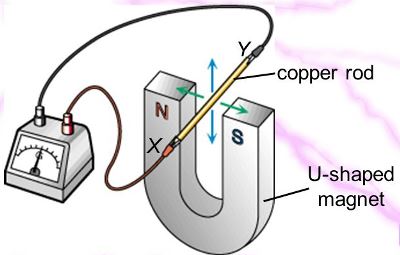
consider the setup below

To investigate direction of current on the straight conductor AB, you can do the following:
- Move the condutor to cut the magnetic fields vertically upwards and note the direction of the magnetic field.
- Move the condutor to cut the magnetic fields vertically downwards wards and note the direction of the magnetic field.
- Hold the wire stationary in the magnetic field and note the deflection
Observations
when the wire is moved upwards, the deflection on the galvanometer goes right showing that the current is flowing from A to B. To represent that on a paper, the induced current is envisioned to be moving into the page away from the eye as in the following illustration.

when moved and when the wire is moved downwards deflections goes left showing that the current is moving from A to B . The current flow can be represented on a paper with current fl0wing out of the page towards the eye as in figure below.

Fleming’s Right-hand rule
Direction of an induced current in a straight conductor can be determined by Fleming’s right-hand rule which states that:
If the thumb and the first two fingers of the right hand are held mutually at right angles with the first finger pointing in the direction of the magnetic field and the thumb pointing in the direction of motion, then the second finger points in the direction of the induced current.
The figure below shows how your right hand should be held to determine the direction of the induced current by use of Flemings’s right hand rule.

Fleming’s right hand rule is also known as the dynamo rule and it agrees with the Lenz’s law.
Consider a horizontal magnet held as shown in figure below:

The direction of the magnetic field is downward. The downward direction of the above magnetic field can be represent by a section of an arrow tail to show that the magnetic field is going down into the paper.
Suppose we have a conductor that is held horizontally between the two poles, the conductor will slide away or towards the magnet if it has some current flowing in it.
The figure below shows current through a certain conductor XY inside a magnetic field moving into the paper and the likely motion for such a setup.

According to Fleming’s rule which is consistent with the lenz’s law, the current must flow from X to Y in order to produce an electromotive force that is to push the rod XY to the right.
Related topics
- The Lenz’s law
- Factors affecting magnitude of the induced e.m.f
- Hans Oersted
- Calculus Integration
- Induced Electromotive force
- Magnetic effect to an electric current
References
- Secondary Physics Student’s Book Four. 3rd ed., Kenya Literature Bureau, 2012.
- Tom D., and Heather K. Cambridge IGCSE Physics. 3rd ed., Hodder Education, 2018.