
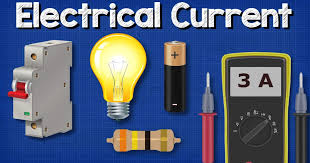
Electric current and potential difference represents two phenomenon that depends on each other to exist in electricity concepts. An electric current is the rate of flow of charge through a conductor. Current flows when there is a potential difference between two points in a conductor. Electric current is measured in amperes by an instrument called ammeter. An ammeter is an electrical instrument used to measure the current flowing through a circuit. The ammeter is designed to be connected in series with the circuit. This ensures that the current flows through the ammeter, allowing it to accurately measure the amount of electrical current.
There are two types of ammeters:
Instruments used in experiments of electric current and potential difference
- Analog Ammeter: This uses a needle or pointer to indicate the current on a scale.
The figure below shows an analog ammeter ammeter common in school laboratories.

2. Digital Ammeter: This displays the current measurement on a digital screen. It provides a digital readout of the electrical current. Digital ammeter allows one to choose a scale of measurement in amperes (A), milli-amperes (mA), or micro-amperes (µA). It uses a numerical display rather than a moving needle or pointer.

Electric current flows between two points in a closed path due to a potential difference between those two points. Sometimes the flowing current can be too small to me measured by an ammeter. A more sensitive instrument may therefore be required to measure small currents.
A millimeter is an instrument used to measure current in terms of one in thousand of an ampere. A milliammeter measures current in terms of milli-amperes.
Much smaller currents can be measured by a micro- ammeter. A micro-ammeter measures current in terms of micro-ampere.

Using an ammeter in measuring electric current
An ammeter has very low electrical resistance. Therefore it is connected in series with the instrument whose current passing through need to be measured. When connecting an ammeter in the circuit, ensure it is done correctly. The correct procedure is such that current enters the ammeter through positive terminal and exits through the negative terminal. If connected such that convectional current enters through negative terminal, the ammeter may get damaged.
The figure below shows the ammeter connected in series with the bulb. The convectional current flowing through the bulb also flows through the ammeter.

The figure below shows wrong ammeter connection. Note that the positive terminal of the ammeter is connected to the negative terminal of the cell.

Before connecting the ammeter in a circuit, confirm that it’s pointer is at zero mark on the scale. Otherwise, use the zero adjusting screw to move it to the correct position. Most of ammeters has two scales. An appropriate scale should be selected to safeguard the coil from damaged if current passing exceeds its capacity. For example an ammeter can have a scale of (0-3)A or (0-5)A. The figure below shows an ammeter dashboard with two scales; (0-5)A and (0-2.5)A.

If a scale of (0 – 5) A is selected, the meter can read up to 5 A. With such a scale, 10 divisions represents 1.0 A. For a (0-2.5) A scale, ten divisions will represent 0.5 A meaning each division is 0.05 A. From the diagram, the reading on the ammeter is 2.45 A while reading (0-5) A or 1.225 while reading the (0 -2.5) A.
Electric current and potential difference: using a voltmeter
while investigating electric current and potential difference, we need to measure potential difference across various components in the circuit. A voltmeter is always connected across the device (parallel to the device) which the voltage is to be measured. The figure below shows voltmeter connected across the bulb in parallel arrangement.

Voltmeter is connected in series because it is an instrument with high resistance to the flow of current. Therefore, It takes no current from the component across which the voltage is to be measured.
The positive terminal of the voltmeter is connected to the point where convectional current is entering a component. Its negative terminal is connected to the point where the current is leaving the component.
One should ensure that the pointer is exactly on the zero mark before connecting the voltmeter. If pointer is not at zero, the pointer should be adjusted to zero by the screw.
potential difference
Work must be done to move an electric charge through a conductor. The device that produces energy to do this work is called a source of electromotive force (e.m.f). The source may be a battery, which converts chemical energy to electrical energy, or a generator, which converts mechanical energy to electrical energy. When the battery does the work of pumping charges through a conductor or an electrical device, an electrical potential difference(p.d) develops between its end. This potential difference is measured in volts using the voltmeter.
Potential Difference and the Voltmeter
A lack of “pumping” charges through a conductor indicates that there is no potential difference between two points. The potential difference (p.d) between two points A and B (Vab)of a conductor is defined as the work done in moving a unit charge from point B to A.
in other words:
where: (VAB) = potential difference across AB.
- (W) = work done (in joules)
- (Q) = charge moved (in coulombs)
From the equation, one volt is equal to one joule per coulomb.
Measuring potential difference
The voltmeter measures potential difference. In laboratories, moving coil voltmeters are commonly used, although today many of these instruments are replaced by digital voltmeters.
(a) Analogue voltmeter

(b) Digital voltmeter


Please note that instruments like fuel gauge and speedometers are essentially voltmeters.
Example
In moving a charge of 10 coulombs from point B to point A, 120 joules of work is done. What is the potential difference between A and B?
solution:
Using a Voltmeter
A voltmeter is always connected across (in parallel to) the device whose voltage is to be measured. consider the diagram below.


Because the voltmeter has a high resistance to the flow of current, it draws very little current from the component.
The positive terminal of the voltmeter is connected to the point where conventional current enters the component, while the negative terminal is connected to the point where the current leaves the component.
Experiment To Investigate the Current and Voltage in a Parallel Circuit Arrangement
Apparatus
- Two 1.5 V cells
- 3 identical bulbs
- 3 ammeters
- 4 voltmeters
- Switch
- Connecting wires
Procedure
- Connect the circuit as shown in figure below.

- Switch on the circuit and take the readings on the ammeters A1, A2,A3 and A4.
- Switch off the circuit and disconnect the ammeters.
- Connect the bulbs and the voltmeters as shown in figure

- Take the readings on V1,V2,V3 and V4.
Observation
- Reading on A1 = Reading on A2 + Reading on A3 = Reading on A4
- Reading on V1 = Reading on V2 = Reading on V3 = Reading on V4.
Conclusion
When components are connected in parallel:
- The sum of the currents in parallel circuits is equal to the total current. The total current entering a junction equals the total current flowing out.
- The same voltage drops across each of the components.
Example 2
Find the current passing through L1 in figure below, given that 0.8 A passes through the battery, 0.28 A through L2, and 0.15 A through L3.

Solution
Current through battery = Current through L1 + Current through L2 + Current through L3
0.8 = I1+I2+I3
0.8=I1 + 0.28+0.15
0.8 =I1 + 0.43
Therefore:
I1 = 0.8A – 0.43A = 0.37A
Experiment To Investigate Current and Voltage in Series Arrangement
Apparatus
- 4 voltmeters
- 3 torch bulbs (2.8 V)
- Bulb holder
- Switch
- Connecting wires
- Two cells
Procedure
- Connect the circuit as shown in figure below

- Switch on the circuit and record the readings on the meters.
- Switch off the circuit and disconnect the ammeter.
- Connect the bulbs, ammeter, and voltmeters as shown in figure below.

- Switch on the circuit and record the readings on the meters.
observations
The reading of current by the ammeters A1 and A2 and A3 is the same.
The total voltage drops across the bulbs (V1+v2+v3) equals to the total voltage v4 across the terminals of the battery.
please note that the observations will remain true even when the bulbs are not identical.
conclusions
In a series arrangement, the same current flows through each component.
The sum of the voltage drops across the components is equal to supply voltage
Summary
- A voltmeter measures potential difference.
- Potential difference is the work done per unit charge.
- Voltmeters are connected in parallel across components.
- In parallel circuits, current splits while voltage remains the same.
- In series circuits, current remains the same throughout the circuit.
Related Topics
- Source of Electric current: precise study
- Electromagnetic induction
- Arrangement of cells: Easy introduction
- Electromotive force and potential difference: introduction
- Installing Git on windows
- Trigonometry