Information literacy is a set of abilities that enables somebody to recognize when information is needed and have the ability to locate, evaluate and use effectively the needed information.
Information literacy has increased it’s importance in the contemporary environment of rapid technological change and rapidly increasing information resources where individuals are faced with diverse and abundant information choices in their academic studies, workplace, and personal lives.
As information increases and becomes readily available, It comes to individuals in unfiltered formats, raising questions about its authenticity, validity, and reliability.
Information literacy enables learners to master content and extend their investigations, become more self-directed, and assume greater control over their own learning especially when they engage in lifelong learning.
Being information literate helps us to:
- Determine the extent of information needed
- Access the needed information effectively and efficiently
- Evaluate information and its sources critically
- Incorporate selected information into one’s knowledge base
- Use information effectively to accomplish a specific purpose
- Understand the economic, legal, and social issues surrounding the
use of information, and access and use information ethically and
legally
Information Literacy and Information Technology
Skills in Information technology enables an individual to use computers,
software applications, databases, and other technologies to achieve a
wide variety of academic, work and personal goals. To be information literate, one will need some literacy in information technology.
information literacy focus on content, communication, analysis, information searching, and evaluation whereas information technology literacy focuses on a deep understanding of technology and skills in using it.
Information literacy is an intellectual framework for understanding,
finding, evaluating, and using information activities which may be accomplished partly by fluency with information technology, in partly by sound investigative methods, through critical discernment and reasoning.
Information literacy initiates, sustains, and extends lifelong learning through abilities which may use technologies but are ultimately
independent of them.
Information Literacy and learning
Colleges and Universities promotes Information literacy to it’s graduates by ensuring they have the intellectual abilities of reasoning and critical thinking and by helping them construct a framework for learning how to learn providing foundation for continued growth throughout their careers and in their roles as informed citizens and members of communities.
Information literacy extends learning beyond formal classroom settings and provides practice with self-directed investigations.
Information literacy augments students’ competency with evaluating, managing and using information and so it is considered by several as a key outcome for college students.
Information literacy is a useful skill for distance learning students not on traditional campuses and enables them to use information resources
available through networks and other channels and in distributed learning technologies permitting teaching and learning to occur when teacher and the student are not in the same place at the same time, enabling range of learning experiences as offered on traditional campuses.
Information Literacy and the Instructional methods
Information literacy is required in student-centered learning environments where learning is accomplished through inquiry , problem solving and critical thinking. It multiplies the opportunities for students self-directed learning, as they become engaged in using a wide variety of
information sources to expand their knowledge, ask informed questions, and sharpen their critical thinking for still further self-directed learning.
Achieving competency in information literacy requires an understanding that this cluster of abilities is not extraneous to the curriculum but is woven into the curriculums’ content, structure, and sequence where students reason about course content at a deeper level than it is possible through the exclusive use of lectures and textbooks.
To obtain the information they are seeking for their investigations, individuals utilizes an information retrieval systems such library or in databases accessible by computer in the networks or select appropriate investigative method for observing phenomena directly.
Standards to measure information literacy
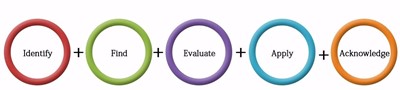
There are five standards and twenty-two performance indicators that focuses upon the needs of students in higher education at all levels.
the standards includes:
1.A person determines the nature and extent of the information needed.
The performance indicator for this is that:
i. An individual defines and articulates the need for information.
ii. The individual identifies a variety of types and formats of potential sources for information
iii.An individual considers the costs and benefits of acquiring the needed information.
iv. An individual reevaluates the nature and extent of the information need.
2. A person accesses needed information effectively and efficiently.
This is indicated by:
i. Individual selects the most appropriate investigative methods or information retrieval systems for accessing the needed information.
ii. An Individual constructs and implements effectively designed search strategies.
iii. An individual retrieves information online or in
person using a variety of methods.
iv.An individual refines the search strategy where necessary.
v. An individual records, and manages the information and its sources.
3.A person evaluates information and its sources critically and incorporates selected information into his or her knowledge base and value system.
This can be indicated by:
i. An individual summarizes the main ideas to be extracted
from the information gathered.
ii. An individual articulates and applies initial criteria for evaluating both the information and its sources.
iii. An individual synthesizes main ideas to construct new concepts.
iv. An individual compares new knowledge with prior knowledge to determine the value added, contradictions or other unique characteristics of the information.
v. An individual determines whether the new knowledge has an impact on the individual’s value system and takes steps to reconcile differences.
vi. An individual validates understanding and interpretation of the information through discourse with other individuals subject-area experts, and/or practitioners.
vii. An individual determines whether the initial query should be revised.
4. A person individually or as a member of a group uses information effectively to accomplish a specific purpose.
This can be indicated by:
i. The individual applies new and prior information to the planning and creation of a particular product or performance.
ii. The individual revises the development process for the product or performance.
ii. The individual communicates the product or performance effectively to others.
5. A person understands many of the economic, legal, and social issues surrounding the use of information and accesses and uses information ethically and legally.
This can be indicated by:
i. The individual understands many of the ethical, legal and socio-economic issues surrounding information and information technology.
ii. The individual follows laws, regulations, institutional
policies, and etiquette related to the access and use of information resources.
iii. The individual acknowledges the use of information
sources in communicating the product or performance.
Related topics
- How to study effectively
- Communication theory
- Communication models
- What is communication
- The art of listening
- Delivering a speech
- Conflict management
- team dynamics
- organizing a speech