
Introduction
Sets have some methods or procedures that can be applied on them hence producing different sets from two or more sets. The procedures we are calling operations on sets are what we are going to discuss in the topic. Among the operations we encounter includes:
- Union
- Intersection
- difference
- Cartesian Product
- practice problems to consolidate our learning
union of the two sets
when we operate union of set, we combine two sets to get the collection of objects that are in either set.

Union of set C = A ∪ B meaning C is the union of A and B.
C = A ∪ B means that the elements of C are exactly the elements which are either an element of A or an element of B or an element of both.
for example if A={7,11,13} and B={8, 13, 15}, then A ∪ B = {7, 8, 11,13,15}.
Intersection
C is the intersection of A and B, when the elements in C are precisely those both in A and in B. So Intersection operation is taking elements that are common on both sets.
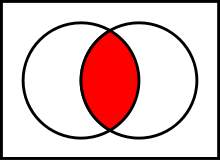
Intersection of set A and be will be given by C = A∩B.
if A = {7, 8, 13} and B = {8, 13, 14}, then A ∩ B = {8, 13}.
complement
complement of a set talks of all the elements which are not in a particular set.
if we say that B is the complement of A, we mean that B contains every element not contained in A and we write ; B=AC .
Universe in set context is the a given set in which we have some interest.
if our universe is {1, 2, 3, 4 ,5, 6,7 ,8 , 9, 10}, a set of counting numbers, and A = {2, 3, 5, 7}, then Ac = {1, 4, 6, 8, 9, 10}.
set difference
set difference between A and B is the set of all elements which are both elements of A and NOT elements of B; that is, A ∩ Bc .
set difference between A and B is written as A \ B.
hence A ∩ Bc = A \ B.
Example Question:
Let A ={1, 2, 3, 4, 5, 6}, B = {2, 4, 6}, C = {1, 2, 3} and D ={7, 8, 9}.
If the universe is U ={1, 2, 3, 4 ,5 , 6, 7, 8, 9, 10}, find:
- A ∪ B
- A ∩ B
- B ∩ C
- A ∩ D
- (B ∪ C)’
- A \ B
- (D ∩ C’)∪(A ∩ B)’
- ∅ ∪ C
- ∅ ∩ C
solution to the practice Problem
1. A ∪ B
solution algorithm
A= {1, 2, 3, 4, 5, 6}
B = {2, 4, 6}
as you can see, everything in A is already in B.
putting everything together in a union set:
A ∪ B = {1, 2, 2, 3, 4, 4, 5, 6, 6}
Then remove the duplicates to get:
A ∪ B = {1, 2, 3, 4, 5, 6}
2. A ∩ B.
solution algorithm
A= {1, 2, 3, 4, 5, 6}
B = {2, 4, 6}
1 is only in A and not in B, hence drop it
drop 3 and 5 as they are not on both sets
or simply just pick an empty set { }
compare elements in each positions from both sets, if an element appears on both sets, add it to the new set. Hence the Intersection of the A and B will be given by:
A ∩ B ={2, 4, 6}
please note that the size of the new set made from intersection is the size of the smaller set.
3. B ∩ C
solution algorithm
B = {2, 4, 6}
C = {1, 2, 3}
only 2 that appears on both sets, hence B ∩ C = {2}
4. A ∩ D.
solution algorithm
A ={1, 2, 3, 4, 5, 6}
D ={7, 8, 9}
starts with an empty set made from A and D such that A ∩ D ={ }
comparing each item on both sets, there is nothing common hence our new set A ∩ D remains empty and we conclude that A ∩ D =∅ (empty set).
5. (B ∪ C)’.
solution algorithm
we first determine B ∪ C then find it’s complement.
B = {2, 4, 6},
C = {1, 2, 3}
combining the two sets; then B ∪ C = {1, 2, 2, 3, 4, 6}
then removing duplicated elements: B ∪ C = {1,2, 3, 4, 6}
The complement of B ∪ C is everything in the universal set that is not in B ∪ C .
in other word; (B ∪ C )c = U- (B ∪ C )
U ={1, 2, 3, 4 ,5 , 6, 7, 8, 9, 10}
U- (B ∪ C )={1, 2, 3, 4 ,5 , 6, 7, 8, 9, 10} – {1,2, 3, 4, 5, 6} = {5, 7, 8, 9, 10}
hence (B ∪ C )c = {7, 8, 9, 10}
6. A \ B
solution algorithm
A ={1, 2, 3, 4, 5, 6}
B = {2, 4, 6}
A\B means or the sets in A but not in B. In other words A \B = A ∩ Bc
Bc = U -B ={1, 2, 3, 4 ,5 , 6, 7, 8, 9, 10} – {2, 4, 6}={1, 3, 5, 7, 8, 9, 10}
A ={1, 2, 3, 4, 5, 6}
Bc ={1, 3, 5, 7, 8, 9, 10}
picking all elements common in both A and Bc :
A ∩ Bc ={1, 3, 5}
Alternatively solution:
A \ B = {1, 2, 3, 4, 5, 6} – {2, 4, 6} ={1, 3, 5}
7. (D ∩ C’)∪(A ∩ B)’
solution algorithm
A ={1, 2, 3, 4, 5, 6}
B = {2, 4, 6}
C = {1, 2, 3}
D ={7, 8, 9}
U ={1, 2, 3, 4 ,5 , 6, 7, 8, 9, 10}
C’ = U – C = {1, 2, 3, 4 ,5 , 6, 7, 8, 9, 10} –
C’ = U – C = {1, 2, 3, 4 ,5 , 6, 7, 8, 9, 10} – {1, 2, 3} = {4 ,5 , 6, 7, 8, 9, 10}
D ={7, 8, 9}
C’ = {4 ,5 , 6, 7, 8, 9, 10}
(D ∩ C’) = {7, 8, 9}
A ={1, 2, 3, 4, 5, 6}
B = {2, 4, 6}
A ∩ B = {2, 4, 6}
(A ∩ B)’ = {1, 2, 3, 4 ,5 , 6, 7, 8, 9, 10} – {2, 4, 6} = {1, 3, 5, 7, 8, 9, 10}
hence (D ∩ C’)∪(A ∩ B)’ = {1, 3, 5, 7, 8, 9, 10}
8. ∅ ∪ C
solution algorithm
∅ = { }
C = {1, 2, 3}
∅ ∪ C = { ,1, 2, 3}={1, 2, 3} =C
hence ∅ ∪ C =C
9. ∅ ∩ C
solution algorithm
∅ = { }
C = {1, 2, 3}
The only common thing between the two is the NULL value, hence
∅ ∩ C = ∅