Tag: science

  •  Electrostatics 1

     Electrostatics is a branch of physics that deals with behavior and properties of charges that are not flowing. When materials are subjected to mechanical friction force against other materials, the electrons near the surface jump out from one material and become lodged to the other material. In other word, when materials rub each other, electrons are transferred. The transfer of electrons is what is referred as charging of the material.

    Materials are made from matter and matter is made of atoms. Atoms are considered to be very tiny particles whose size is in the order of 0.1 nanometers and that cannot be divided further. Atom is considered as the blue print of every matter whether it is a gas, liquid or solid. They are the basic structures that are joined together to make molecules that composes matter.

    Structure of an atom

    Atom is made up of two parts, a central core called nucleus and outer orbits where electrons goes around the nucleus. The nucleus contains particles called protons and neutrons closely and tightly packed inside.

    Protons carries a positive charge whereas electrons carries negative charges. Neutrons carries no charge.

    structure of an atom

    The number of protons and electrons in an atom are equal in number such that the resultant charge is zero. This is because there are equal number of positive charge as there are negative charge so that they cancel out each other making the overall charge in an atom to be zero.

    Causes of electrostatics charging

    In some materials , electrons are not tightly bound to the nucleus and so when given some little energy, they tend to jump out of the atom. When two materials are rubbed against each other, the heat energy developed due to friction may cause some loosely held electrons from one material to move and be transferred to the other material. Some materials easily losses electrons whereas others readily accepts electrons during friction.

    Materials that losses electrons are said to be positively charged because they have overall more positively charged protons compared to electrons.

    Materials that gains electrons are said to be negatively charged because they have overall more negatively charged electrons as compared to the protons. As an example, when polythene is rubbed against flannel clothe, it gains electrons and becomes negatively charged . Consequently, flannel clothe becomes positively charged because it looses some of its negatively charged electrons to polythene.

    Glass will loose electrons to silk when they are rubbed together making the glass to gain positive charge and silk to be negatively charged.

    The following has been observed when materials have been charged by friction.

    • Excess negative charge on one body is equal to excess of positive charge on the other body and so no new charges is ever created. charges are never created, they are only transferred.
    • Some materials will always acquire they same type of charge during charging and so it will be possible to predict the charges on materials after you rub them together.
    • The quantity of charge in some cases maybe small and in some cases charges will escape before they are detected. When charging by friction, the idea environment is a dry atmosphere and clean charging bodies to avoid discharge.

    Some Experiments to explain electrostatic charges

    Take a polythene strip and rub it against silk and then take the strip near a thin stream of flowing tap water as shown:

    When a charged strip is brought near a thin stream of water, the of water is strongly attracted to the polythene as shown.

    when a plastic comb, pen or plastic ruler is rubbed against your clothe or hair, it is observed to attract small pieces of paper as shown.

    A household mirrors and windows attract dust and other particles when wiped with a dry clothe because of electrostatic charges.

    All the above observations are as a result of electrostatic charges.

    There are two types of charges namely negative and positive charges. The SI unit of charge is the coulomb(c).

    • 1 Coulomb = 1000 millicoulombs
    • 1 millicoulombs = 1000 microcoulombs
    • 1 coulomb = 1000 000 microcoulombs

    Related topics

  • Cause of Upthrust

    Cause of Upthrust

    Consider a cylindrical solid of cross-section area A which is totally immersed in a fluid of density ρ as shown.

    The pressure due to liquid column is usually given by P=ρgh.

    Pressure at the top of the solid will be given by, PT = h1ρg.

    Where h1 is the height of the liquid column above the top of the object.

    Pressure at the lower end of the object will be given by

    Pb=h2ρg where h2 is the height of the liquid above the lover surface of the cylinder .

    The pressure at the top of the cylinder will provide downward force exerted by the liquid up on the object.

    From the pressure laws, F=pressure P x Area A.

    i.e F=PA.

    Taking the area of the cylinder at the top, the force from the liquid acting on that surface is Given by F=PT x A=h1ρgA.

    Similarly, pressure at the bottom is given as F=PB x A=h2ρgA.

    The total resultant upwardward force F is this given as

    F=F2-F1

    Hence F=h2ρgA-h1ρgA

    Factoring out the common factors: F=ρgA (h2-h1)

    Let h be the difference between liquid column on top and the one at bottom h2 such that h=h2-h1

    Hence F=ρgAh

    But Volume is always given by V=Ah

    The resultant force F is the upthrust force U and will thus be expressed as.

    F=U=Aρpg=pgV

    where V is the volume of the liquid displaced.

    Mass of the liquid is usually given by density x volume. Hence mass m of liquid displaced will be given by m=Ahρ

    Weight is usually given as Weight W=mg

    Hence weight of liquid displaced will be W=U=Ahρg which represents the upthrust force we calculated earlier. This confirms the archimedes principle that upthrust force is equal to the weight of the fluid it displaces.

    From our mathematical arguments, it should be easy to see that Magnitude of the upthrust force is equal a function of volume of the object and density of the liquid considering that gravitational pull g is a constant.

    Related topics


  • Longitudes and latitudes

    Longitudes and latitudes

    Latitude and longitude are lines used to locate locations on planet earth.

    The GreenWich Meridian

    It is a historic prime meridian or the Greenwich meridian used as a geographical reference line that passes through the Royal Observatory, Greenwich, in London, England and that passes from south to north pole of the earth.

    The greenwich Meridian divides the earth into equal parts.

    Because the earth is considered to be a circular sphere for the purpose of most of scientific studies, Greenwich Meridian is considered to pass through the center of the spherical earth dividing it into two hemispheres.

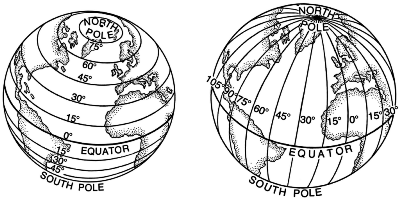
    See the illustrations below:

    illustrating the greenwich meridian division of the globe

    Axis of the Earth

    The axis of Earth is the imaginary line that is imagined to run from North Pole to South Pole through the center of the earth and believed
    to be the line at which the earth rotate. It is imagined as the support the earth will have so that it is able to rotate at the 24 hours rotation
    making one part face the sun and the earth be dark after every 12 hours.

    The figure below illustrates the earth’s axis.

    Illustrating an earth’s axis

    The line running on the Equator is usually referred to as the great circle because all the other circles besides it, to the right or left are smaller than it and are referred to as small circles. We are referring the lines as circles because they goes around the globe.

    Note that the circles reduces in diameter as one moves from the equator towards the North or towards the South pole.

    The Equator divides the circle into two hemispheres.

    The equator is a circle perpendicular to axis of a spheroid, such as Earth, and dividing such a spheroid into two equal halves mostly refered to as north and south hemisphere.

    see the illustrations below:

    Illustrating equator on a globe

    On Earth surface, the Equator is an imaginary line located at center of the earth and running from east to west and estimated to be about 40,075 km (24,901 mi) in length around the earth and lying halfway between the North and South poles.
    The term equator can also be used for any other celestial body that is roughly spherical meaning we can find an equator in other planets of the universe and other bodies like moon.

    In the sphere below, we illustrate an equator AB that divides the sphere into two equal parts. The circles on the south and the north of AB are both small circles and there are many circles that are drawn on either side of the equator AB known as the Latitudes.

    Illustrating and equator line on a sphere

    Unlike the horizontal lines parallel to AB that changes in diameter relative to their distance from the equator; we have other lines that runs from south to north and each one of them have equal circumference and each one of them divides the globe into two equal parts. Because they are all equal in length and are greater than the equator, they are all regarded as great circles.

    In the figure below, the lines are drawn that are parallel to PQ each one of them dividing the sphere into two. The radius R of each of the great circles is also the radius of the sphere.

    Illustrating great circles

    Related Topics


  • Density of some substances

    Density of some substances

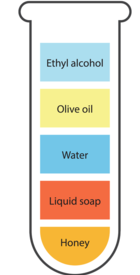
    The table below shows density of some common substances.

    Please note that density of water being 1.0gcm-3 can be used as a relative density to compare densities of other substances. For example , density of gold is 19.3 times that of water.


    Related Topics

  • Explaining upthrust force

    Explaining upthrust force

    Objects will weigh less in water than in air.

    Take a spring balance and hang some mass on it. Determine the weight of the mass and then push the mass up slightly with your hand. What have u observed?

    When you place some upward force on a mass hanging on the spring, it’s weight is seemed to reduce as observed by lesser leading of the spring balance.

    When you apply a force upward on the object hanging on a spring balance, you are providing some force that is acting opposite to the weight of the object. Weight is always acting downward on a straight line that is directed towards the center of the earth.

    When you push the object upward, you are reduce the overall resultant downward force by providing some force acting opposite to the weight.

    From the law of addition of forces, when two forces are acting in opposite direction on the same object, then one force is considered positive force and the other one taken as negative force . The total resultant force acting on the object is the algebraic sum of the forces acting on that object Consider the setup below that shows some weight acting on an object hanging freely on air.

    Spring balance measuring some weight

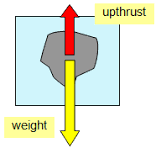
    We consider the force acting on the object which is it’s weight as W and any force applied upward as U as shown.

    Illustrating forces acting on an object hanging on air

    The resultant force will be given as W’=W-U. Where W’ represents the reduced weight.

    If U is greater than W’, then the object will accelerates upward, otherwise it will accelerates downward with reduced force.

    The downward acceleration force is balancing with tensional forces on the spring causing some extension, hence the object remains on the spring balance but causing it to extend in length.

    Upthrust Force

    When an object is immersed in a fluid, the upward forces on the object are provided by pressure in the fluid. That is why objects weighs less in water because some weight of the object is being cancelled out by the upward forces in water. This upward forces produced by fluid on an object is known as the upthrust force. It is the same force that causes object to float in water.

    Illustrating upthrust force,

    However, it is important to note that, for heavier objects falling in air, the upthrust by air is soo small such that it cannot be notices. We say that upthrust of air on an object is negligible.

    Paper and Stone

    If you release a piece of paper and a stone from some distance above the ground, you will notice that the stone reaches the ground faster than the paper. This is because upthrust force on paper is comparable to that of paper, because a piece of paper has very small weight. However, the stone weight is much more than the upthrust that can be provided by paper hence the total resultant downward forces is larger than that of paper hence causing more acceleration downward.

    Later on, we will see that upthrust fall is a characteristic of both volume of the object and density of the fluid.

    Related topics


  • Rates

    Rates

    Rates are mathematical expressions that shows the relationship between two quantities. It shows how changes of one value is causing change to another variable.

    A common examples of rates is when growth is compared with time. Time is an important factor when determining rates. For example when we compare rate of growth of a population over a number of years we are comparing number of people that has been added to the population over a certain period of time, maybe six months or one year, probably through birth or immigration.

    A business can determine rate of increase of it’s sales by determine the number of sales across given periods of time like months or years.

    Another example of rate is speed that determines how object changes it’s distance from point where it started it’s motion to the change of time.

    Example

    Calculate the rate of change of flow of oil in a pipeline per minute if an 800000 litres storage tank was filled in 4 hours 10mins.

    Solution

    The number of minutes in 4 hours and 10mins is (4*60)+10 =250mins.

    Rate of flow = numbers of liters flowed/ time taken in minutes

    Rate of flow=800000/250 hence

    Rate of flow= 3200 liters per min

    which we can also write as 3200litres/min.

    Note:

    The above rate of flow could also be expressed in terms of litres per hour where in that case the number of hours will be 4(1/6) hours which can also be expressed as 25/6 hours.

    Hence rate of flow in hours will be:

    800000liters/(25/6) hours

    Which will be (800000/25)*6 and hence rate of flow=192000liters/hour

    Related topics


  • Some Trigonometric Ratios

    Some Trigonometric Ratios

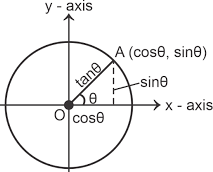
    Consider a right-angled triangle ABC below.

    The angle θ can be expressed in terms of cosine ratio or sine ratio. The hypotenuse of the triangle has dimension r.

    Adjacent side to angle θ is the line AB and the opposite side to the angle θ  is line BC.

    expressing angle θ  in terms of cosine ratio and sin ratio:

    by use of Pythagoras theorem:

    (AB)2 + (BC)2 = r2

    (rcosθ)2 + (rcosθ)2 = r2 and hence

    r2 cos2 θ + r2 sin2 θ  = r2

    then dividing everywhere by r2 , then we get

    cos2 θ + sin2 θ  =1 which is a trigonometric identity which holds true for all values of  θ.

    Example

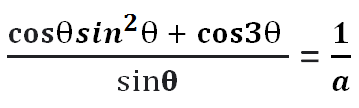
    If tan θ = a, show that:

    solution

    we factor out cosθ to get:

    but sin2 θ + cos2 θ  =1

    hence:

    but tanθ = a, so 1/tanθ = 1/a

    Related Topics


  • Using tangents in Solving Triangles

    Using tangents in Solving Triangles

    if you know the tangent ratio of a given angle, you already know that the ratio is a result of dividing opposite side over tangent. If you know the length of one side, the you can get the other.

    let us say there exits an angle θ that has a tan ratio of 0.821 and the side opposite to it is 8.5 cm. Then the adjacent side can be obtained as follow:

    Example

    Find the length BC in the figure below:

    solution

    The side BC is the opposite side and line AB which is the adjacent side to angle  θ which is equal to  70o is equal to 25cm. Then we proceeds as follows:

    Exercise Questions

    Use tangents to find the lengths of the side marked x in the below tri-angles.

    Q1: Find the unknown side in each of the following

    (a)

    (b)

    Q2: Find the unknown angle θ,α in each of the following triangle

    (a)

    (b)

    Related Posts


  • Characteristics of Wave Motion

    Characteristics of Wave Motion

    The characteristics of a wave motion can be explained with reference to the oscillatory motion of mass attached to a spring or by use of a bob on a swinging pendulum.

    The figure below shows a mass that is attached to a spring and one end and fixed on the other end as shown

    illustrating mass oscillating on a spring
    illustrating mass oscillating on a spring

    Initially, the mass is at rest at the end of the spiral spring at position M. The mass is then depressed slightly to position L and released and is then observed that it oscillates up and down about the mean position M.

    One complete oscillation occurs when the mass moves through positions N-M-L-M-N. That is, it makes one complete oscillation when it has returned to it’s starting position and is moving in the same direction. For example if the mass starts at M the move to M-N-M, it will not have moved a complete oscillation because although it has returned to it’s starting position, it is moving in the opposite direction.

    Consider a swing pendulum shown below

    illustrating swinging pendulum
    illustrating swinging pendulum

    For the pendulum, the bob makes a complete oscillation when after an initial displacement from position X, the pendulum swings through position X-Y-Z-Y-X. If the mass in the above diagram takes two seconds to make a complete oscillation, a sketch of it’s time-displacement graph for the motion will be as shown below.

    Displacement time graph for a swinging pendulum
    Displacement time graph for a swinging pendulum

    As can be seen from the above diagram, the displacement time graph for an oscillatory motion is a sine curve similar to the transverse wave profile.

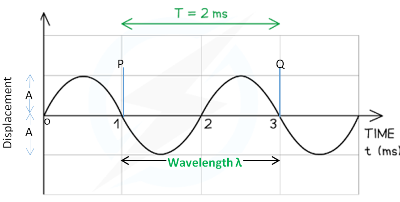
    To describe the general characteristics of a wave motion, consider the motion-time graph representing a certain wave motion as shown below

    To illustrate wave characteristics

    The Displacement value A shows the maximum displacement A from the mean position o.

    P and Q are said to be points in phase because the wave pattern is repeating itself at Q and P.

    The distance between two points in phase is called the wavelength λ. The distance between P and Q represents on wavelength.

    The wave starts repeating itself at P before repeating itself again at Q. Hence when the wave moves from P to Q, it is said to make one complete oscillation.

    The time taken to complete one oscillation is known as the Periodic time T. In the motion-time graph above, the periodic time is two milliseconds(ms) as it has taken 2ms to make one complete oscillation.

    Two points in a wave are said to be in phase, if they are in the same position, relative to the wave profile. P and Q are in phase.

    The number of oscillations that can be made by a wave motion in one second is called the frequency f of the wave and is usually the reciprocal of the periodic time.

    from the above diagram, it takes 2ms to make one complete revolution which is equivalent to (2/1000)s = 0.002 Seconds.

    The frequency of the wave can then be determined as follow:

    It can be shown that:

    Where T is the periodic time and f the frequency of a given wave

    Related Topics