Angle θ is sitted on line AB and it faces line BC. AB makes a right angle with BC.
AB is refered as the adjacent side of Angle θ because the θ lies on it.
Side BC is known as the opposite side of angle θ because θ directly faces it.
In the figure shown above, BC=8.70cm and Ab=9.90cm.
I introduce a new line DE, FG, ,IJ, KL and MN all parallel to BC shown.
The ratio BC/AB = 8.70cm/9.8cm = 0.8876 to 4 decimal places.
similarly the ratio DE/AE = 7.2cm/8.2cm = 0.8780
FG/AG = 5.6cm/6.3cm = 0.8888
IJ/AJ = 4.0cm/4.6cm = 0.8696
KL/AL = 2.7/3.1 = 0.8710
MN/AN = 1.7/1.90 = 0.8947
As can be seen, all the ratios of opposite sides over the adjacent sides is approaching a constant value an all will be 0.9 when rounded to 1 decimal places. Further investigation of ratios of opposite sides versus adjacent sides reveals that such a ratio gives a constant value for a given angle. Such constant value is the tangent of that angle θ and is referred to as the tangent of angle θ usually denoted as tan θ .
By definition, the tangent of a given angle is the ratio of the opposite side to the adjacent side. That is:
and in short form:
Exercise
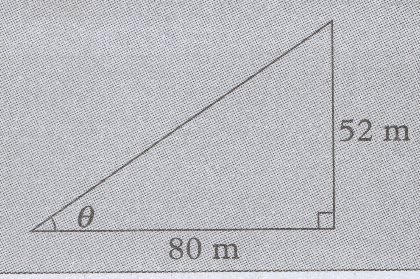
Express tan θ as a fraction in the figure below
Solution
practice question
Study the triangle below an express the angle θ as a tan ratio leaving your answer as a fraction.
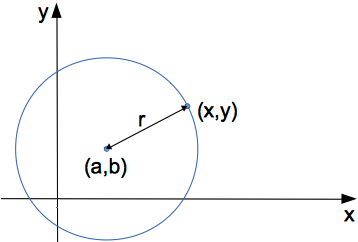
Consider a circle of radius r on a Cartesian plane centered at point o(a,b) as shown in figure below. A point p on the circumference of the circle has an arbitrary point (x, y).
line OQ an QP makes a right angle triangle with the radius r of the circle such OP=r, OQ = x-a and QP=y-b.
using Pythagoras’ theorem: (x-a)2 + (y-b)2 = r2.
Hence the general equation of a circle is given as:
(x-a)2 + (y-b)2 = r2.
where:
r is the radius of the circle
(a, b) are the coordinates at the center of the circle
(x,y) is an arbitrary point on the circumference of the circle.
Example
Find the equation of a circle centered at (4, 5) and with radius of 3 units.
Density is mass of a substance contained it it’s unit volume.
Density is usually represented by rho (ρ)
The SI Unit of density is kilogram per cubic meter, that is; (kgm-3)
A common unit of density is grams per cubic centimeter (gcm-3) which is very common in day to day measurement of density.
Formula for density
we can use symbols alone to write expressions about density when solving problems involving density.
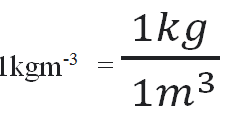
we should be able to convert densities expressed in Kilogram per cubic meter(kgm-3) into grams per cubic centimeter (gcm-3). In many cases, conversion from on unit of measurement to another is usually necessary. Let say we want to change 1kgm-3 into grams per cubic centimeter (gcm-3) . 1kgm-3 means that:
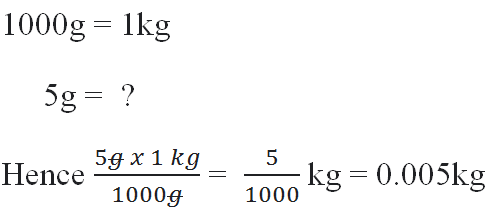
Now we convert 1 kg into grams remembering that, 1 kg =1000 grams and 1 cubic meter into cubic centimeters;
remembering that 1m3 = 1000000 cm3
hence 1 kgm-3 = 0.001 gcm-3
then dividing by 0.001 gcm-3 on both sides:
hence 1 gcm-3 is equivalent to 1000 kgm-3
Example
The density of a substance in a lab is expressed as 5g/cm3. Express it’s density in SI Unit.
solution
The SI unit of density is kilogram per cubic meter. We therefore change grams into kilograms and cubic centimeter into cubic meter.
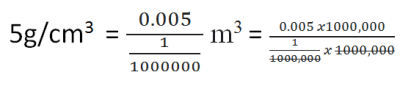
expressing density in terms of grams and cubic centimeters:
1 000,000 cm3 = 1 m3 hence :
hence
=5000 kgm-3
Practice Questions
A glass block measures 180mm by 80 mm by 20 mm. It’s mass is 280 g. Determine it’s density in SI Units
A certain metal has it’s density given as 1.9gcm-3. If 50000 kg of such metal was purchased by a company. what volume did it occupy?
According to oxford dictionary Advanced learner version; Science is knowledge about the structure and behavior of the natural and the physical world, based on facts you can prove for example by experiments.
Another definition from the same dictionary is that science is a system for organizing the knowledge about a particular subject, especially one concerned with aspects of human behavior or society.
According to Wikipedia; Science is a rigorous, systematic endeavor that builds and organizes knowledge in the form of testable explanations and predictions about the world.
Most of text books about science defines science as a set of methods or techniques used to gather systematic information about the world phenomena.
Questions we should ask ourselves when deciding whether psychology is a science may include:
Is psychology based on facts you can prove by experiments?
does psychology a body of knowledge that have structure and behavior of the natural world?
Is psychology a system of organized knowledge?
Are ideas in psychology testable?
can psychology be used to predict behavior?
does psychology have set of methods and techniques that are used to gather systematic data about a certain observation in the discipline?
If all this questions about psychology turns to be true, then psychology is not far from being a science.
Psychology scholars do agree that psychologists uses precise, methodical and systematic means of investigation to understand a phenomena. Psychologist do not rely on abstract untested theories but rather on testing, retesting again and again all the assertions and hypothesis before accepting them as correct and true principles of psychology.
Even though the methods of psychology are different from those of physics, biology or chemistry, the basic scientific demands of observations, experimentation, test and retesting when formulating hypothesis and theories is applied in studies and research related to psychology.
Even though psychology sometimes begins with common sense, it is mostly based on observations and use of scientific methods where psychologists tests hypothesis which are speculations about how the world behaves.
Hypothesis comes from different places among them social cultural practices, social norms and common sense.
In psychology, a research program tests many hypothesis confirming some to be true and disproving others as false.
Psychology as a discipline has been developed over time by application of scientific methods from the time it emerged around 1879 when Wilhelm Wundt opened the first psychological laboratory at the university of Leipzig in Germany.
Characteristics of science
Have formal methods which are systematic procedures used to collect data.
Involves accumulation of facts and generalizations
theories are used to organize observations.
Should have ability to predict and control phenomena based on gathered documented information.
conclusion
Psychology meets most of the requirements to be a science. In psychology, there are thousands of empirical articles that shows observations of facts.Methods of psychology includes experiments, observations, data analysis, study of documented facts and formulation of hypothesis among other methods.
Liquids takes the shapes of the container but have fixed volume. Hence apparatus has been devices to measure conveniently and precisely volume of a liquid.
This article describes the idea behind calibration of measuring cylinders and discuss some important apparatus used to measure volume. They apparatus includes:
Measuring Cylinder
Volumetric flasks
beakers
pipettes
burettes
user customized apparatus
Introduction
liquids have no definite shape but assumes the shape of the containers in which they are put in.
One of the methods that can be used to measure volume of a liquid is to pour the liquid into a container of uniform cross-section as shown in figure below.
The volume of the liquid is obtained from the formula:
Volume = cross-section area x height
i.e V = Ah
For the diagram above, area of the cross-section is given as l x b.
This is because the cross-section area of the prism is a rectangle.
Considering the space occupied by the liquid in the container as having shape of a rectangular prism, The volume of the liquid can thus be determined.
using the above diagram, the volume of the liquid in the container = l x b x h=lbh
Relationship between volume and height a liquid
if area of a container is not changing, then increase in volume of the liquid will be reflected in the increase of height of the liquid column.
In the following, we investigate the change how change of liquid height is affected by volume.
Apparatus
Rectangular container
A cylinder
procedure
Take two containers. P with a rectangular base and Q with a cylindrical base.
Container Q is uniformly calibrated as in figure below
pour some water into P and find it’s volume V.
Transfer the water from P to Q and record the height h of water in Q.
Repeat the above procedures for different values of V and record corresponding values of h as in the table below.
Volume V(cm3)
150
200
300
400
500
600
800
height h(cm)
0.97
1.30
1.95
2.60
2.35
3.90
5.20
(v/h)cm2
154.64
153.84
153.85
153.85
153.85
153.85
153.85
a table for Volume against height of a liquid in a uniform container
Draw the graph of V against h
In practice,measuring vessels are made of cylindrical form that have its height calibrated uniformly so that each level of height represents the volume putting in mind that the bottom surface area is fixed and cannot change.
Increase in height shows increase in volume and so the volume that is represented by a particular height can be conveniently indicated on each level of height so that it can always be read off directly without using the formula; V=BaseAarea X height.
Measuring Instruments marked as described above are called measuring cylinders and are commonly used in measuring liquid volumes.
Measuring cylinders are usually made of glass or transparent plastic and graduated incm3 or milliliters(ml).
Measuring cylinders of various capacities
other instruments that can be used to measure volumes includes:
Measuring flasks
pipettes
burettes
beakers
Measuring flasks
Also known as volumetric flasks.
It is commonly used in laboratories to transfer known volumes of liquids.
A volumetric flask is usually calibrated to contain a precise volume at a certain temperature and are used for precise dilutions and preparation of standard solutions. These flasks are usually pear-shaped, with a flat bottom, and made of glass or plastic.
Measuring flask of capacity 500ml with some chemical solution.
pipettes
A pipette is usually used to transport a measured volume of liquid.
It’s name comes from the word pipe because it has a pipe like shape. Mostly it transfers liquids of less than 250ml in volume.
a bulb-type pipette
Burettes
A burette is a long graduated glass tube with a tap at lower end and of a fixed capacity with a tapered capillary tube at the tap’s outlet. Typical burettes ranges from 50ml to 500ml in capacity. stop-cock valve controls the flow of liquid from the burette so that a precise amount of liquid is fetched at any given moment.
An illustration of a burette
The scale of a burette starts from zero at the top and increases downward to the maximum value.
In the diagram above, volume marking markings reads 20ml. This means 20ml of the liquid has been removed from the burette and so the volume left is (50-20)ml = 30ml.
Beaker
A beaker is a cylindrical container with flat bottom. It usually have a small spout (beak) to aid pouring. Beakers are of various capacities and the largest can carry several litres of liquid.
Unlike a volumetric flask, beaker have a straight curved surface as opposed to sloping sides.
Beakers are usually made of glass (borosilicate glass), but can also be in metal (stainless steel or aluminum) or certain plastics, notably polythene or polypropylene.
Beakers are common lab apparatus.
How to use a measuring cylinder and beaker
When reading volumes, the reading should be taken with the eye positioned with the bottom of meniscus as in figure below.
How to use a measuring cylinder
Conclusion
In this article, we have described various instruments used to measure volumes and highlighted their special features . We have described how to calibrated a measuring cylinder using principles of regular prism. we have discussed some apparatus like beaker,volumetric flasks,pipette and burettes.
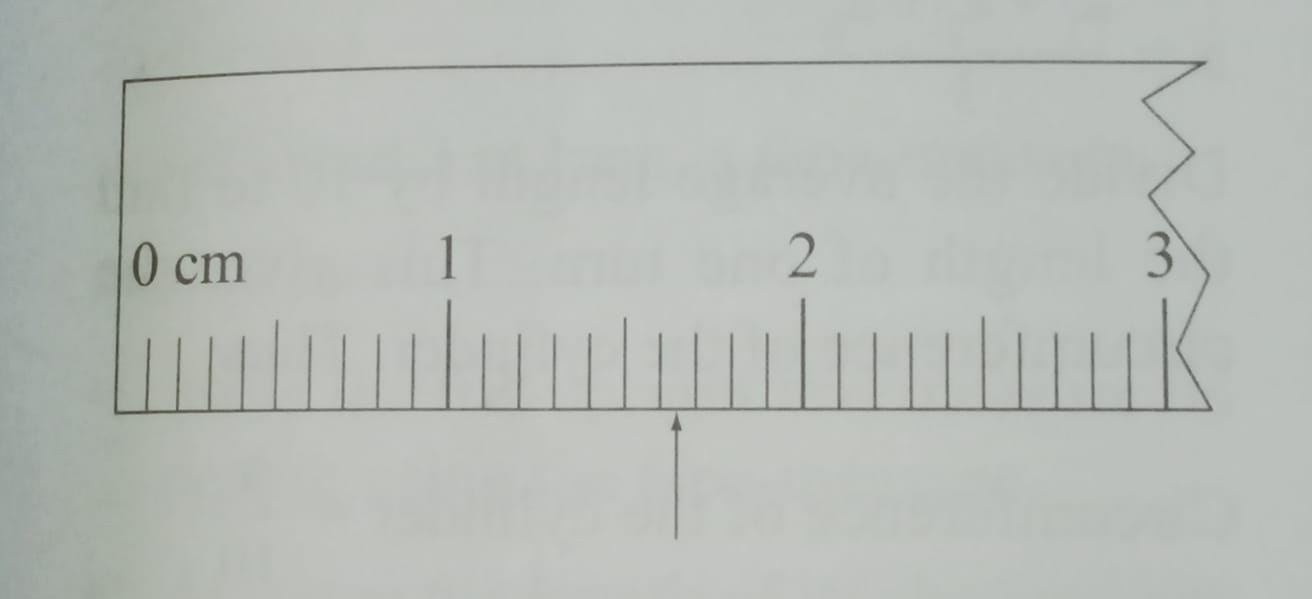
most of people don’t read metre rule correctly. A metre rule has 100cm and between two consecutive centimeter marks there are gaps. The gaps between centimeter marks can be reduced by dividing the gap into smaller sub units. When divided into 10 equal divisions, then each of such smaller division is called a millimeter because it will be dividing the metre length into 1000 divisions with each divisions being equal to 0.001m. Then the accuracy of the meter rule can be said to be equal to 1/1000 of a metre(0.001m). when the rule is calibrated into centimeter divisions alone, then the metre length is divided into 100 divisions with each divisions being equal to 0.01m. the accuracy of the measurements taken by such a rule is thus (1/100)m=0.01m).
consider the reading shown by the arrow in figure below.
demonstrating reading of a meter rule
The reading above is more than 1.6 cm but less than 1.7 cm. The position of our point object is not lying on exact reading. we cannot precisely state what measurement it is because it is not indicated. there is an empty gap and we need to approximate that extra length beyond the 1.6 cm because it is not indicated. We can increase the accuracy of the meter rule by dividing the gap into smaller divisions. suppose we approximate the second decimal to be 1.65 cm, there is nothing that prevents us from stating it as 1.66 cm,1.67 cm or even 1.64 cm.
The second decimal place cannot be accurately determined. Nevertheless, the readings from a meter rule may be written up to the second decimal place of a centimeter.
A reading like 2.584 cm cannot be taken by a metre rule. In later lessons, we will discuss how to increase the decimal places in measurement of length using other special instruments like micrometer screw-gauge.
If the readings of 3.6 cm and 7 cm are taken with a meter rule, then they should be written as 3.60 cm and 7.00 cm respectively. This is because a meter rule is calibrated to an accuracy of 0.01 m (100 divisions).
Practice Question
Record the readings indicated by P1,P2 and P3 shown in the figure below.
Answer to practice question
P1=69.50 cm (approximations done)
P2=71.00cm
p3=71.50cm
Practice Exercise
State the readings indicated by the arrows in the figures below
Contains information related to marketing campaigns of the user. These are shared with Google AdWords / Google Ads when the Google Ads and Google Analytics accounts are linked together.
90 days
__utma
ID used to identify users and sessions
2 years after last activity
__utmt
Used to monitor number of Google Analytics server requests
10 minutes
__utmb
Used to distinguish new sessions and visits. This cookie is set when the GA.js javascript library is loaded and there is no existing __utmb cookie. The cookie is updated every time data is sent to the Google Analytics server.
30 minutes after last activity
__utmc
Used only with old Urchin versions of Google Analytics and not with GA.js. Was used to distinguish between new sessions and visits at the end of a session.
End of session (browser)
__utmz
Contains information about the traffic source or campaign that directed user to the website. The cookie is set when the GA.js javascript is loaded and updated when data is sent to the Google Anaytics server
6 months after last activity
__utmv
Contains custom information set by the web developer via the _setCustomVar method in Google Analytics. This cookie is updated every time new data is sent to the Google Analytics server.
2 years after last activity
__utmx
Used to determine whether a user is included in an A / B or Multivariate test.
18 months
_ga
ID used to identify users
2 years
_gali
Used by Google Analytics to determine which links on a page are being clicked
30 seconds
_ga_
ID used to identify users
2 years
_gid
ID used to identify users for 24 hours after last activity
24 hours
_gat
Used to monitor number of Google Analytics server requests when using Google Tag Manager