
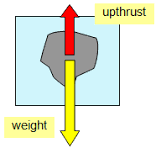
Objects will weigh less in water than in air.
Take a spring balance and hang some mass on it. Determine the weight of the mass and then push the mass up slightly with your hand. What have u observed?
When you place some upward force on a mass hanging on the spring, it’s weight is seemed to reduce as observed by lesser leading of the spring balance.
When you apply a force upward on the object hanging on a spring balance, you are providing some force that is acting opposite to the weight of the object. Weight is always acting downward on a straight line that is directed towards the center of the earth.
When you push the object upward, you are reduce the overall resultant downward force by providing some force acting opposite to the weight.
From the law of addition of forces, when two forces are acting in opposite direction on the same object, then one force is considered positive force and the other one taken as negative force . The total resultant force acting on the object is the algebraic sum of the forces acting on that object Consider the setup below that shows some weight acting on an object hanging freely on air.

We consider the force acting on the object which is it’s weight as W and any force applied upward as U as shown.

The resultant force will be given as W’=W-U. Where W’ represents the reduced weight.
If U is greater than W’, then the object will accelerates upward, otherwise it will accelerates downward with reduced force.
The downward acceleration force is balancing with tensional forces on the spring causing some extension, hence the object remains on the spring balance but causing it to extend in length.
Upthrust Force
When an object is immersed in a fluid, the upward forces on the object are provided by pressure in the fluid. That is why objects weighs less in water because some weight of the object is being cancelled out by the upward forces in water. This upward forces produced by fluid on an object is known as the upthrust force. It is the same force that causes object to float in water.

However, it is important to note that, for heavier objects falling in air, the upthrust by air is soo small such that it cannot be notices. We say that upthrust of air on an object is negligible.
Paper and Stone
If you release a piece of paper and a stone from some distance above the ground, you will notice that the stone reaches the ground faster than the paper. This is because upthrust force on paper is comparable to that of paper, because a piece of paper has very small weight. However, the stone weight is much more than the upthrust that can be provided by paper hence the total resultant downward forces is larger than that of paper hence causing more acceleration downward.
Later on, we will see that upthrust fall is a characteristic of both volume of the object and density of the fluid.