
Consider a triangle ABC shown below.

Angle θ is sitted on line AB and it faces line BC. AB makes a right angle with BC.
AB is refered as the adjacent side of Angle θ because the θ lies on it.
Side BC is known as the opposite side of angle θ because θ directly faces it.
In the figure shown above, BC=8.70cm and Ab=9.90cm.
I introduce a new line DE, FG, ,IJ, KL and MN all parallel to BC shown.

The ratio BC/AB = 8.70cm/9.8cm = 0.8876 to 4 decimal places.
similarly the ratio DE/AE = 7.2cm/8.2cm = 0.8780
FG/AG = 5.6cm/6.3cm = 0.8888
IJ/AJ = 4.0cm/4.6cm = 0.8696
KL/AL = 2.7/3.1 = 0.8710
MN/AN = 1.7/1.90 = 0.8947
As can be seen, all the ratios of opposite sides over the adjacent sides is approaching a constant value an all will be 0.9 when rounded to 1 decimal places. Further investigation of ratios of opposite sides versus adjacent sides reveals that such a ratio gives a constant value for a given angle. Such constant value is the tangent of that angle θ and is referred to as the tangent of angle θ usually denoted as tan θ .
By definition, the tangent of a given angle is the ratio of the opposite side to the adjacent side. That is:

and in short form:

Exercise
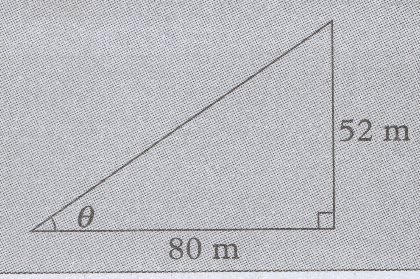
Express tan θ as a fraction in the figure below

Solution

practice question
Study the triangle below an express the angle θ as a tan ratio leaving your answer as a fraction.


