Category: mathematics

  • Probability

    Probability refers to the likelihood or chance of an event occurring. It is a measure of uncertainty and is typically represented as a number between 0 and 1, where 0 indicates impossibility (an event will not occur) and 1 indicates certainty (an event will occur). The higher the probability of an event, the more likely it is to happen.

    Types of probabilities include:

    Classical Probability:- Classical probability is based on equally likely outcomes in a sample space. It assumes that each outcome has the same chance of occurring.

    Empirical Probability:-Empirical probability is based on observed data or experiments. It involves collecting data and calculating the relative frequency of an event occurring.

    Subjective Probability:-Subjective probability is based on personal judgment or beliefs about the likelihood of an event occurring. It does not rely on historical data or mathematical calculations but rather on an individual’s opinions, experiences, or intuition.

    Conditional Probability:-Conditional probability measures the likelihood of an event occurring given that another event has already occurred. It is denoted by 𝑃(𝐴∣𝐵)P(AB), where 𝐴A is the event of interest and 𝐵B is the condition. For example, the probability of drawing a red card from a deck of cards given that a card drawn was a face card would be a conditional probability.

    Joint Probability:-Joint probability refers to the probability of two or more events occurring simultaneously. It is denoted by 𝑃(𝐴∩𝐵)P(AB), where 𝐴A and 𝐵B are the events of interest. For example, the joint probability of rolling a 3 on a fair six-sided die and flipping a coin and getting heads would be a joint probability.

    Marginal Probability:-Marginal probability refers to the probability of a single event occurring without considering any other events. It is obtained by summing or averaging over all possible outcomes of the other events. For example, the marginal probability of rolling an even number on a fair six-sided die would consider all possible outcomes that result in an even number (2, 4, or 6).


    Related topics


  • Distance along a small circle

    small circle

    All latitudes except the equator are small circles. The path joining two points on the same latitude forms an arc of the circle of that latitude.

    The radius r of a latitude is given by r=R cos θ where θ is the angle of latitude.

    Along the small circle defined by θoN or θoS, an arc of length 60 cos θ nm subtends an angle of 1o at the center of that latitude. That is;

    1o = 60 cos θ nm on a latitude θoN or θoS. Also note that 1 nm = 1.853 km.

    Consider two positions on the surface of the earth illustrated below.

    The distance AB will be given by AB = (x/360)o x 2𝝅r= (x/360)o x 2𝝅R Cos θ .

    that is; r = Rcosθ

    θ is the angle of latitude and x is the value of angle difference between the longitude of the two points A and B.

    Exercise

    Find the distance between the following pair of points in km given that 𝝅 = 22/7 and R = 6370 km.

    (a) R(70oS, 35oW), S(70oS, 80oE)

    (b) R(14oN, 100oE), S(14oN, 10oE)

    Related Topics

  • Distance along a great circle

    The path between two points A and B on a great circle is an arc of the circle.

    The arc of a circle is given by l= /360) x 2πr where r is radius of the circle from where the arc is cut from and θ is angle between the two radii that encloses the circle.

    Considering a great circle to be circular around the earth, arc of any length made by point A and B on that circle will be given by /360) x 2πR where θ is the angle subtended by the arc AB at the Centre of the earth and R is radius of the earth.

    Great circles are all the longitudes and the equator.

    The distance between two points along any great circle is either measured in Kilometers(km) or in nautical miles(nm). A nautical mile is the length of an arc subtending and angle of 1/60 of a degree (1/60)o or 1 minute (1′) at the center of a great circle. see the figure below;

    in other words; 1o = 60 nm along a great circle.

    Consider the figure below:

    The arc length of AB=60 x θ nm.

    Example

    Find the distance between the following points in (i) km (ii)nm

    (a) A(65oN, 15oE) and B(20oN, 15oE)

    (b) A(65oN, 15oE) and B(50oS, 15oE)

    (c) A(0oN, 58oE) and B(0oN, 12oE)

    Solution

    we represent solution of (a) and (b) by sketching the points as in diagram below

    (a) The angle subscribed by the arc AB along the longitude 15oE is given by θ = 65o-20o=45o.

    (i) length AB = (θ/360) x 2πR km = (45/360)x 2 x 22/7 x 6370 = 5003.635km

    (ii) arc length in nm = 60 x θ nm hence length AB= 60 x 45 nm = 2700 nm

    (b) (i) The arc AC subtends angle 115o = 65o+50o at the center of the earth. The arc length is therefore (115/350) x 2 x 22/7 x 6370 = 12.787.06 km

    b(ii) length of AC in nm = 60 x 115 nm = 6900 nm

    (c) point D and E are on the equator which is a great circle as shown.

    The arc DE subtends angle θ = 58o -12o = 36o at the center of the earth.

    (i) Length of DE = (θ/360) x 2πR = (36/360) x 2 x 22/7 x 6370 = 4 002.91 km

    (ii) DE in nm = 60 x 36 nm = 2760 nm

    Example 2

    An plane flew south from A(60oN, 45oE) to a point B. The distance covered by the plane was 8000 km. Determine the position of B taking π as 22/7.

    solution

    The relative position of position A and B cab be represented in the following sketch.

    Let the latitude difference between A and B = θ

    the length AB = (θ/360) x 2 x 22/7 x 6370 =8000

    θ = (800 x 2520)/(44 x 6370 = 71.93o

    Latitude of B = 71.93o – 60o

    hence the position of B = B(11.93oS, 45oE)

    Related Topics


  • Positions on earth’s surface

    In two dimensional Cartesian coordinate system, the position of a point is given by the intersection of x and y-coordinates. Similarly, the position of a point on the earth’s surface is given by the intersection of a latitude and a longitude. The position of any place on the earth surface is describe using the latitude and longitude on which it lies and is expressed in the form P(latitude, longitude).

    Note that the latitude is stated first and then the longitude.

    Example

    Consider the diagram below and state the positions of points A, B, C, D, E, F, G, H and I

    Solutions

    A(0o,20oE)

    B(75oS, 20o E)

    C(75oS, 0o)

    D(0o, 0o)

    E(61oN, 0o)

    F(61oN,20oE)

    G(61oN, 50oE)

    H(0o, 50oE)

    The longitude of I and J is directly opposite the longitude 50oE. They make a full circle thus the longitude SIJN is 180o-50o = 130o .

    I(75oS, 130oW)

    J(61oN, 130oW)

    Related topics


  • Fundamental Theorem of Calculus Examples and Solutions

    Fundamental Theorem of Calculus Examples and Solutions

    Suppose that f is continuous at a closed interval [a,b]

    if the function F is defined on a closed interval [a, b] by

    where a is a real number, Then F is the anti-derivative of f. in other words, F'(x) = f(x)

    consider the relationships:

    then

    f(x) = x2 and

    Note: We use the dummy variable (t) in the integrand to avoid confusion with the upper limit x.

    Sometimes the fundamental theorem of calculus is interpreted to mean that:

    differentiation and integration are inverse processes to each other.

    It follows that:

    The fundamental theorem of calculus states that:

    In other words, the fundamental theorem of calculus argues that differentiation cancels the effect of intergration of continous f(x’).

    in short:

    For example

    Example problem1

    Use the fundamental theorem of calculus to find derivative of the following functions

    (a)

    solution
    Example problem2

    (b)

    solution to problem 2
    Example problem 3

    Find h'(x) given that :

    solution

    let y=h(x) and u=x2 and hence:

    since u=x2;

    and therefore:

    By use of chain rule:

    which implies u3sinu(2x) = (x2)3sin(x2)2x resulting to:

    =2x7sin(x2)

    Example problem 4

    Consider the expression below, we exchange the limits in the intergral and then change the sign from positive to negative before using the fundamental theorem to solve it.

    Example

    We exchange limits and so the sign of the integral so that the upper limit is the valuable x.

    Example problem 6

    Use the fundamental theorem of calculus to solve:

    Solution

    splitting the integral about point zero we have:

    and then exchanging limits in the first intergral;

    let u=-x; first part of the expression above becomes;

    from laws of differentiation du/dx=-1 and using chain rule;

    and hence

    and finally

    Revision Exercise

    Related Topics


  • Basic Integration rules

    Rule 1
    Rule 2
    Rule 3
    Rule 4
    Rule 5
    Rule 6
    Rule 7
    Rule 8
    Rule 9
    Rule 10
    Rule 11

    Example Problem

    solution

    let = 1 + x2

    and hence we have

    and finally substitute for u to get:


    Related Topics


  • Latitudes

    Latitudes

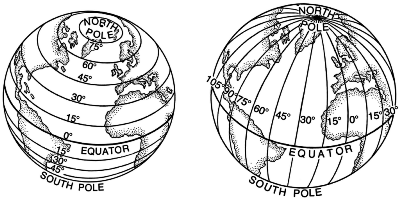
    Latitudes is any circle whose plane is perpendicular to the axis of the earth. The greatest latitude is the equator that divides the earth into two equal parts with planes of the two parts perpendicular to the axis.

    Latitudes are identified by the angle turned North or South upto 90o in each case about the center of the earth starting from the plane of the equator. Equator is taken to be the reference point for all the other latitudes and is thus 0oNorth or 0o South.

    The radius r of any latitude at an angle θ relative to the equator is given as r = Rcosθ where R is radius of the equator. It is easy to see that radius of the latitudes decreases as one moves from the equator towards the poles

    Equator is the only great circle among the circles of latitudes.

    All other circles of latitudes are parallel to the equator and are measured in degrees north or south of Equator.

    The figure below shows P on Latitude 40oN and Q 70oS.

    The radius of latitude P is given by R cos40o where R is radius of the earth.

    Radius of Q will be given by R cos70o

    Lines of latitude are also known as horizontal mapping lines as they are perceived to be in horizontal direction with relative to the earth’s axis.
    They are are referred to as parallels of latitude as the run parallel to the equator.

    The angle of a latitude is number of degrees from the center of the sphere with equator as the reference line.

    A line is drawn from the center of the earth against the equator line to a point on the Earth’s surface on the latitude which we need.

    Equator is the reference point for all other circles of latitudes and it is considered to be at 0o.

    Consider a point A on the Earth’s surface located at angle θ north of equator and another point C located at angle α to the south of Equator as shown in figure below.

    B is the reference point which is also the equator.

    The angle θ subtended by the arc AB at the center of the earth is the latitude of the circle passing through point A north and parallel to the equator.

    Angle α is the latitude of the circle passing through C parallel and to the south of equator.

    Latitude lines are a numerical way to measure how far north or south of the equator a place is located. equator is the origin point hence marked as 0 degrees latitude. The number of latitude degrees will be larger the further away from the equator the place is located where the farthest place is on 90o latitude. Latitude locations are given as θ degrees North or α degrees South.

    . see the figure below.

    Example

    In the figure below, A, E and B are on the same longitude and the angle between OA and OE is 40o where O is the center of the earth and E is a point on the equator which is on the same longitude as A.

    Since A is due north of E, we write the latitude of A as 40oN. Similarly, the latitude of B is 55oS.

    A and B are on the opposite side of the equator and Therefore the angle between them is the angle is the angle AOB given by <AOB = 40o+55o = 95o.

    The angle between Latitude A and B is referred to as the latitude difference.

    Consider a latitude C(20oN). The difference between A(40oN) and C(20oN) is 40o-20o = 20o.

    Note: If two latitudes are on the same side of the equator, the angle between them is the difference in angle of the two latitudes.

    The difference between B(55oS) and C(20oN) will be 55o + 20o = 75o .

    Please note that when two latitudes are on the opposite side of equator, the angle between them is the sum of their latitudes.

    Related posts


  • Longitudes and latitudes

    Longitudes and latitudes

    Latitude and longitude are lines used to locate locations on planet earth.

    The GreenWich Meridian

    It is a historic prime meridian or the Greenwich meridian used as a geographical reference line that passes through the Royal Observatory, Greenwich, in London, England and that passes from south to north pole of the earth.

    The greenwich Meridian divides the earth into equal parts.

    Because the earth is considered to be a circular sphere for the purpose of most of scientific studies, Greenwich Meridian is considered to pass through the center of the spherical earth dividing it into two hemispheres.

    See the illustrations below:

    illustrating the greenwich meridian division of the globe

    Axis of the Earth

    The axis of Earth is the imaginary line that is imagined to run from North Pole to South Pole through the center of the earth and believed
    to be the line at which the earth rotate. It is imagined as the support the earth will have so that it is able to rotate at the 24 hours rotation
    making one part face the sun and the earth be dark after every 12 hours.

    The figure below illustrates the earth’s axis.

    Illustrating an earth’s axis

    The line running on the Equator is usually referred to as the great circle because all the other circles besides it, to the right or left are smaller than it and are referred to as small circles. We are referring the lines as circles because they goes around the globe.

    Note that the circles reduces in diameter as one moves from the equator towards the North or towards the South pole.

    The Equator divides the circle into two hemispheres.

    The equator is a circle perpendicular to axis of a spheroid, such as Earth, and dividing such a spheroid into two equal halves mostly refered to as north and south hemisphere.

    see the illustrations below:

    Illustrating equator on a globe

    On Earth surface, the Equator is an imaginary line located at center of the earth and running from east to west and estimated to be about 40,075 km (24,901 mi) in length around the earth and lying halfway between the North and South poles.
    The term equator can also be used for any other celestial body that is roughly spherical meaning we can find an equator in other planets of the universe and other bodies like moon.

    In the sphere below, we illustrate an equator AB that divides the sphere into two equal parts. The circles on the south and the north of AB are both small circles and there are many circles that are drawn on either side of the equator AB known as the Latitudes.

    Illustrating and equator line on a sphere

    Unlike the horizontal lines parallel to AB that changes in diameter relative to their distance from the equator; we have other lines that runs from south to north and each one of them have equal circumference and each one of them divides the globe into two equal parts. Because they are all equal in length and are greater than the equator, they are all regarded as great circles.

    In the figure below, the lines are drawn that are parallel to PQ each one of them dividing the sphere into two. The radius R of each of the great circles is also the radius of the sphere.

    Illustrating great circles

    Related Topics


  • Proportion

    Direct proportion

    Two quantities are said to be in direct proportion if they increase or decrease at the same rate.

    The ration between two corresponding values in the two quantities is the same.

    Example

    In a school, 4 teachers serves 80 students.

    (a) how many teachers will be needed for 150 students.

    (b) what number of students can be served by 6 teachers.

    (a)Solution

    The number of students increases by ratio:

    150:80=15:8

    The number of teachers will increase in the same ratio.

    Hence (15/8)*4=approximate 8 teachers. The correct answer from the working is 7.5 but we approximate to the nearest whole number because we cannot have fractional number of teachers.

    (b) solution

    Teachers has increase by the ration 6:4=3:2

    Increase the number of teacher by the same ration:

    (3/2)*80= 120 students

    Inverse proportion

    Two quantities are inversely proportional to each other if increase of one quantity causes decrease of the other quality by the same ratio and decrease of one quantity results to increase of the other quantity.

    Example

    A farmer has enough feed to last her 75 vows for 30 days. If he buys 15 more cows, how long will the feed last now?

    Solution

    cows increases in the ratio 90:75= 6:5

    The feed days decreases by the ratio 5:6, hence, the feed will be used in (5/6)*30=25.

    Meaning if cows increases by 15 based on the current stock value, the feed stock will last 5 days less

  • Reciprocals

    Given a number a, it’s reciprocal is 1/a.

    Finding reciprocal of a number can be described as dividing 1 by that number. Reciprocal of a fraction involves exchanging denominator with numerator. For example reciprocal of 3/7 is 7/3.

    Reciprocal of 9/2 is 2/9 or 2/4.5

    Exercise

    Find the reciprocal of :

    (a) 3/25 b(5/16) (24/250)