Category: mathematics

  • Cardinality of sets

    Definition

    A set is finite if the number of elements in the set is a whole number.

    As an example take set A = {5, 12, 18, 39}

    The set A above is finite because it has 4 elements where 4 is a whole number quantity.

    An opposite of finite is infinite.

    A set is infinite if the number of it’s elements cannot be represented by a whole number. For example the set B given by B= {1, 3, 5, _ _ _ _} can be continued for ever hence no single number can be assigned the number of it’s elements. Hence B is an infinite set.

    Cardinality

    Cardinality is size of the set.

    Cardinality of a given set A is denoted by |A|

    Cardinality of a null set is 0 and can be written as |∅| =0

    As an example, let D= the set of even numbers less than 10 such that D={2,4,6,8} then |D| = 4

    sometimes the term cardinal number is used to refer to cardinality.

    Definition

    The cardinal number of a finite set is the number of elements in the set.

    The cardinal number of a finite set A is denoted by the notation n(A) or |A|

    if set R={2.5, 8.9, 8.23, 11.256} then n(R) = 4.

    then we say that R has a cardinal of 4.

    set cardinality

    Example

    Let J = {2, 6, 8, 10, 15, 17, 23, 35, 92}

    then n(J) = 9

    Sometimes it can be time consuming to count the number of elements if the number of elements are many in a given set.

    If the elements are consecutive Integers in a big set, a formulae can be used to get the number of elements.

    Number of Elements = (Largest Value – smallest value) + 1

    For example take the set T={8, 9, 10,………….,23}

    Largest value=23

    smallest value=8

    The number of elements in T n(T) = (23-8)+1 = 15+1 = 16 elements.

    that is n(T)=16

    Example

    Let G = {4, 5, 6, _ _ _ _ _45}

    largest value=45

    smallest value = 4

    n(G) = (45-4)+1=42

    Note:

    The above method works if and only if the elements are consecutive Integers

    Some formulas to count elements with sets

    n(A U B) = n(A) + n(B) – n(A ∩ B)

    for disjoint sets A ∩ B = ∅ then n(A U B) = n(A) + n(B)

    n(A U B U C) = n(A) + n(B) + n(C) -n(A∩B)-n(A∩C)-n(B∩C)+n(A∩B∩C)

    Question

    From 50 students taking examinations in Mathematics,Physics and Chemistry,each of the students has passed in atleast one of the subject.37 passed mathematics,24 passed physics and 43 passed chemistry. At most 19 passed mathematics and physics, at most 29 passed mathematics and chemistry and at most 20 passed physics and chemistry. What is the largest number that could have passed all three examinations.

    please send your answers in the comments. some few examples to be discussed in the next lesson.

    Related Pages
  • Visual Representation of Set Relationships with Venn Diagrams

    Visual Representation of Set Relationships with Venn Diagrams

    They are nice visual tools used to represent set operations by displaying sets as intersecting circles and shading out results of of set operations.

    The also represents cardinality of a particular set by putting the number in the corresponding region in the diagram.

    Venn diagrams are frequently used to build intuition for proofs. The diagrams are designed to represent the general pictures of what is known helping a person to see the theoretical relationships among sets.

    The universal set

    The universal set is represented by a rectangle such that points in the rectangle represent the elements of a universal set as shown.

    Universal presentation of a set
    The universal set Venn diagram

    Intersection of sets

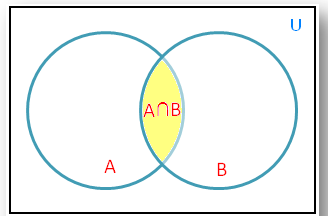
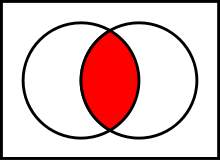
    Two sets A and B when they intersect will be represented by two circles that will have a common region. The common region will have the results of intersection as shown in figure below.

    The region shaded with color represents results of intersection operations. The region labelled A represents all elements in set A alone which are not in B.

    The figure below shows intersection of three sets A, B and C.

    Union of sets

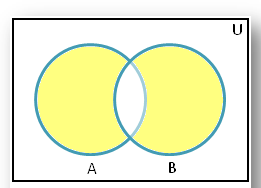
    From our previous lessons, we were able to see that, union of two sets consists of elements in either sets or in both. The union of two sets will be represented by shading the two circles completely as the elements of union will be in either circles or in both as shown in figure below.

    The figure below shows union of three sets A U B U C

    Difference in sets

    Set difference between A and B (A-B) or A\B represents elements of Set A that are not in B. The figure below represents set difference between A and B

    The Venn diagram for the set difference A\B

    If we can put it in other words, the difference of two sets A and B taken in this order is the set of all those elements of A which are not in B.

    we can write:

    A – B = {x : x ∈ A and x ∉ B} i.e. those elements in A but not in B

    B -A =B – A = {x : x ∈ B and x ∉ A} i.e. those elements in B but not in A

    let A = {1, 2, 3, 4} and B={2, 3, 4, 5, 6}; then

    A – B = {1} and B – A = {5, 6}

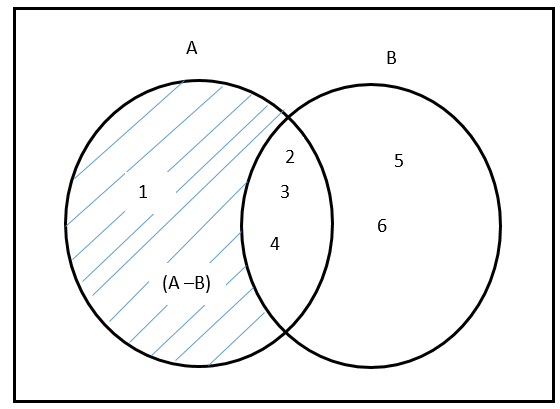
    The representation of the set difference A -B is represented by a Venn diagram as shown below:

    the set difference A-B

    The shaded region in the figure above is the result of A\B which is {1}.

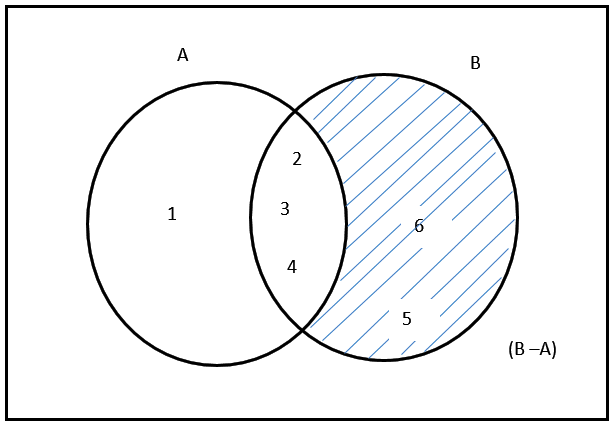
    The set difference between B and A as shown in the figure below

    the set difference A\B

    Venn diagrams for the subsets

    Subsets of the universal set are represented by circles or ovals in the rectangle as shown

    Suppose A, B and C are subsets of the universal set U. The region within the circle A represents the elements of A and region around B elements of B and similarly for C.

    In the figure above, A is a subset of B, that is, A ⊂ B and A and C have no common elements hence they are not intersecting.

    Theorem: Let A, B and C be sets. If A ⊆ B and B ⊆ C, then A ⊆ C.

    In the figure below A ⊆ B and B ⊆ C and so such relationship is represented with centric circles where A is inside B and B inside C and A and B are inside C but the the three circles are not intersecting.

    subsets illustration where A ⊆ B and B ⊆ C

    Disjoint sets

    if two or more sets are not intersecting but are within the same universe , then they are represented by two circles next to each other as shown. such sets are said to be disjoint sets

    set difference where A B and C are disjoint

    In the figure above A , B and C are sets that have no common elements among them; for example let A equals sets of counting numbers between 0 and 9.

    let A = {2, 4, 6, 8}, a set of even numbers in the discourse.

    let B = {1, 3, 5,7, 9}

    then we can represent A and B as shown.

    disjoint sets A and B

    Symmetric difference of sets in Venn Diagrams

    The Symmetric difference of two sets A and B is defined as the union of sets A-B and B-A. The symmetric difference of A and B is denoted by A Δ B

    Using set builder notation:

    A Δ B ={x : x ∈ (A – B) and x ∉ (B-A)}

    The set difference between A and B can be represented by Venn diagram as shown

    symmetrical set difference (A-B) U (B-A)

    Complement of a set and the Venn diagram

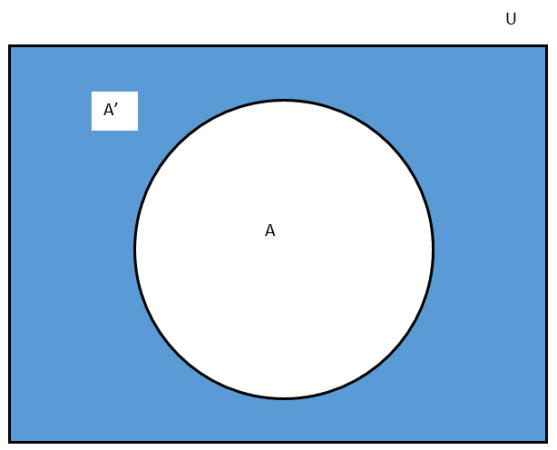
    If A is a subset of Universal set U, Then the compliment of A with respect to U is defined as the set of all those elements of U which are not in A.

    The compliment of A is denoted by A’ or Ac

    A’ = {x : x ∈ U) and x ∉ A }

    set compliment is represented as shown below

    The set compliment of set A illustrated

    please note that U = A’ U A

    Conclusions

    A Venn diagram is pictorial representations of set relationships that uses circles to show the such relationships. Circles that overlap have common elements while circles that do not overlap have no common elements . Venn diagrams help to visually represent set relationships.

    Related topics:


  • Volume of Regularly-shaped Solids

    Volume of Regularly-shaped Solids

    according to oxford dictionary,solid means hard or firm.

    A regularly shaped solid is an object with a definite shape that can always be described. Each regularly shaped solid have a known geometrical shape and hence can be identified by name.

    Some of the common known regular solids includes:

    A cube is a six sided object with all its edges equal in length. A cube has a solid shape with six square faces all equal in area and lengths.

    The cube

    A cuboid is an object with six faces where each pair of the opposite faces are equal in shape and size. Cuboid means “like a cube” because it has the same shape with a cube, except that all its sides are not equal.

    The figure below shows a cuboid with one edge named length, another one named width and the other one named height.

    A cylinder is a three dimensional object consisting of two parallel circular surfaces that are connected by a curved surface. The distance between the two circular faces is a fixed distance and is usually refereed to as the height of the cylinder. There is an imaginary line that passes through the center of the circles and perpendicular to the circles known as the axis.

    A cylinder with radius r and height h
    A cylinder with radius r and height h

    A sphere is a geometrical object that is round in shape and is defined in a three-dimensional space without any face.

    showing a sphere with radius r

    Volume of a sphere (Vsphere) will be given by ;

    where r the radius and π a mathematical constant.

    A cone is a three-dimensional shape with a flat circular base and a curved surface that forms a sharp point at the top. The sharp point is called the vertex.

    The three parts that makes a cone are its radius, height, and slanting height. Radius r is the distance between the center of the circular base to any point on the circumference of the base.

    The slant-height l is defined as the distance between the vertex of the cone to any point on the circumference of the circular base.

    The height h of a cone is the distance between the vertex and the center of the circular base.

    Figure below illustrates a cone

    but πr2h = volume of a cylinder.

    Prisms

    An octagonal prism
    An octagonal prism

    A prism is a three-dimensional object with two identical surfaces facing each other usually referred to as the bases of a prism. The base of the prism is usually called the cross-sectional area.

    Length of the prism is distance between the two identical surfaces.

    The base of the prism can assume varied shapes hence we have different types of prisms like:

    • square prism
    • triangular prism
    • rectangular prism
    • pentagonal prism
    • hexagonal prism
    • octagonal prism
    • nonagonal prism
    • decagonal prism
    • hendecagonal prism
    • Dodecagonal prism
    • tridecagonal/triskaidecagonal prism
    • tetradecagonal prism
    • pentadecagonal prism
    • e.t.c.

    To get the volume of the prism, you simply gets area of the base and multiply it with the length of the prism. hence

    Volume of a Hexagonal prism

    The hexagonal prism is a prism with hexagonal base. The word hexagonal comes from the word hexagon. In geometry, a hexagon is a six-sided polygon.

    so volume of Hexagonal prism is given as a product of the area of the hexagonal base and the length between the two hexagonal ends.

    A regular hexagon has six sides each with the same length. By drawing lines from vertices that are joining at the center of the hexagon, six isosceles triangles can be obtained from the hexagon. The area of the hexagon is equal to area of one triangle multiplied by number of triangles.

    Related posts


  • Set Operations: Union, Intersection, Difference, and practical Examples

    Set Operations: Union, Intersection, Difference, and practical Examples

    Introduction

    Sets have some methods or procedures that can be applied on them hence producing different sets from two or more sets. The procedures we are calling operations on sets are what we are going to discuss in the topic. Among the operations we encounter includes:

    • Union
    • Intersection
    • difference
    • Cartesian Product
    • practice problems to consolidate our learning

    union of the two sets

    when we operate union of set, we combine two sets to get the collection of objects that are in either set.

    union of sets venn diagram

    Union of set C = A ∪ B meaning C is the union of A and B.

    C = A ∪ B means that the elements of C are exactly the elements which are either an element of A or an element of B or an element of both.

    for example if A={7,11,13} and B={8, 13, 15}, then A ∪ B = {7, 8, 11,13,15}.

    Intersection

    C is the intersection of A and B, when the elements in C are precisely those both in A and in B. So Intersection operation is taking elements that are common on both sets.

    Intersection of set A and be will be given by C = A∩B.

    if A = {7, 8, 13} and B = {8, 13, 14}, then A ∩ B = {8, 13}.

    complement

    complement of a set talks of all the elements which are not in a particular set.

    if we say that B is the complement of A, we mean that B contains every element not contained in A and we write ; B=AC .

    Universe in set context is the a given set in which we have some interest.

    if our universe is {1, 2, 3, 4 ,5, 6,7 ,8 , 9, 10}, a set of counting numbers, and A = {2, 3, 5, 7}, then Ac = {1, 4, 6, 8, 9, 10}.

    set difference

    set difference between A and B is the set of all elements which are both elements of A and NOT elements of B; that is, A ∩ Bc .

    set difference between A and B is written as A \ B.

    hence A ∩ Bc = A \ B.

    Example Question:
    1. A ∪ B
    2. A ∩ B
    3. B ∩ C
    4. A ∩ D
    5. (B ∪ C)’
    6. A \ B
    1. (D ∩ C’)∪(A ∩ B)’
    2. ∅ ∪ C
    3. ∅ ∩ C

    solution to the practice Problem

    1. A ∪ B

    solution algorithm

    2. A ∩ B.

    solution algorithm

    3. B ∩ C

    solution algorithm

    4. A ∩ D.

    solution algorithm

    5. (B ∪ C)’.

    solution algorithm

    6. A \ B

    solution algorithm

    7. (D ∩ C’)∪(A ∩ B)’

    solution algorithm

    8. ∅ ∪ C

    solution algorithm

    9. ∅ ∩ C

    solution algorithm

    Related Posts

  • Volume

    Volume

    In physics, volume is a measure of the three-dimensional space occupied by a substance or enclosed within a container. It is typically measured in cubic units such as cubic meters (m³) or cubic centimeters (cm³).

    Volume as a three dimensional quantity, is obtained when three lengths are multiplied together.

    because volume results from product of three lengths, the SI unit of volume is cubic-meter(m3). That is, SI unit of volume is the cube of the SI unit of length. This tells us that volume is a derived quantity.

    However, There are common sub-multiples of volumes like:

    • cubic-centimeters (cm3)
    • cubic-millimeters (mm3)
    • cubic-micrometers (µm3) ………….just to name a few.

    1m3 =1m x 1m x1m

    but 1m =100cm

    hence 1m3 =100cm x 100cm x 100cm = 1000000cm3.

    From Volume, we can find units of capacity like litres(l) and millitres(ml).

    1 ml =1cm3

    1 litre = 1000ml

    1 m3 = 1000 litres.

    when you buy a half litre packet of milk from the supermarket, you are actually buying 500ml of milk.

    Example

    Express 43.5mm3 into m3.

    Solution

    Example

    convert 0.00006 m3 into cm3

    Solution

    practice Questions

    The radius of a typical atom is considered to have a volume of 10-10m3. Express the given volume in:

    1. mm3
    2. cm3
    3. µm3

    Related posts


  • Understanding Set Theory: Notations, Relationships and Power Set

    Understanding Set Theory: Notations, Relationships and Power Set

    We use these braces { } to enclose the elements of a set. for example

    {7, 11, 13} is the set containing 7, 11, and 13.

    • : means “such that. for example {x : x > 2} is the set of all x such that x is greater than 2.
    • ∈ means “is element of for example 11 ∈ {7, 11, 13} asserts that 11 is an element of the set {7, 11, 13}.
    • ∉ means “is not an element of for example 4 ∉ {7, 11, 13} because 4 is not an element of the set {7, 11, 13}.
    • ⊆ means ” is a subset of for example A ⊆ B asserts that A is a subset of B, that is; every element of A is also an element of B.
    • ⊂ means “is a proper subset of“. for example A ⊂ B asserts that A is a proper subset of B: every element of A is also an element of B, but A , B.
    • ∪ means “union of. for example A ∪ B is the union of A and B: is the set containing all elements which are elements of A or B or both.
    • × means “Cartesian product of for example A × B is the Cartesian product of A and B: the set of all ordered pairs (a, b) with a ∈ A and b ∈ B.
    • \ means “set difference between”. for example A \ B is set difference between A and B; that is, the set containing all elements of A which are not elements of B.
    • A’ or Ac means “complement of set A”.
    • The complement of A (AC)is the set of everything which is not an element of A.
    • |A| means “cardinality or size of A“.
    • The cardinality (or size) of A is the number of elements in A sometimes written as n(A).

    Sets Relationships

    Two sets are be equal if they have exactly the same elements. For example {7, 11, 13} = {11, 7, 13} as every element in first set is the same element in the second set.
    The order in which the elements are written down in does not matter.

    {7, 11, 13} = {7, 8 + 3, 6 + 2 + 5} = {VI, XI, XIII} = {7, 11, 13, 7 + 6}

    The above statement shows that the way elements are represented in a set does not matter, as long as the elements evaluates to the same value at the end.

    Consider the sets A = {7, 11, 13} and B = {7, 11, 13, 20}.

    A and B are not equal but every element of A is also an element of B.
    we say that A is a subset of B, or in symbols A ⊂ B or A ⊆ B.

    Both symbols are read “is a subset of.”

    This is analogous to the difference between < and ≤.

    ⊆ is analogous to ≤ and ⊂ comparable to <.

    power set

    power set of a subset A is the set made from all possible subsets of A.

    power set of A is often written as P(A) or sometimes as 2A .

    consider the set A = {5, 7, 9}.

    P(A) ={ ∅, {5}, {7}, {9}, {5, 7}, {5, 9}, {7, 9}, {5, 7, 9}}.

    If the set A has n elements, then the power set has 2n elements.

    Please note that all elements of power set P(A) are sets and NOT number elements. Therefore; 5 P(A) but {5} P(A) since elements of P(A) are not numbers but sets.

    NOTE:

    {5} ⊄ P(A) because not everything in {5} is in P(A).

    However, {{5}} ⊆ P(A).

    The only element of {{5}} is the set {5} which is also an element of P(A).

    cardinality of a set

    cardinality of a set is the number of distinct elements a set has often referred as the size of the set. if a set A = {a, b, c, d, e, f}, then it’s cardinality is 6 as it has 6 distinct element. that is |A|=6.

    For a set with a finite number of elements, the cardinality of the set is simply the number of elements in the set.

    The cardinality of the set B = {1, 2, 3, 4, 1, 2, 3} is 4 as it has 4 distinct elements. repeated elements are not counted when determining cardinality of a set.

    Related topics


  • Area of irregularly-shaped surfaces

    Area of irregularly-shaped surfaces

    Irregular shapes are shapes that cannot be precisely described in terms of geometrical shapes. Their edges and vertices are not uniform.

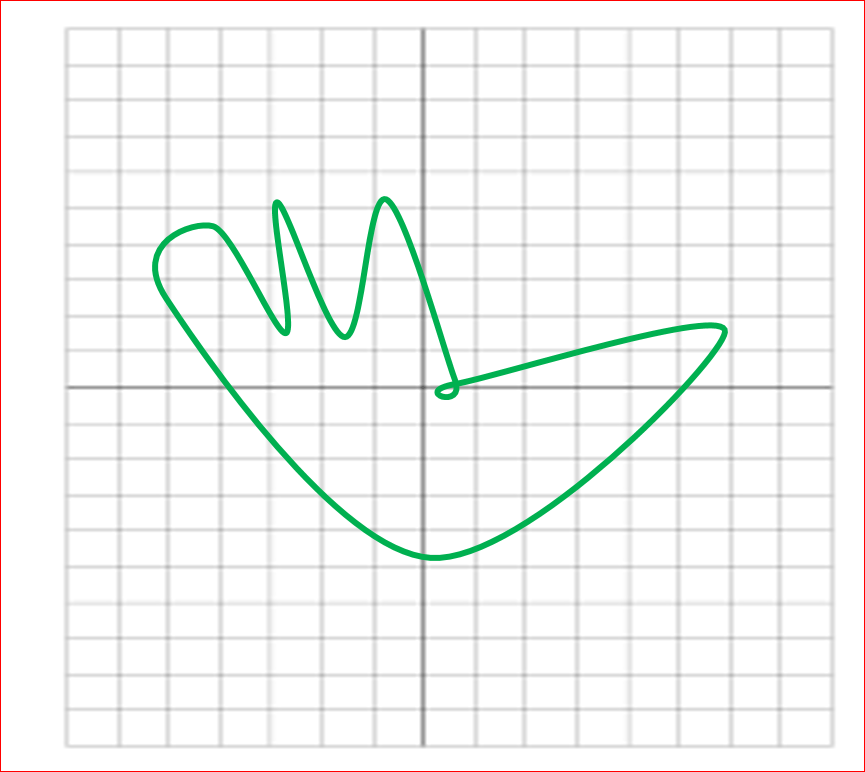
    An estimate of the area of an irregular shape can be made by dividing the shape up into squares each of area 1 cm2 . By counting the number of small squares, the area of the irregular shape can be estimated. consider the diagram below.

    in the figure above, the number of squares that are completely covered by the shape are 39. The number of squares that have been touched by the figure (partially covered) are 30. confirm by counting.

    The area is thus calculated as follow:

    Practice Question

    Determine the area of the figure below.

    Related pages

    Area

    Home

  • AREA

    AREA

    Area is the quantity that expresses the extent of a given surface on a plane and it is a derived quantity of length. Area is obtained from product of two lengths. The SI Unit of square metre (m2).

    square metre can be expressed into other units like square-centimeter (cm2), square-millimeter(mm2) or square-kilometer (km2).

    similarly;

    we will go ahead and convert area in square meters to some other units

    Express the following into square-centimeter (cm2)

    1. 8.2 m2
    2. 5.4 m2
    3. 0.078m2
    4. 0.000000000064 km2

    solution

    1.     1m2 =100cm x 100cm=10000cm2  

    2. 

    3.

    4.

    Example

    convert the following into m2

    1. 4500 cm2
    2. 0.0072 cm2

    solution

    1.

    2.

    Related pages


  • Understanding Sets: Definition, Notation, and Examples

    Understanding Sets: Definition, Notation, and Examples

    Objects in a set are called elements or members of the set. For example a group of students taking a computer science course can be described as a set.  A group of singers that sings hip-hop is a set. Numbers between 0 and 9 is a set of Natural Numbers.

    The set consisting of the four seasons has elements spring, summer, and winter. We could say that Kendrick Lamar is an element in a set of hip-hop artists where Joe Biden is not a member of the set of hip-hop artists. 7 is an element in a set of natural numbers where letter h is not.

    Equal sets

    Two sets are exactly equal if they contain the exact same elements.

    The set containing vowels in the phrase ‘declaration of independence’ is the same set as the set of vowels in the word questionably.

    We do not care about the order or repetitions, just whether the element is in the set or not.

    An important feature of a set is that its elements are distinct or uniquely identifiable.

    Set Notation

    A set is typically expressed by curly braces { } enclosing its elements. It is common to denote sets using upper case letters and its elements denoted by lower case letters.

    If A is a set with elements {a, b, c, d}, we say that a is an element of A and we write it as a ϵ A. If a is not an element of set A, we write a ∉ A.

    Consider the set A={2,4,6,8,0}, then:

    • 2 ϵ A.
    • 4 ϵ A.
    • 6 ϵ A.
    • 8 ϵ A.
    • 0 ϵ A.
    • 7 ∉ A as 7 is not contained in A.
    • 5 ∉ A as 5 is not contained in A.

    Example 1

    Let X={0,1,2,3,4,5,6,7,8,9}. The X is a set of first 10 natural numbers. Or in other words X is the set of integers between 0 and 9.

    Example 2

    Let X= {apple, Orange, banana, pineapple}.

    Apple ϵ X but cabbage ∉ X.

    Example 3

    X = {x1, x2, . . . x10}.

    Then x100 ∉ x since the last element in the set is x10 and so x100 is outside the set.

    A picture showing a set of kitchen ware
    A set of kitchen utensils
    Example of equivalent sets

    The sets {4, 5, 6}, {6, 5, 4} and {digits in the number 45654} are all the same as the order in which the elements appears does not matter.

    Empty set or null set

    The set S that contains no elements is called the empty set or the null set. Null set is denoted by empty braces { } or Ø.

    Singleton set

    A set that has only one element is called a singleton set

    Three ways of expressing a set

    It includes listing all elements of the set. e.g. X= {2, 3, 5, 7, 11, 13, 17,19} where X is the set of prime numbers between 0 and 20.

    It involves stating a property with notations. e.g.  X={x: x is a prime number}.

    This reads as X is the set of all x such that x is a prime number. x is a variable in the expression and will stand for any object that meets the criteria after colon

    The set X = {1, 3, 5, 7, 9, 11, 13, 15, 17, 19} in the predicate notation can be written as:

    • X = {x : 0 < x≤ 20; x is an odd integer}, or
    • X = {x: 1 ≤ x < 21; x is an odd integer}, or
    • X = {x: 1 ≤ x ≤ 20; x is an odd integer} etc.

    Predicate notations defines a certain rule that helps in defining the elements of the set X.

    In general, we writes X = {x : p(x)} or X = {x | p(x) } to mean the set of all elements x such that property p(x) is true.

    Please not that: can be replaced by |.

    This is defining a set of rules which generates its members .e.g. X = {x: x is an even integer greater than 40. 

    X can also be specified by:

    (a) 42 ϵ X,

    (b) whenever x ϵ X, then x+2 ϵ X and

    (c) every element of X satisfies the above two rules.

    In the recursive definition of a set, the first rule is the basis of recursion, the second rule gives a method to generate new element(s) from the elements already determined and the third rule binds or restricts the defined set to the elements generated by the first two rules. The third rule should always be there. But, in practice it is left implicit.

    Subsets

    Common sets in mathematics

    The empty set ∅ is the set which contains no elements.
    The universe set U is the set of all elements.
    The set of natural numbers N. That is, N = {0, 1, 2, 3 . . .}.
    The set of integers Z. That is, Z ={. . . , −2, −1, 0, 1, 2, 3, . . .}.
    The set of rational numbers Q.
    The set of real numbers R.
    The power set P(A) of any set A is the set of all subsets of A.

    Related Topics


    Related pages

    Home


  • Reading a metre rule

    Reading a metre rule

    most of people don’t read metre rule correctly. A metre rule has 100cm and between two consecutive centimeter marks there are gaps. The gaps between centimeter marks can be reduced by dividing the gap into smaller sub units. When divided into 10 equal divisions, then each of such smaller division is called a millimeter because it will be dividing the metre length into 1000 divisions with each divisions being equal to 0.001m. Then the accuracy of the meter rule can be said to be equal to 1/1000 of a metre(0.001m). when the rule is calibrated into centimeter divisions alone, then the metre length is divided into 100 divisions with each divisions being equal to 0.01m. the accuracy of the measurements taken by such a rule is thus (1/100)m=0.01m).

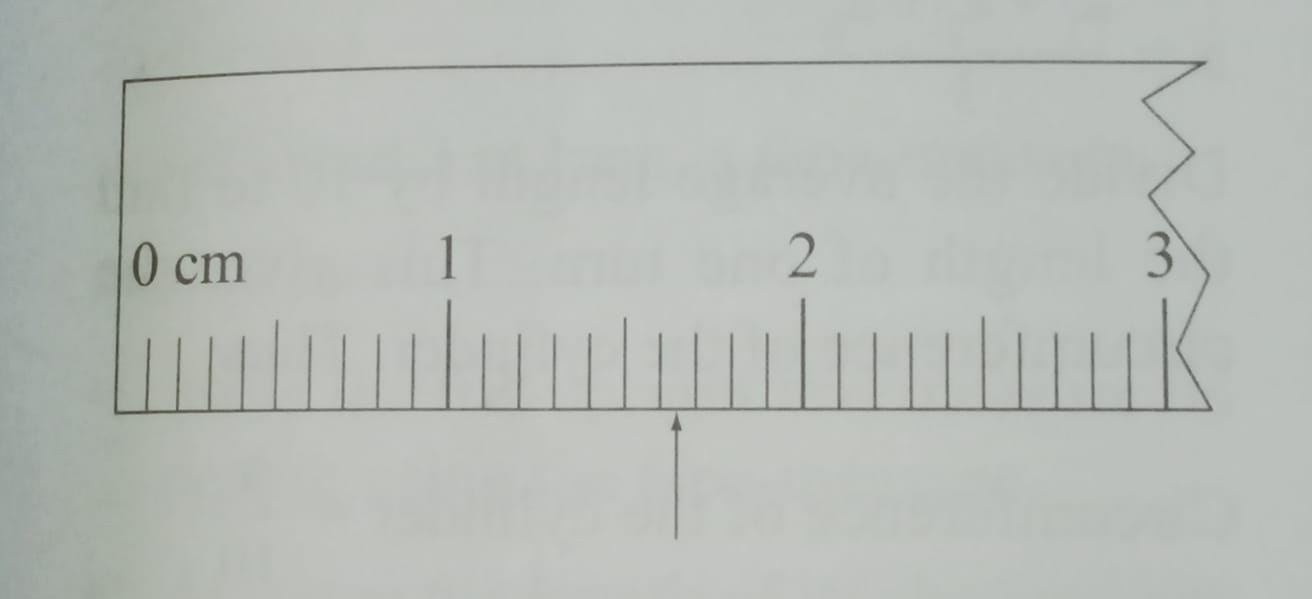
    consider the reading shown by the arrow in figure below.

    demonstrating reading of a meter rule

    The reading above is more than 1.6 cm but less than 1.7 cm. The position of our point object is not lying on exact reading. we cannot precisely state what measurement it is because it is not indicated. there is an empty gap and we need to approximate that extra length beyond the 1.6 cm because it is not indicated. We can increase the accuracy of the meter rule by dividing the gap into smaller divisions. suppose we approximate the second decimal to be 1.65 cm, there is nothing that prevents us from stating it as 1.66 cm,1.67 cm or even 1.64 cm. 

    The second decimal place cannot be accurately determined. Nevertheless, the readings from a meter rule may be written up to the second decimal place of a centimeter.

    A reading like 2.584 cm cannot be taken by a metre rule. In later lessons, we will discuss how to increase the decimal places in measurement of length using other special instruments like micrometer screw-gauge.

    If the readings of 3.6 cm and 7 cm are taken with a meter rule, then they should be written as 3.60 cm and 7.00 cm respectively. This is because a meter rule is calibrated to an accuracy of 0.01 m (100 divisions).

    Practice Question

    Record the readings indicated by P1,P2 and P3 shown in the figure below.

    Answer to practice question

    1. P1=69.50 cm (approximations done)
    2. P2=71.00cm
    3. p3=71.50cm

    Practice Exercise

    State the readings indicated by the arrows in the figures below

    Related links