
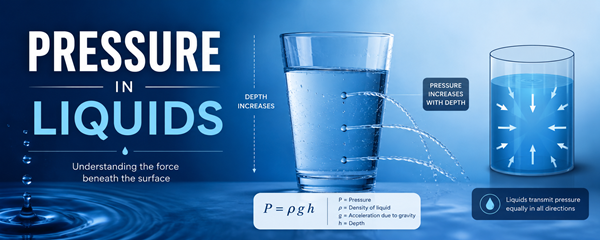
Pressure in liquids is a fascinating concept that explains why divers feel greater force underwater and why dams are built thicker at the bottom than at the top. As depth increases, the pressure exerted by a liquid also increases because more liquid presses down from above.
This principle plays an important role in everyday life, engineering, and natural water systems. Understanding how depth affects pressure helps us explain many real-world phenomena, from submarine design to the flow of water in oceans and rivers.
At the same depth in a given liquid, differences in levels obtained is the same regardless of the direction which the funnel faces.
To investigate the variation of liquid pressure with depth and density
Apparatus
A tall jar, liquids of different densities, thistle funnel, U-tube, rubber tubing.
Procedure
- Using the nail, make three holes, A, B and C, of the same diameter along a vertical line on one side of the tin.
- Fill the tin with water as shown in figure 4.3.
- With the tin full of water, observe the jets of water from the holes A, B and C.
Observation
The lower hole, A, throws water farthest, followed by B
Conclusion
Pressure in liquids increases with density and depth.
In summary:
- Pressure in a liquid increases with depth below its surface.
- Pressure in a liquid at a particular depth is the same in all directions.
- Pressure in a liquid increases with the density of the liquid.
Fluid Pressure Formula
Consider a liquid in a container, as shown in figure 4.8.


If A is the cross-sectional area of the column, h the height of the column and ρ the density of the liquid, then:
Volume of the liquid= cross-sectional area × height
= Ah
Mass of the liquid=volume of the liquid × density
= Ahρ
Therefore, weight of the liquid
= mass of the liquid × gravitational force per unit mass
= Ahρg
From the definition of pressure:
So fluid pressure becomes:
P=hρg
EXPERIMENT To show the distribution of pressure at a point in a liquid
Apparatus
A tall jar, water, thistle funnels, U-tube, rubber tubing.
Procedure
- Fill the glass vessel G with water.
- Connect one of the thistle funnels to a U-tube filled to some level with water.
- Lower the funnel to a depth from the surface of water and notice the difference in levels, h, of the water in the U-tube.
- Replace the funnel with others, in turn, whose mouths are pointing in different directions.
- Lower the funnel into the water so that the mouth of the funnel is at the same point as the straight one. Observe the difference in levels of the water in the U-tube.


Figure 4.6: Pressure variation in a liquid
Procedure
- Fill the glass vessel G with water.
- Connect the thistle funnel to a U-tube filled to some level with water.
- Lower the funnel to different depths from the surface and notice the difference in levels, h, of water in the U-tube.
- Replace water in G with a denser liquid, such as sodium chloride solution (brine).
- Lower the funnels to the same depths as above and compare the heights obtained.
Observations
- The deeper the funnel goes below the surface, the greater the difference in levels, h.
- The differences in levels, h, obtained with brine at a particular depth is greater than that obtained with water at that depth.
Liquid Levels in a U-tube
When water is poured into a U-tube, it will flow into the other arm. The water will settle in the tube with the levels on both arms being the same, see figure 4.5(a).


When one arm of the U-tube is blown into with the mouth, the level moves downwards, while on the other arm it rises, see figure 4.5(b). This is caused by the pressure difference between the two arms. The pressure increases on the arm that is blown into and causes water to rise on the other arm.
Effect of pressure on liquid levels
Pressure of water at A is greater than pressure at B and pressure at B is greater than at C. Hence, pressure increases with depth.
For this reason, a diver at the bottom of the dam experiences pressure due to the weight of water above him. The deeper the diver goes, the greater the pressure.
Liquid Levels
When a liquid is poured into a set of connected tubes with different shapes, it flows until the levels are the same in all the tubes, as shown in figure 4.4.
