High voltage power transmission systems are designed to transport electrical power over long distances while reducing power losses caused by resistance in transmission cables. By increasing voltage and lowering current, power companies can deliver electricity more efficiently, safely, and reliably. This process plays a major role in modern power grids and helps ensure stable electricity supply across cities and rural areas.
In this article, you will learn how high voltage power transmission works, why power losses occur during transmission, the importance of transformers in reducing energy wastage, and the dangers associated with high voltage lines. You will also explore practical examples and calculations that explain how electrical engineers minimize power loss in transmission systems.
Whether you are a physics student, engineering learner, teacher, or simply curious about electricity transmission, this guide will help you clearly understand the science behind high voltage power transmission and power losses.
Electricity generated at power stations must travel long distances before it reaches homes, industries, schools, and businesses. To make this possible efficiently, electrical power is transmitted using high voltage transmission lines. High voltage transmission helps reduce energy losses and ensures reliable delivery of electricity over large distances.

- Electricity is generated at power stations.
- Voltage is stepped up for efficient long-distance transmission.
- High voltage reduces power losses in transmission cables.
- Substations step the voltage down before distribution to consumers such as homes, industries, schools, and businesses.
What is High Voltage Transmission?
High voltage transmission is the process of carrying electrical power over long distances using very high voltages such as 110 kV, 220 kV, 400 kV, or even 765 kV. Transmitting electricity at high voltage reduces the amount of energy lost as heat in the transmission cables.
Power stations usually generate alternating current (AC) electricity at voltages between 11 kV and 25 kV. Before the electricity is transmitted, transformers are used to step up the voltage to much higher levels, typically between 132 kV and 400 kV.
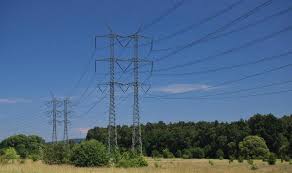
The electricity is then transmitted through overhead power lines to substations, where the voltage is stepped down for safe distribution to consumers.
Different consumers require different voltage levels:
- Heavy industries may require voltages above 30 kV
- Light industries may use around 10 kV
- Homes and domestic users usually require 240 V

How Power is Distributed
The transmission and distribution process follows these stages:
- Electricity is generated at the power station.
- A transformer steps up the voltage for long-distance transmission.
- Electricity travels through high voltage transmission cables.
- Substations step down the voltage.
- Electricity is distributed to homes, industries, and businesses at suitable voltage levels.
Why High Voltage Reduces Power Loss
Electrical cables have resistance, and this resistance causes some electrical energy to be lost as heat during transmission.
The power loss in transmission lines is given by:
P=I2R
Where:
- P = power loss
- I = current flowing through the cable
- R = resistance of the cable
From the formula, power loss increases when current increases. Therefore, reducing current reduces energy losses.
Since electrical power is also given by:
For the same amount of power, increasing the voltage allows the current to decrease. This is why electricity is transmitted at very high voltages and low currents.
Methods Used to Reduce Power Losses
Power companies use several methods to minimize losses during transmission:
1. Stepping Up Voltage
Transformers increase the voltage before transmission. Higher voltage means lower current and therefore lower power loss.
2. Using Thick Transmission Cables
Thicker cables have lower resistance, which reduces heat losses.
3. Using Good Conductors
Transmission cables are made using materials with low electrical resistance.
Why Aluminum is Preferred for Transmission Cables
Aluminum is commonly used in transmission lines because:
- It is a good conductor of electricity
- It is lightweight
- It is cheaper than many other conducting materials
Dangers of High Voltage Transmission
Although high voltage transmission is efficient, it also presents several risks:
- Electric shock if cables fall or hang too low
- Fires caused by loose or damaged cables
- Strong electric fields that may affect nearby communities
- Lightning strikes causing surges in electrical systems
- Cables touching during strong winds and causing sparks or fires
Proper maintenance and safety measures are therefore very important.
Example Problem
A transmission cable has a resistance of 100 Ω and carries electricity at 10 kV with a current of 1.0 A. The voltage is stepped up to 18 kV using a transformer.
Determine the power loss after stepping up the voltage.
Solution
Assuming the transformer is 100% efficient:
Step 1: Use the transformer power relationship
VpIp=VsIs
Substituting the values:
- Primary voltage = 10,000 V
- Primary current = 1.0 A
- Secondary voltage = 18,000 V
10000×1.0=18000×Is Is=1800010000 Is=0.556 A
Step 2: Calculate Power Loss
Using:P=I2R P=(0.556)2×100 P≈30.9 W
Without Stepping Up the Voltage
P=(1.0)2×100 P=100 W
This shows that stepping up the voltage significantly reduces power loss.
Practice Question
A generator produces 750 kW at a voltage of 15 kV. The voltage is stepped up to 125 kV and transmitted through cables with a resistance of 500 Ω.
Assuming the transformers are 100% efficient, calculate:
- The current produced by the generator
- The current flowing through the transmission cables
- The voltage drop across the cables
- The power lost during transmission
- The power reaching the substation
Conclusion
High voltage transmission is an essential part of modern electrical power systems. By transmitting electricity at high voltage and low current, power companies minimize energy losses and improve efficiency over long distances.
Transformers play a key role in stepping voltage up for transmission and stepping it down for safe use by consumers. Despite the dangers associated with high voltage lines, proper design and maintenance make power transmission both efficient and reliable.