
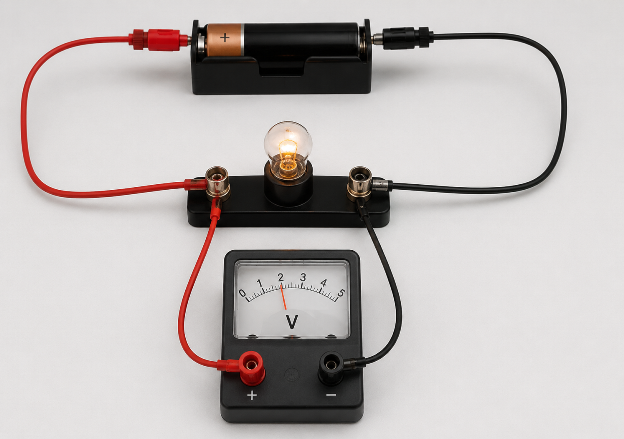
Electricity powers our homes, devices, and industries, yet many students find electrical concepts difficult to understand. Two of the most important ideas in electricity are Electromotive Force (E.M.F) and Potential Difference (P.D). These concepts explain how electrical energy is supplied and how electric current flows in a circuit.
One of the easiest ways to understand E.M.F and P.D is by comparing an electric circuit to the flow of water through pipes. Just as a pump pushes water through a system, a battery pushes electric charges through a circuit. This simple analogy helps explain how voltage is produced, why current flows, and why some energy is lost inside a battery.
In this article, you will learn:
- What Electromotive Force (E.M.F) means
- The meaning of Potential Difference (P.D)
- The difference between E.M.F and P.D
- How batteries supply electrical energy
- The role of internal resistance and lost volts
- Real-life examples of voltage in electric circuits
By the end of this guide, you will have a clear understanding of how electrical energy moves through a circuit and why voltage behaves differently in open and closed circuit
What is Potential Difference?
Potential difference is the work done in moving a unit charge from one point to another in a circuit. It is commonly called voltage and is measured in volts (V).
A simple way to understand potential difference is by comparing it to water flowing between two containers.
Water Flow Analogy
Imagine two containers connected by a pipe:
- If one container has a higher water level than the other, water flows from the higher level to the lower level.
- The greater the difference in water levels, the faster the flow.
- When the water levels become equal, the flow stops.
see the figure below:

(a) Water flows to lower level
This difference in water levels is similar to potential difference in electricity. Charges only flow when there is a difference in electrical potential between two points.
Potential Energy in Water Flow
Water at a higher position possesses gravitational potential energy.
If water is raised to a height , it can flow down to a lower level . The larger the height difference, the greater the energy available to move the water.
Similarly, electric charges move from a point of higher electrical potential to a point of lower electrical potential.
The figure below shows water falling under gravitational force:

A useful way to understand electric potential difference is by comparing it to the flow of water in a closed circuit. Water raised to a higher level possesses gravitational potential energy. The higher the water is raised, the greater its potential energy and the faster it can flow to a lower level. A pump is needed to lift the water back to the higher level and maintain continuous flow. In the same way, a battery supplies energy to electric charges, creating a potential difference that causes them to move through a circuit from a region of higher potential to a region of lower potential.
Let us study the flow of water in figure below, which can be referred to as a water circuit because water flows round a complete ring.

Difference
Water at a height h₁ from the ground level has potential energy because of its position. The greater the height, the higher the potential energy. The rate of flow will depend on the height at which the water had initially been raised. A higher water level results in a faster rate of flow.
The potential energy can be calculated as:
Potential energy = mgh, where m is the mass of water falling and g the gravitational pull on water.
At a height h₀, the water has no potential energy.
If the water is to be raised to h₁, a pump has to be used. So long as the pump in the water circuit is working, the water will move round the complete path, from a point of higher potential energy to a point of lower potential energy.
The pump creates a difference in potential.
The Role of a Pump and a Battery in e.m.f
In a water circuit, a pump raises water to a higher level so that it continues flowing around the system. In an electric circuit, the battery performs a similar role:
- The battery pumps charges to a higher electrical potential.
- These charges then move through the conductor and electrical devices such as bulbs or lamps.
- The movement of charges forms an electric current.
The battery therefore creates the potential difference needed for current to flow.
consider the setup below:

For the charges to move through the conductor, there must be a battery which produces an electrical potential difference at the ends of the conductor. The battery does the work of pumping charges to a high potential so that they can flow. The higher the potential difference (p.d.), the stronger the current in the circuit, if other factors like opposition to flow of current (resistance) are kept constant. The model of the circuit shown in the figure above can help suggest that the function of a battery is to cause a potential difference across a conductor.
Not all the energy supplied by the pump is used to drive the water round the circuit. Some of the energy is lost in moving or raising parts of the pump. Similarly, for the battery, some energy is lost in moving charges through the battery itself. The total energy supplied by the battery is called its electromotive force (e.m.f.).
Potential difference is measured in volts, by an instrument called voltmeter.
Although both e.m.f. and p.d. are measured in volts, the potential difference of a cell is different from its e.m.f. The e.m.f. of a cell is the voltage across its terminals when it is supplying no current in the circuit (an open circuit), while the p.d. of a cell is the voltage across the cell in a closed circuit. in the Figure below: (a) and (b) shows the e.m.f. of the cell as 1.5 V and the p.d. as 1.45 V respectively.

illustrating e.m.f and p.d in a battery
Close the switch to complete the circuit
Open circuit
- No current flows
- Bulb is OFF
- Voltmeter reads the emf
V₁ = 1.50 V
Closed circuit
- Current flows
- Bulb shines brightly
- Voltage drops slightly
V₂ = 1.45 V
When the switch is open No current flows in the circuit (a), therefore the voltmeter reads the full e.m.f of the cell.
When the switch is closed Current flows through the circuit. Some energy is lost inside the cell because of internal resistance. The terminal voltage becomes slightly lower.That is, 1.45V.
The difference between the readings is known as the lost volts, in this case 0.05 V. This voltage is lost because of the opposition to the flow of charges within the cell (internal resistance).”
Electromotive Force (E.M.F)
The total energy supplied by a battery to move charges around a complete circuit is called the electromotive force (e.m.f).
Although both e.m.f and potential difference are measured in volts, they are not exactly the same.
by definition; E.m.f is the voltage across the terminals of a cell when the circuit is open, and no current is flowing.
Difference Between E.M.F and Potential Difference
| Electromotive Force (E.M.F) | Potential Difference (P.D) |
|---|---|
| Energy supplied by the cell | Energy used between two points |
| Measured when no current flows | Measured when current flows |
| Occurs in an open circuit | Occurs in a closed circuit |
| Represents total supplied energy | Represents useful energy delivered |
e.m.f and the Lost Volts
The difference between the e.m.f and the terminal potential difference is known as the lost volts.
Example:
This loss in voltage occurs because of the opposition to the flow of charges within the cell. This resistance is referred to as the internal resistance.
Key Points to Remember
- Charges flow only when there is a potential difference.
- A battery creates the potential difference in a circuit.
- E.m.f is the total energy supplied by a cell.
- Potential difference is the energy used between two points in a circuit.
- Internal resistance causes some voltage to be lost inside the cell.
Conclusion
The concepts of e.m.f and potential difference are fundamental in electricity. Using the water-flow analogy helps simplify these ideas:
- Water level difference corresponds to electrical potential difference.
- A pump corresponds to a battery.
- Water flow corresponds to electric current.
Understanding these concepts provides a strong foundation for studying electric circuits and electrical energy transfer.
Revision exercise
Prepared for physics learners and teachers as a simple guide to understanding electromotive force and potential difference.