Category: Physics

  • Isaac Newton

    Sir Isaac Newton was an English scientist active as a mathematician, physicist, astronomer, alchemist, theologian, and author who was described in his time as a natural philosopher.He was a key figure in the Scientific Revolution and the Enlightenment that followed. His pioneering book ‘Philosophiæ Naturalis Principia Mathematica’ first published in 1687, consolidated many previous results and established classical mechanics.Newton also made seminal contributions to optics, and shares credit with German mathematician Gottfried Wilhelm Leibniz for developing infinitesimal calculus, though he developed calculus years before Leibniz.He is considered one of the greatest and most influential scientists in history.

    Isaac Newton’s Quick Information

    Some few important facts about Isaac Newton:


    Official name: Sir Isaac Newton Newton
    Date of Birth: 25Th December 1642
    Death: 20th March 1727
    Age: 84 years
    Place of Birth: Woolsthorpe Manor, Lincolshire county, England.
    Occupation: polymath
    Height: 5 feet 6 inches(1.68m)
    Father’s Name: Isaac Newton
    Mother’s Name: Hannah Ayscough
    Wife: Never Married
    Siblings: Mary Smith, Benjamin Smith and Hannah Smith.

    Isaac Newton’s Age

    Early Life

    His father died three months before he was born. His mother left her with maternal grandmother when he was three years old in order to marry a clergy man called Reverend Barnabas Smith. He disliked his step father, Mr. Smith and quarried constantly with the mother for marrying him.

    Isaac Newton’s Education

    He joined The King’s School in Grantham,a small town in Lincolnshire,England at the age of 12 and stayed in the school for 5 years. In that school, he learn Latin and Greek. Death of her mother’s second husband caused him to drop out of school. Through intervention of the principal of King’s school, He was readmitted back to school and did well academically.
    He was admitted to Trinity College at the Cambridge University in 1661. He paid for his studies by doing manual jobs in school for the school staffs. In 1964, he was awarded scholarship that covered his university costs for four years until he completed masters of Art degree.

    Newton’s Family

    His Father was called Isaac newton and his mother was called Hannah Ayscough. His father died before he was born, when her mother was six months pregnant.
    He had a step father called Barnabas Smith. His grandmother was called Margery Ayscough and had an uncle called Reverend Willam Ayscough. His uncle influenced his entry to University of Cambridge.

    Newtons wife

    Isaac Newton never married. He only showed some little interest on women when he was a teenage but later showed no interest with them. It is alleged that Isaac Newton died a virgin.However, in his teenage years, he seemed to enjoy company of girls than boys.

    Newton’s contribution to science

    • in 1687 he wrote his first book by title ‘Philosophie Naturalis Principia’ where he prostrated the laws of motion and universal gravitation that form contributed immensely to the scientific world until it was superseded by theory of relativity.
    • He used his mathematical descriptions of gravity to derive Kepler’s law of planetary motion, explain trajectories motions, describe the p recession of the equinoxes and explain for tides.
    • His claim that the earth is an oblate spheroid was later confirmed by many scientist later on.
    • He built the first practical reflecting telescope.
    • He developed a sophisticated theory of color by splitting white light into colors of the visible spectrum.
    • Researched on light and wrote a book called Opticks which was published in 1974.
    • he prostrated the empirical law of cooling
    • He made the first theoretical calculations of the speed of sound
    • Introduced the concept of Newtonian’s fluid.
    • contributed to the study of power series
    • generalized the binomial theorem to non-integer exponents
    • developed a method of approximating the roots of a function
    • classified most of the cubic plane curves
    • He was a fellow of Trinity College and the second Lucasian Professor of Mathematics at the University of Cambridge.

    Final analysis

    Isaac newton is considered a father of classical mechanics. He contributed immensely in the field of Science and mathematics.Isaac Newton feared criticism and controversy. He was not good with interpersonal relationship, but good in mathematical and analytical skills. in later years of his life, he became religious.

  • The Induced Electromotive Force(EMF)

    The Induced Electromotive Force(EMF)

    The Induced Electromotive Force (EMF) is a fundamental concept in electromagnetism that explains how electrical energy can be generated without direct contact between a power source and a conductor. Induced EMF occurs when a conductor experiences a change in magnetic flux, causing an electric potential difference to develop across it.

    This principle, discovered by Michael Faraday, forms the basis of many modern technologies, including electric generators, transformers, and induction motors. Understanding induced electromotive force is essential for students and enthusiasts of physics, as it reveals how magnetic fields and electricity interact to power countless devices in our daily lives. In this article, we will explore the meaning of induced EMF, the factors that affect it, and its practical applications in science and engineering

    Through careful experiments, Scientist Michael Faraday discovered that a wire capable of conducting electric current produces some current when it is made to move through magnetic field.

    Experiments on electromagnetic induction

    Consider the following diagram below

    production of an e.m.f by   moving a conductor across the magnetic fields

    G stands for the galvanometer.

    Galvanometer
    The Induced Electromotive Force (EMF)
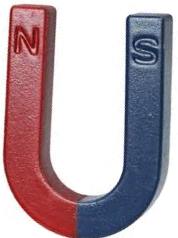
    u-shaped Magnet

    The galvanometer is connected to a copper cable which can be moved up and down between the two poles of the u-shaped magnet in arrangement similar to the following.

    conductor moving inside the magnetic field to show the induced electromotive force (EMF)

    After the setup, one can do the following to the copper rod XY so as to investigate inducement of current.

    • Move it vertically downwards between the poles of the magnet
    • Move it vertically upwards between the poles of the magnet
    • Hold it stationary between the poles of the magnet
    • Move it parallel to the direction of the magnetic field
    • Move it to cut the magnetic field at various angles like 45o,90o,60, etc.
    • Hold the wire stationary and move the magnet upwards and downwards

    here is an animation to show the lab activities:

    EMF: 0.00 V
    Current: None

    Likely observations

    When the wire is moved up, the galvanometer deflects in one direction and when the wire is moved downwards the galvanometer deflects to the opposite direction

    When moved horizontally or held in a fixed position there is no deflection in the galvanometer.

    The magnitude of the induced current increases with the angle at which the conductor cuts the magnetic field and maximum current is observed when angle is about 90o and current is zero when conductor moves parallel to the magnetic field.

    This shows that e.m.f is induced due to the relative motion of the wire or the magnet.

    Investigating EMF using a coil

    A coil of wire, galvanometer and a magnet are set as shown.

    A movement of the pointer on the galvanometer is observed due to the following:

    • When the magnet is moved towards the coil at a steady speed
    • magnet moved from the coil at a steady speed
    • magnet is held stationary in the coil
    • The coil is moved towards and from the magnet
    Observations
    Current: None

    The pointer on the galvanometer deflects in one direction when the magnet is moved towards the coil and in the opposite direction when magnet is moved away from the coil.

    The galvanometer deflects in one direction when coil is moved towards a stationary magnet and to the opposite direction when moved away from the stationary magnet.

    When there is no relative motion between the coil and the magnet, no deflection is observed.

    Explanations

    The magnetic fields exerts force on electrons in a conductor when there is relative motion between the conductor and the magnetic field causing them to flow in the conductor.The movement of electrons causes convection current whose direction can be determined using Fleming’s Left-hand rule.

    Electrons entering a magnetic field are usually deviated as shown in figure below due to force from the magnetic field.

    force on electrons in electromagnetic induction

    Consider a section of conductor XY cutting a magnetic field as shown in figure below.

    From the Fleming’s left-hand rule, it can be determined that the electrons in the conductor experiences a force that pushes them from X to Y causing conventional current to flow in direction YX.

    From the above illustrations and from lab experiments, we conclude that; whenever there is a relative motion between a magnetic field and a conductor capable of carrying current, an induced current flows in the conductor as a result of an induced e.m.f in that conductor

    Revision questions

    Electromagnetic Induction Quiz
    Electromagnetic Induction Quiz

    Related Topics


  • LENGTH

    length is the distance between two fixed points. length is a one dimension quantity. The SI unit for length is the meter (m).
    Other units of length are indicated in the table below.

    UNITSYMBOLEQUIVALENCE IN METERS
    KilometerKm1000
    HectometerHm100
    DecameterDm10
    decimeterdm0.1
    centimetercm0.01
    millimetermm0.001
    micrometerμm0.000001
    table of length prefixes

    MEASUREMENT OF LENGTH
    Length can be estimated or measured accurately using appropriate measuring instrument. The type of instrument to be used at any time depends on two factors:

    • The size of the object to be measured
    • The desired accuracy
      The methods used include;
      a) Approximation/ Estimation
      b) Accurate measuring using standard instruments

    Estimation of length

    This method involves comparing the object to be measured with length of another object that has a known length. For example, the height of a tall flag post can be compared with that of a wooden rod whose length is known.

    Estimations can be done by comparing the sizes of objects directly or sometimes it is better to compare length of an object with that of a chosen basic length called a standard length.

    consider a straight rod of length two metres in length. The rod can be used to estimate height of a tree nearby because the length of their shadows is proportional to their length height. So we can measure length of the shadow caste by the rod and the one caste by the tree. Note that it can be difficult to measure the actual height of the tree using measuring instruments, but by comparing it with that of a straight rod whose height is known, will give quite an accurate approximation of the tree height.

    a tree casting a shadow
    a straight rod caste shadow
    a sun ray relationship with shadow

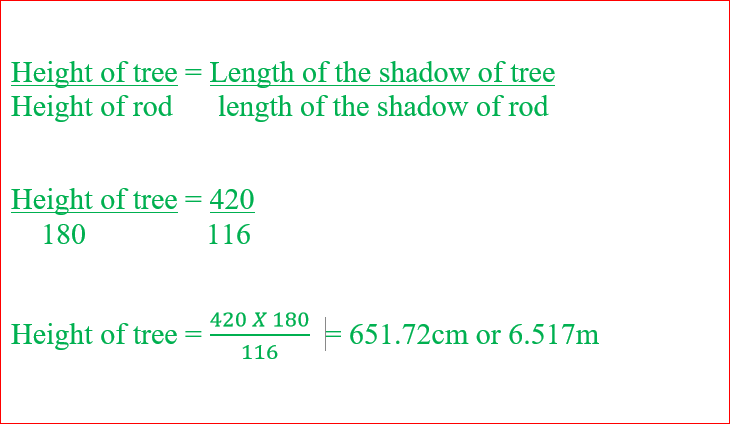
    The following formula is be applied to applied to determine the height of a tree using a straight rod:

    Formula to determine height of a tree

    Suppose there is a tree whose shadow is measured with a measuring tape at 4.00 pm and its shadow is found to be 36.46m. Let us take the length of the shadow caste by our straight rod of 2m to be 6.42m. The height of the tree can then be calculated as below.

    Example Question

    In estimating the height of a tree, the following measurements were recorded:
    Height of the rod = 180cm.
    Length of the shadow of the rod = 116cm
    Length of the shadow of the tree = 420cm
    Calculate the height of the tree.

    Answer

    Converting Kilometers to miles

    1 kilometer (km) = 0.621371192 miles (mi).

    To convert kilometers to miles,we multiply the number of kilometers by the conversion factor (0.621371192) to get the equivalent distance in miles. For example, if you have 10 kilometers and you want to convert it to miles, for example:

    20 km × 0.621371192 miles/km = 12.42742384 miles

    So, 20 kilometers is approximately equal to 12.42 miles.

    Converting centimeter to Inches

    The conversion factor between centimeters and inches can be found from the relationship:

    1 centimeter (cm) = 0.393701 inches (in)

    To convert centimeters to inches, you multiply the number of centimeters by the conversion factor (0.393701) to get the equivalent length in inches. For example, if you have 50 centimeters and you want to convert it to inches:

    50 cm × 0.393701 in/cm ≈ 19.68505 inches

    So, 50 centimeters is approximately equal to 19.68 inches.

    Converting inches to feet

    There are 12 inches in a foot. So, to convert inches to feet, you divide the number of inches by 12. For example, if you have 36 inches and you want to convert it to feet:

    36 inches ÷ 12=3 feet

    36 inches ÷ 12=3 feet

    So, 36 inches is equal to 3 feet.

    24 inches ÷ 12=2 feet

    24 inches ÷ 12=2 feet

    So, 24 inches is equal to 2 feet.

    Questions for practice

    Click to find examination questions about measuring of lengths

    Related pages


  • International System of Units (SI): Definition, Basic Quantities, and Derived Quantities

    International System of Units (SI): Definition, Basic Quantities, and Derived Quantities

    In order to measure we need to know or define the quantity to be measured and the units for measuring it. In 1971 in Paris France, a system known as the International System of Units (Systeme’ Internationale) with seven basic physical quantities and units were agreed upon as shown in table 1.1 below.

    Basic quantitySI unitsSymbols 
    LengthMeterm
    MassKilogramkg
    TimeSeconds
    Electric currentAmpereA
    Thermodynamic temperatureKelvinK
    Luminous intensityCandelaCd
    Amount of substanceMole mol
    table 1.1 the seven basic Physical quantities

    before the SI Units were developed, scientists were using different units of measurements depending on their immediate environment.

    some of the earlier units of measurements used includes:

    • inch which is equivalent to 0.0254 m
    • mile which is equal to 1061m
    • pint which is equal to 0.57 litres
    • gallon which is equal to 4.55 litres
    • pound which is equal to 0.45kg
    • tonne which is equal to 1000kg
    • acre which is equal to 0.41 Hectares
    • grams
    • centimeters
    • seconds

    Basic Physical quantities

    Other quantities can be obtained from these basic quantities and are referred to as derived quantities.

    Derived quantities

    Derived quantities are quantities obtained by multiplication or division of basic physical quantities. derived quantities includes:

    • Area
    • volume
    • density
    • speed
    • Force
    • acceleration
    • Magnetic flux density
    • velocity
    • weight

    As an example, Area can be obtained from multiplying two lengths together. The rectangle below has its shorter length labelled w and it’s longer length labelled l. it’s area is obtained by multiplying l with w. that is, area= l x w

    Area is derived quantity because two lengths are being multiplied together. As an example, consider Speed is defined as distance covered per unit time and is usually given as distance covered/time taken. distance is a length which is a basic quantity and so is the time hence speed is obtained by dividing two basic quantities together.

    Related Topics

    Related Pages