A lens can be defined as a piece of curved glass or plastic that makes things look larger, smaller or clearer when you look through it.
In human eye, one component is a lens and so we can also define lens as the transparent part of the eye, behind the pupil, that focuses light so that you can see clearly.
The idea behind lens operations is that when a light ray passes from air which is more optically denser than the lens material, it is refracted.
When many rays passes through the lens, they all refracted the same way and so they meet at a common point. Sometimes they don’t meet but instead they are scattered after refraction but they are seemed to be spreading from a common point.
Lenses are usually made of glass, transparent plastic or perspex.
common application of lenses includes cameras, spectacles,telescopes, microscopes, film projectors and the human eye.
A thin lens means a lens whose thickness is negligible compared to the radius of curvature of the lens surfaces.
Types of lenses
The basic two types of lenses are convex and concave lenses.
Convex lenses are also called converging lenses as they cause the rays that passes through it to meet at a point. Convex lenses are thickest at the middle and they thin in as you move towards their edge.
In this lesson we will be talking about biconvex lenses meaning that it is symmetrical if we cut it long it’s edges. Both sides of it’s services at the center are bulging outwards and the edges are curved inwards uniformly on both sides.see the figure below
Bi convex lens
showing symmetrical in bi-convex lens
Concave lenses are also called diverging lenses as they cause the rays passing through them to be spreading from a common pint. Concave lenses are thinnest at the middle and they they become thicker as you move towards the edges.
Illustrating concave lens
illustrating bi-concave lens
There are variations of convex and concave lenses as illustrated in figures below
plano convex lens
convex meniscus lens
plano concave lens
concave meniscus lens
Effects of lenses on Parallel rays of light
A cardboard with parallel slits is placed between the mirror and a bi-convex lens as in figure below
The mirror is set such that it reflects the sun rays so that the rays passes through the slits before they reach the lens.
After making observations, the bi-convex lens is replaced with a concave lens
Observation
when a convex lens is used, the rays are converged at a point on the paper and then diverge as they continue as shown.
illustrations of parallel rays as they pass through a bi-convex lens
When concave lens is used , the rays diverge as if they were from the focal point in front of the lens as shown.
illustrations of parallel rays as they pass through a biconcave lens
Investigating convergence and divergence of light using a ray box
A ray box acts as a source of parallel beam. A spot light can also be used.
A parallel beam is directed incident to the the lens as shown
Parallel rays of light incident to a convex lens
A white paper is placed on the other side of the lens and it’s position adjusted until a sharp point is observed.
observation
When a convex lens is used, the rays are converged at a point on the paper and then diverges as they continue as shown below
Parallel beam after passing through a converging lens
If convex lens was replaced with concave (diverging) lens, the rays will be observed diverging as if they are coming from a point on the other side of the lens. see the diagram below.
Parallel beam incident to diverging lens
Explanations
Light is usually refracted when it passes through a glass prism. A lens can be considered as an assembly of many tiny prisms where each prism refracts light as in figure below.
Illustrations of bi-convex lens as an assembly of prisms
Please note that, the middle part of the prism is like a rectangular glass prism and a ray that is incident to it at a perpendicular angle passes through without being refracted. As we may see in other lessons, a ray of light that passes normally through the geometrical center of the lens, passes through undeviated.
The figure below shows representation of concave lens as an assembly of prisms.
illustrations of concave lens as an assembly of prisms
conclusions
Rays of light that passes through a lens converges at a fixed point from the lens if the lens is a converging lens or diverge from a common imaginary point if the lens is a diverging lens.
The point at which the rays emerging from the lens converge or seems to diverge from is referred to as the principal focus.
A convex lens has a real principal focus while a concave lens has a virtual (imaginary) principal focus.
Volume of irregular solids are measured using the displacement method.
A solid whose volume is needed must NOT be soluble in water because the method involves immersing the object in water. Similarly, the object should NOT be able to absorb water nor react with water.
displace methods can be used in two different ways:
Using Measuring cylinder
Using a Eureka can
Using a measuring cylinder
The basic principle behind this method is like that of the Archimedes’s principle because the volume of water displaced by the solid in the measuring cylinder is the actual volume of the solid.
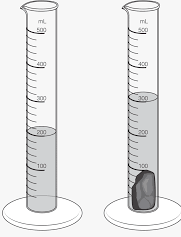
Some water is placed in a measuring cylinder and it’s volume which we call V1 is read and recorded as from the diagram below.
reading of water level before immersing the solid
After the volume is read, the solid is tied on a string and slowly lowered into the measuring cylinder. The new Volume V2 of the liquid is recorded as in figure below.
Level of water after immersing the stone
The change in volume from V1 to V2 represents the addition of volume added by the solid; hence the volume of the solid will be given by
Vs = V2-V1 where Vs = volume of the stone
Using a Eureka can
A Eureka can (also known as a displacement can) is a container with a spout from the side. Any liquid that is beyond the spout level flows out through the spout. It is also known as an overflow can.
Our stone which represents any solid that whose volume can be measured displaces the water causing it to flow through the spout.
Consider the diagram below.
Eureka can before placing the stone
Before the stone is immersed, you ensure that the water is at the level of the spout exactly. It is an important step because it determines accuracy of your measurements.
You ensure the level is correct by adding some water on the can and then wait until it stops overflowing.You then bring a dry and clean measuring cylinder under the spout before lowering the stone as shown here.
after immersing the stone
After the stone is lowered into the can, the water it displaces flows out of the spout.
The volume read from the collected water in the measuring cylinder is the volume of the stone.
Experiment to determine Volume of an objects that floats on water surface
The idea behind the exercise is to tie a floating object onto the object that sinks into water so that both can sink. It is like increasing the density of the floating object so that it exceeds that of water.
Apparatus:
Eureka can
measuring cylinder
plastic cork
small metal block(sinker)
Procedure:
Fill the Eureka can with water such that you allows excess water to flow through the spout as in figure below.
After water has stopped flowing through the spout, place a measuring cylinder under the spout.
Tie the sinker with a thread and lower it gently into the can as in figure below.
Measure the volume V1 of the water that overflows and is collected into the measuring cylinder.
Remove the sinker and tie it to the cork as shown
Fill the Eureka can again and allow excess water to flow out
When water stops flowing from the spout, place a dry clean measuring cylinder under the spout.
Lower the sinker and the cork tied together gently into the eureka can as illustrated below.
Measure the new volume V2 that is collected into the measuring cylinder.
The water collected in the measuring cylinder is the volume of the sinker and cork combined. If we subtract the volume V1 collected earlier for the sinker alone, we finds the volume of the cork.
Therefore, Volume of the cork Vc = V2-V1
Conclusion
In this lesson, we discussed about finding volume of irregular solids. The method we discussed is called displacement method and it involves immersed the object in water and determining amount of water that is displaced by the object.
Albert Einstein was a Jew born by Jews Parents living German Empire in 19th century And became a theoretical physicist who is considered one of the greatest and most influential scientists of all time.
He is best known for his theory of relativity and development of quantum mechanics.
He was a central figure in reshaping the scientific understanding of nature in modern physics which had been accomplished in the first decades of the twentieth century.
His equation that relates mass with energy, E=mc2 is considered the world’s most famous equation.
Einstein’s Quick facts
Here are few things you may need to know about Albert Einstein.
Real Name: Albert Einstein
Gender: Male
Age: Died at 76 years 0 months 25 days
Birth Date: 14th March 1879
Place of Birth: Ulm, Kingdom of Württemberg, German.
He was born in Ulm in the n the Kingdom of Württemberg in the German Empire, on 14 March 1879 by secular Askenazi Jews.
His father, Hermann Einstein was a salesman and an engineer who had married Einstein’s mother Mrs Pauline Koch,a Jew.
His Family moved to Munich’s borough(District) of Ludwigsvorstadt-Isarvorstadt where his father partnered with his uncle Jakob to establish a company that manufactured D.C electrical equipments.
Albert Einstein was enrolled at Catholic elementary school in Munich in 1884. In 1887, he was transferred to Luitpold-Gymnasium where he received advanced primary and secondary education.
His father’s company failed to secure a contract to install electric lighting in Munich beacuse it lacked a capacity to provide alternating current (A.C) technology which was needed. Consequentially, they sold the company and moved the family to Milan Italy and few months later, they moved to settle at Palazzo Cornazzani in Pavia, in Lombardy, where they lived between 1895 and 1896. Einstein was left at Munich so that he can finish school.
His father wanted him to study electrical Engineering but he was irritable and quarrelsome child that criticized school. He was quoted saying that the school’s policy of strict rote learning could never help in creativity.
At the end of December 1894, a letter from a doctor persuaded the Luitpold’s authorities to release him from its care, and he joined his family in Pavia.
Einstein the genius
Einstein excelled in physics and mathematics from an early age and quickly acquired mathematical skills that could match the ability of students that were several years ahead of him in school.
A family tutor, Max Talmud, expressed frustrations with Einstein beacuse Einstein speed of learning was higher than the teacher could catch up.
By age of fourteen, he had already mastered the concepts of integral and differential calculus. At age of twelve, he confidently claimed that nature could be described as a mathematical structure.
His tutor said that at age of only thirteen, he could understand and enjoy Kant’s Critique of Pure Reason which was usually difficult to understand by common people.
Albert Einstein Education
Albert Einstein sat the entrance examination for the federal polytechnic school in 1895 in Zürich, Switzerland and failed to reach the required standard in the general part of the test though he performed with distinction in physics and mathematics.
He completed his secondary education at the Argovian cantonal school (a gymnasium) in Aarau, Switzerland and graduated in 1896.
He enrolled in the four-year mathematics and physics teaching diploma program at the Federal polytechnic school in 1896.
Einstein graduated from the Federal polytechnic school in 1900, duly certified as competent to teach mathematics and physics.
He successfully acquired Swiss citizenship in 1901 but was rejected for Switzerland mandatory millitary service and could not be accepted for a teaching position in any school in Switzerland within two years of looking for a job.
career life
However with a help of his friend’s father, a friend who was also a classmate, he was able to secure a job at Swiss Patent Office as an assistant examiner-level III. In 1903, he was confirmed in permanent basis in the company.
It is suspected that his work experiences in the job contributed to his insights about his special theory of relativity.
He stayed in his job long time without being promoted because they claimed that he could not master machine technology.
He arrived at his revolutionary ideas about space, time and light through imagining experiments about the transmission of signals and the synchronization of clocks, matters which also figured in some of the inventions submitted to him for assessment.
In 1902, together with friends he had met in Bern, they formed a science club they called ‘Olympia Academy’ in which they met regularly to discuss science and philosophy.
When in sabbatical leave as a civil servant, he secured a junior teaching position at the University of Bern.
A lecture he gave on relativistic electrodynamics in 1909 in University of Zurich as an invited guest earned him a position in the university as an associate Professor through the influence of Alfred Kleiner, A Swiss Physicist and a professor of Experimental Physics at the University of Zurich.
He was promoted to full professorship in 1911 when he accepted a position of departmental chair at the German Charles-Ferdinand University of Prague in Czech republic which caused him citizenship in Austro-Hungarian Empire.
In 1912, He returned to Federal Institute of Technology in Zurich to take up a position of departmental chair in theoretical Physics.
His fields of specialization in teaching included thermodynamics and analytical mechanics.
His research interests included :
Molecular theory of heat
Continuum mechanics
Development of a relativistic theory of gravitation
He research work was partnered with his friend, Marcel Grossmann, who helped him with mathematical modelling in his works.
Max Plank and Walther Nernst visited Zurich in 1913 and successfully convinced Einstein to relocate to Berlin using their influence to provide him positions in Prussian Academy of science, kaiser Wilhem Institute of Physics and Humboldt University with good salary but without teaching duties that could burden him. He partly accepted their offer because Berlin was a home to his girlfriend, Elsa Löwenthal.
He moved into an apartment in the Berlin district of Dahlem on April 1914 and was installed in his Humboldt University position after a short time.
Einstein’s Marriage and Relationships
He fell in love with a daughter of a family that had accommodated him while he was trying to finish secondary school at the Argovian cantonal school (a gymnasium) in Aarau, Switzerland.
While in polytechnic, he befriended the only woman in their class, Serbian, Mileva Marić and Einstein spent most of his time in college with her as they discussed their shared interest in physics and who become his study partner.
He married his first wife, Serbian, Mileva Marić in 1903 and they gave birth to a son called Hans Albert while they were in Bern, Switzerland In 1904.
While in Zurich, Their second son Eduard was born in 1910.
Einstein entered into a relationship with Elsa Löwenthal In 1912, who was both his first cousin on his mother’s side and his second cousin on his father’s. This caused Marić to return to Zurich with her two sons and they successfully applied for a divorce in 1919 on the grounds of having lived apart for five years. Einstein married Elsa Löwenthal the same year.
Four years later he began a relationship with a secretary named Betty Neumann, the niece of his close friend Hans Mühsam.
Löwenthal nevertheless remained loyal to him, accompanying him when he emigrated to the United States in 1933. In 1935, she was diagnosed with heart and kidney problems and She passed on in December 1936.
A volume of letters discovered by Hebrew University of Jerusalem added further names to the list of women he was romantically related to. About six of them.
After being widowed, Einstein was briefly involved in a relationship with Margarita Konenkova who was believed to be a Russian spy and who was married to a Russian sculptor Sergei Konenkov.
His son eduard was diagnosed with schizophrenia. He spent the remainder of his life in the care of his mother or sometimes in asylum. After death of his mum, he was permanently committed to Burghölzli, the Psychiatric University Hospital in Zürich, until his death in 1965.
Mileva Marić suffered a severe stroke and died at age 72 in 1948, in Zürich. She was burried at Nordheim-Cemetery.
Rise to Fame
Einstein began his new life as an intellectual icon in America after arriving there on 2nd April 1921. He was welcomed to New York City by Mayor John Francis Hylan and then spent three weeks giving lectures and attending receptions. He spoke several times at Columbia University and Princeton and in Washington, he visited the White House with representatives of the National Academy of Sciences. He returned to Europe via London, where he was the guest of the philosopher and statesman Viscount Haldane. He used his time in the British capital to meet several people prominent in British scientific, political or intellectual life, and to deliver a lecture at King’s College.
Einstein and politics
Einstein’s political view was in favor of socialism and he was noted criticizing capitalism. He was among the founder of a political party, German Democratic party.
He was called on to give judgments and opinions on matters related to society away from science and mathematics.
He criticized a political party that took power in Germany in 1917 for not having a well regulated system of government and called their rule a regime of terror and a tragedy in human history.
He strongly advocated the idea of a democratic global government that would check the power of nation states in the framework of a world federation.
Contribution to science
He published more than 300 scientific papers and 150 non-scientific ones.
On 5 December 2014, universities and archives announced the release of Einstein’s papers, comprising more than 30,000 unique documents.
He also collaborated with other scientists on additional projects including the Bose–Einstein statistics, the Einstein refrigerator and many others works.
His Annus Mirabilis papers of 1905 contains four articles pertaining to the photoelectric effect which gave rise to quantum theory, Brownian motion, special relativity and the famous Einstein’s equation, E=mc2. This four articles contributed immensely to the foundation of modern Physics and changed views about space, time and matter.
His paper submitted in 1900 to Annalen der Physik was published in 1901 with the title “Conclusions from the capillary phenomena” that describes capillary attraction.
Two papers he published between 1902 and 1903 were the foundations on publication about Brownian motion which showed that Brownian Movement can be constructed as firm evidence that molecules exist.
The theory of critical opalescence publication discussed the problem of thermodynamic fluctuations giving a treatment of the density variations in a fluid at its critical point.
His paper on On the Electrodynamics of Moving Bodies published on June 1905 resolved the conflicts between Maxwell’s equation and the laws of Newtonian mechanics by introducing changes to the laws of mechanics.
He developed the Theory of general relativity between 1907 and 1915 that has become an essential tool in modern astrophysics providing the foundation for the current understanding of black holes.
In 1911, He published an article on the Influence of Gravitation on propagation of light adding on 1907 publications in which he estimated the amount of deflection of light by massive bodies enabling theoretical predictions of general relativity to be tested experimentally for the first time.
In 1916, Einstein predicted gravitational waves ripples in the curvature of spacetime which propagate as waves, traveling outward from the source, transporting energy as gravitational radiation.
He started a research about general relativistic field theory where he looked for fully generally covariant tensor equations and searched for equations that would be invariant under general linear transformations only which gave birth to the draft theory of 1913.
Einstein applied general theory of relativity to the structure of the universe as a whole. He discovered that the general field equations predicted a universe that was dynamic, either contracting or expanding.
Einstein collaborated with Nathan Rosen to produce a model of a wormhole, often called Einstein–Rosen bridges in 1935.
Liquids takes the shapes of the container but have fixed volume. Hence apparatus has been devices to measure conveniently and precisely volume of a liquid.
This article describes the idea behind calibration of measuring cylinders and discuss some important apparatus used to measure volume. They apparatus includes:
Measuring Cylinder
Volumetric flasks
beakers
pipettes
burettes
user customized apparatus
Introduction
liquids have no definite shape but assumes the shape of the containers in which they are put in.
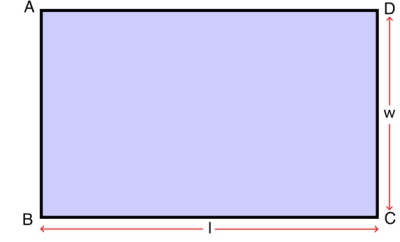
One of the methods that can be used to measure volume of a liquid is to pour the liquid into a container of uniform cross-section as shown in figure below.
The volume of the liquid is obtained from the formula:
Volume = cross-section area x height
i.e V = Ah
For the diagram above, area of the cross-section is given as l x b.
This is because the cross-section area of the prism is a rectangle.
Considering the space occupied by the liquid in the container as having shape of a rectangular prism, The volume of the liquid can thus be determined.
using the above diagram, the volume of the liquid in the container = l x b x h=lbh
Relationship between volume and height a liquid
if area of a container is not changing, then increase in volume of the liquid will be reflected in the increase of height of the liquid column.
In the following, we investigate the change how change of liquid height is affected by volume.
Apparatus
Rectangular container
A cylinder
procedure
Take two containers. P with a rectangular base and Q with a cylindrical base.
Container Q is uniformly calibrated as in figure below
pour some water into P and find it’s volume V.
Transfer the water from P to Q and record the height h of water in Q.
Repeat the above procedures for different values of V and record corresponding values of h as in the table below.
Volume V(cm3)
150
200
300
400
500
600
800
height h(cm)
0.97
1.30
1.95
2.60
2.35
3.90
5.20
(v/h)cm2
154.64
153.84
153.85
153.85
153.85
153.85
153.85
a table for Volume against height of a liquid in a uniform container
Draw the graph of V against h
In practice,measuring vessels are made of cylindrical form that have its height calibrated uniformly so that each level of height represents the volume putting in mind that the bottom surface area is fixed and cannot change.
Increase in height shows increase in volume and so the volume that is represented by a particular height can be conveniently indicated on each level of height so that it can always be read off directly without using the formula; V=BaseAarea X height.
Measuring Instruments marked as described above are called measuring cylinders and are commonly used in measuring liquid volumes.
Measuring cylinders are usually made of glass or transparent plastic and graduated incm3 or milliliters(ml).
Measuring cylinders of various capacities
other instruments that can be used to measure volumes includes:
Measuring flasks
pipettes
burettes
beakers
Measuring flasks
Also known as volumetric flasks.
It is commonly used in laboratories to transfer known volumes of liquids.
A volumetric flask is usually calibrated to contain a precise volume at a certain temperature and are used for precise dilutions and preparation of standard solutions. These flasks are usually pear-shaped, with a flat bottom, and made of glass or plastic.
Measuring flask of capacity 500ml with some chemical solution.
pipettes
A pipette is usually used to transport a measured volume of liquid.
It’s name comes from the word pipe because it has a pipe like shape. Mostly it transfers liquids of less than 250ml in volume.
a bulb-type pipette
Burettes
A burette is a long graduated glass tube with a tap at lower end and of a fixed capacity with a tapered capillary tube at the tap’s outlet. Typical burettes ranges from 50ml to 500ml in capacity. stop-cock valve controls the flow of liquid from the burette so that a precise amount of liquid is fetched at any given moment.
An illustration of a burette
The scale of a burette starts from zero at the top and increases downward to the maximum value.
In the diagram above, volume marking markings reads 20ml. This means 20ml of the liquid has been removed from the burette and so the volume left is (50-20)ml = 30ml.
Beaker
A beaker is a cylindrical container with flat bottom. It usually have a small spout (beak) to aid pouring. Beakers are of various capacities and the largest can carry several litres of liquid.
Unlike a volumetric flask, beaker have a straight curved surface as opposed to sloping sides.
Beakers are usually made of glass (borosilicate glass), but can also be in metal (stainless steel or aluminum) or certain plastics, notably polythene or polypropylene.
Beakers are common lab apparatus.
How to use a measuring cylinder and beaker
When reading volumes, the reading should be taken with the eye positioned with the bottom of meniscus as in figure below.
How to use a measuring cylinder
Conclusion
In this article, we have described various instruments used to measure volumes and highlighted their special features . We have described how to calibrated a measuring cylinder using principles of regular prism. we have discussed some apparatus like beaker,volumetric flasks,pipette and burettes.
according to oxford dictionary,solid means hard or firm.
A regularly shaped solid is an object with a definite shape that can always be described. Each regularly shaped solid have a known geometrical shape and hence can be identified by name.
Some of the common known regular solids includes:
Cube
A cube is a six sided object with all its edges equal in length. A cube has a solid shape with six square faces all equal in area and lengths.
The cube
The volume of a cube (Vcube) is given by Vcube= l x l x l = l3 where l is the length of the edge of the cube.
cuboid
A cuboid is an object with six faces where each pair of the opposite faces are equal in shape and size. Cuboid means “like a cube” because it has the same shape with a cube, except that all its sides are not equal.
The figure below shows a cuboid with one edge named length, another one named width and the other one named height.
Volume of a cuboid (Vcuboid) will be given by Vcuboid = Length x Width x Height
Cylinder
A cylinder is a three dimensional object consisting of two parallel circular surfaces that are connected by a curved surface. The distance between the two circular faces is a fixed distance and is usually refereed to as the height of the cylinder. There is an imaginary line that passes through the center of the circles and perpendicular to the circles known as the axis.
A cylinder with radius r and height h
Volume of a cylinder (Vcylinder) is given by Vcylinder = BaseArea(BA) x height(h) where BaseArea is the area of one of the circular face given by Area (A) = πr2 hence Vcylinder = πr2 h
Sphere
A sphere is a geometrical object that is round in shape and is defined in a three-dimensional space without any face.
Volume of a sphere (Vsphere) will be given by ;
Vsphere = (4/3)πr3
where r the radius and π a mathematical constant.
Cone
A cone is a three-dimensional shape with a flat circular base and a curved surface that forms a sharp point at the top. The sharp point is called the vertex.
The three parts that makes a cone are its radius, height, and slanting height. Radius r is the distance between the center of the circular base to any point on the circumference of the base.
The slant-height l is defined as the distance between the vertex of the cone to any point on the circumference of the circular base.
The height h of a cone is the distance between the vertex and the center of the circular base.
Figure below illustrates a cone
Volume of a cone (Vcone) will be given by Vcone = (1/3) πr2h.
but πr2h = volume of a cylinder.
hence Vcone = (1/) x Volume of a cylinder
Prisms
An octagonal prism
A prism is a three-dimensional object with two identical surfaces facing each other usually referred to as the bases of a prism. The base of the prism is usually called the cross-sectional area.
Length of the prism is distance between the two identical surfaces.
The base of the prism can assume varied shapes hence we have different types of prisms like:
square prism
triangular prism
rectangular prism
pentagonal prism
hexagonal prism
octagonal prism
nonagonal prism
decagonal prism
hendecagonal prism
Dodecagonal prism
tridecagonal/triskaidecagonal prism
tetradecagonal prism
pentadecagonal prism
e.t.c.
To get the volume of the prism, you simply gets area of the base and multiply it with the length of the prism. hence
volume a prism = cross-section Area(A) x length (l).
Volume of a Hexagonal prism
The hexagonal prism is a prism with hexagonal base. The word hexagonal comes from the word hexagon. In geometry, a hexagon is a six-sided polygon.
so volume of Hexagonal prism is given as a product of the area of the hexagonal base and the length between the two hexagonal ends.
A regular hexagon has six sides each with the same length. By drawing lines from vertices that are joining at the center of the hexagon, six isosceles triangles can be obtained from the hexagon. The area of the hexagon is equal to area of one triangle multiplied by number of triangles.
In physics, volume is a measure of the three-dimensional space occupied by a substance or enclosed within a container. It is typically measured in cubic units such as cubic meters (m³) or cubic centimeters (cm³).
Volume as a three dimensional quantity, is obtained when three lengths are multiplied together.
Another popular definition is that volume is a measure of space.
because volume results from product of three lengths, the SI unit of volume is cubic-meter(m3). That is, SI unit of volume is the cube of the SI unit of length. This tells us that volume is a derived quantity.
However, There are common sub-multiples of volumes like:
cubic-centimeters (cm3)
cubic-millimeters (mm3)
cubic-micrometers (µm3) ………….just to name a few.
1m3 =1m x 1m x1m
but 1m =100cm
hence 1m3 =100cm x 100cm x 100cm = 1000000cm3.
From Volume, we can find units of capacity like litres(l) and millitres(ml).
1 ml =1cm3
1 litre = 1000ml
1 m3 = 1000 litres.
when you buy a half litre packet of milk from the supermarket, you are actually buying 500ml of milk.
Example
Express 43.5mm3 into m3.
Solution
Example
convert 0.00006 m3 into cm3
Solution
practice Questions
The radius of a typical atom is considered to have a volume of 10-10m3. Express the given volume in:
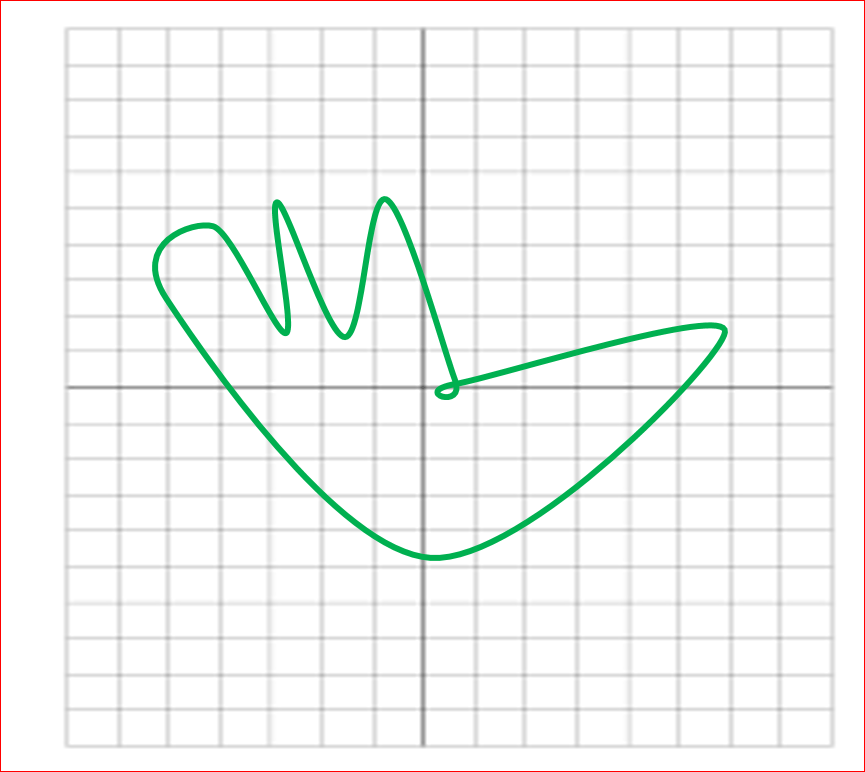
Irregular shapes are shapes that cannot be precisely described in terms of geometrical shapes. Their edges and vertices are not uniform.
An estimate of the area of an irregular shape can be made by dividing the shape up into squares each of area 1 cm2 . By counting the number of small squares, the area of the irregular shape can be estimated. consider the diagram below.
in the figure above, the number of squares that are completely covered by the shape are 39. The number of squares that have been touched by the figure (partially covered) are 30. confirm by counting.
The area is thus calculated as follow:
Area covered by complete squares = 39 cm2 .
Area covered by partially covered squares = 30/2= 15cm2 .
Therefore the area covered by the figure =( 39 + 15 ) cm2=54 cm2
Hence the estimated area of the given figure is 54 cm2
Area is the quantity that expresses the extent of a given surface on a plane and it is a derived quantity of length. Area is obtained from product of two lengths. The SI Unit of square metre (m2).
square metre can be expressed into other units like square-centimeter (cm2), square-millimeter(mm2) or square-kilometer (km2).
1 m2 = 1m x 1m
but 1m = 100cm
hence 1m2 =100cm x 100cm
and so 1m2 =10000cm2
similarly;
1m = 1000mm (millimeters)
1m2 =1000mm x 1000mm =1000,000 mm2.
1 km2 =1000m x 1000m = 1000,000 m2.
we will go ahead and convert area in square meters to some other units
Express the following into square-centimeter (cm2)
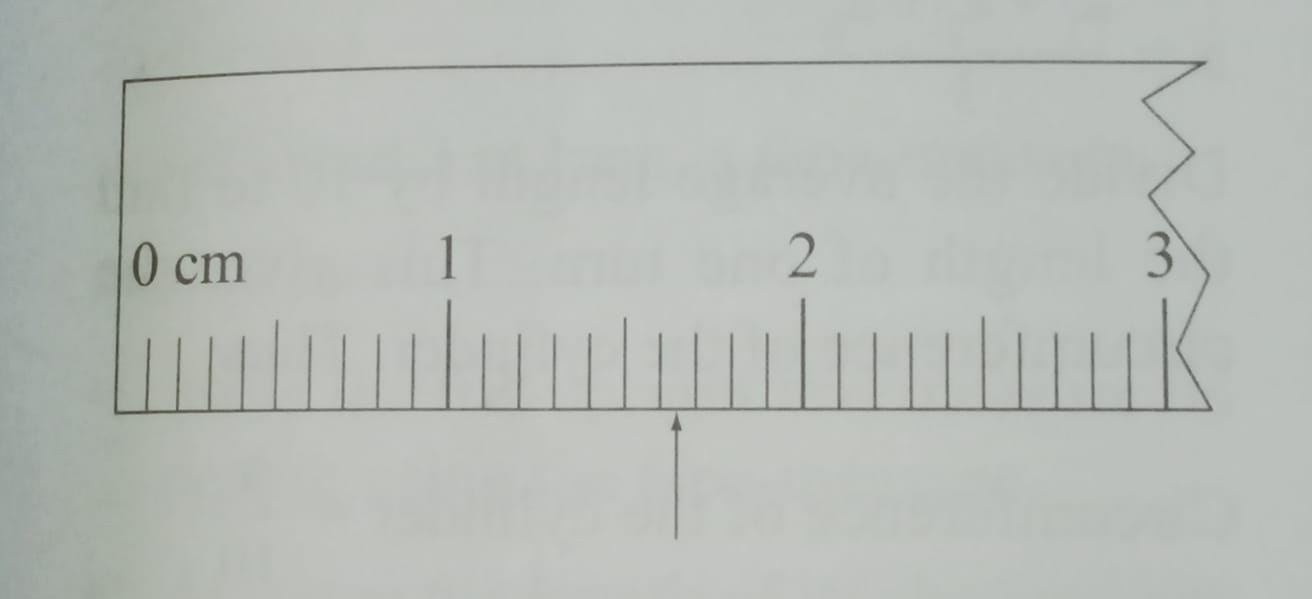
most of people don’t read metre rule correctly. A metre rule has 100cm and between two consecutive centimeter marks there are gaps. The gaps between centimeter marks can be reduced by dividing the gap into smaller sub units. When divided into 10 equal divisions, then each of such smaller division is called a millimeter because it will be dividing the metre length into 1000 divisions with each divisions being equal to 0.001m. Then the accuracy of the meter rule can be said to be equal to 1/1000 of a metre(0.001m). when the rule is calibrated into centimeter divisions alone, then the metre length is divided into 100 divisions with each divisions being equal to 0.01m. the accuracy of the measurements taken by such a rule is thus (1/100)m=0.01m).
consider the reading shown by the arrow in figure below.
demonstrating reading of a meter rule
The reading above is more than 1.6 cm but less than 1.7 cm. The position of our point object is not lying on exact reading. we cannot precisely state what measurement it is because it is not indicated. there is an empty gap and we need to approximate that extra length beyond the 1.6 cm because it is not indicated. We can increase the accuracy of the meter rule by dividing the gap into smaller divisions. suppose we approximate the second decimal to be 1.65 cm, there is nothing that prevents us from stating it as 1.66 cm,1.67 cm or even 1.64 cm.
The second decimal place cannot be accurately determined. Nevertheless, the readings from a meter rule may be written up to the second decimal place of a centimeter.
A reading like 2.584 cm cannot be taken by a metre rule. In later lessons, we will discuss how to increase the decimal places in measurement of length using other special instruments like micrometer screw-gauge.
If the readings of 3.6 cm and 7 cm are taken with a meter rule, then they should be written as 3.60 cm and 7.00 cm respectively. This is because a meter rule is calibrated to an accuracy of 0.01 m (100 divisions).
Practice Question
Record the readings indicated by P1,P2 and P3 shown in the figure below.
Answer to practice question
P1=69.50 cm (approximations done)
P2=71.00cm
p3=71.50cm
Practice Exercise
State the readings indicated by the arrows in the figures below
A ruler is a tool mostly used to measure small lengths.A metre rule has a length of one metre, which is equal to one hundred centimeters.
A ruler, also known as a rule, scale and sometimes a line gauge, is an instrument used to measure lengths. A user estimates a given length by reading from a series of markings called rules along an edge of an object whose measurements are required. Mostly it is a rigid straightedge which allows one to draw straight lines.
you can use a meter rule to determine approximation of given length or you can use the rule to get accurate measurements.
Approximation – This includes estimating the length.
Using a standard measure(instruments)
Meter rules and half meter rules are used.
They are graduated in centimeters and millimeter.
They are made of wood, plastic or steel.
How to read a ruler
Reading measuring instruments at an angle can make us read incorrectly. To be able to read a ruler accurately and effectively, proceed as follows:
Put the zero (0) mark to coincide with the start of the object to be measured.
Look perpendicular to the edge end of the measurement taken
For accurate reading, always place your eyes vertically above the mark to avoid parallax. see figure 1.1 below
The figure below shows the correct measurement of length using metre rule:
figure 1.4: using a meter rule correctly
Errors associated with measuring with a ruler includes:
The end of the object is not aligned to the zero mark of the meter rule scale as shown.
figure 1.2 : rule not aligned with the zero mark of the object
The rule is not in contact with the object
figure 1.3: rule not in contact with the object
The error that occurs when the position of the eye is not perpendicular to the scale is called parallax error
Contains information related to marketing campaigns of the user. These are shared with Google AdWords / Google Ads when the Google Ads and Google Analytics accounts are linked together.
90 days
__utma
ID used to identify users and sessions
2 years after last activity
__utmt
Used to monitor number of Google Analytics server requests
10 minutes
__utmb
Used to distinguish new sessions and visits. This cookie is set when the GA.js javascript library is loaded and there is no existing __utmb cookie. The cookie is updated every time data is sent to the Google Analytics server.
30 minutes after last activity
__utmc
Used only with old Urchin versions of Google Analytics and not with GA.js. Was used to distinguish between new sessions and visits at the end of a session.
End of session (browser)
__utmz
Contains information about the traffic source or campaign that directed user to the website. The cookie is set when the GA.js javascript is loaded and updated when data is sent to the Google Anaytics server
6 months after last activity
__utmv
Contains custom information set by the web developer via the _setCustomVar method in Google Analytics. This cookie is updated every time new data is sent to the Google Analytics server.
2 years after last activity
__utmx
Used to determine whether a user is included in an A / B or Multivariate test.
18 months
_ga
ID used to identify users
2 years
_gali
Used by Google Analytics to determine which links on a page are being clicked
30 seconds
_ga_
ID used to identify users
2 years
_gid
ID used to identify users for 24 hours after last activity
24 hours
_gat
Used to monitor number of Google Analytics server requests when using Google Tag Manager