A leaking cooking gas cylinder is a serious emergency that can quickly lead to a fire, an explosion, serious injuries, or even death. In many cases, accidents occur not because of the leak itself, but because someone unknowingly does the wrong thing after detecting the smell of gas.
Knowing the correct actions to take can make the difference between a close call and a tragedy.
First, Stay Calm
If you smell cooking gas or hear a hissing sound near your gas cylinder, do not panic. Panic can lead to poor decisions. Instead, think clearly and follow the safety guidelines below.
❌ DON’TS – Things You Should NEVER Do
1. Don’t Light Matches, Candles or Lighters
This is the most dangerous mistake people make.
Even a tiny flame can ignite accumulated gas and cause a devastating explosion.
2. Don’t Smoke
Never smoke anywhere near a suspected gas leak.
A burning cigarette can ignite leaking gas instantly.
3. Don’t Switch Electrical Appliances On or Off
Avoid operating:
Light switches
Ceiling fans
Television
Refrigerator switches
Chargers
Power sockets
Doorbells
Many electrical switches produce tiny sparks that are invisible to the eye but are capable of igniting gas.
4. Don’t Use Electrical Fans to Remove the Gas
Although it may seem like a good idea to blow the gas outside, switching on an electric fan may create a spark.
Instead, rely on natural ventilation by opening doors and windows.
5. Don’t Use Mobile Phones Inside the House
If you need to make a call, first leave the building.
Once you are in a safe outdoor location, contact the appropriate emergency services.
6. Don’t Search for the Leak Using Fire
Never use:
A match
A lighter
A candle
Burning paper
People have lost their lives attempting to “see where the leak is” using a flame.
Always use soapy water instead.
7. Don’t Ignore the Smell
Some people assume the smell will disappear on its own.
Never ignore even a faint smell of gas.
A small leak can quickly become a large one.
8. Don’t Continue Cooking
If you notice the smell of gas while preparing a meal, stop immediately.
Turn off the gas supply if it is safe to do so and leave the area.
Finishing your meal is never worth risking your life.
9. Don’t Attempt Repairs Unless You Are Qualified
Do not dismantle:
Regulators
Gas valves
Burners
Cylinders
Improper repairs can make the leak worse.
Always leave repairs to trained professionals.
10. Don’t Re-enter the House Until It Is Safe
Even if the smell appears to have disappeared, do not return inside until you are confident the leak has been stopped and the building is safe.
If emergency responders are on the scene, wait until they tell you it is safe to re-enter.
Common Mistakes That Cause Gas Explosions
Many household gas explosions occur because someone:
Lights a match to investigate the smell.
Turns on the kitchen light.
Continues cooking despite smelling gas.
Switches on an electric fan.
Attempts to repair the cylinder while it is leaking.
Ignores a hissing sound from the regulator or hose.
Uses a damaged hose or faulty regulator.
Stores gas cylinders in poorly ventilated spaces.
Avoiding these mistakes greatly reduces the risk of an accident.
✅ DO’S – What You Should Do Immediately
1. Turn Off the Gas Cylinder Valve
If you can safely reach the cylinder, turn the valve clockwise to stop the flow of gas.
Stopping the leak at its source prevents more gas from escaping into the room.
If the leak is too large or the valve cannot be reached safely, leave the building immediately.
2. Open All Doors and Windows
Open every door and window to allow fresh air into the room.
Cooking gas can accumulate near the floor and in enclosed spaces. Good ventilation helps disperse the gas and reduces the risk of ignition.
Leave doors and windows open until the smell has completely disappeared.
3. Evacuate Everyone
Ask everyone in the house to leave immediately.
Help children, elderly people, persons with disabilities, and pets to move to a safe location outside the building.
Remain outside until the leak has been identified and fixed.
4. Warn Other People
Inform your neighbours or anyone nearby about the gas leak.
Prevent anyone from entering the house while gas is still present.
5. Call for Professional Help
Once you are safely outside:
Contact your LPG supplier.
Call the fire and rescue service if necessary.
Contact a qualified gas technician.
Never assume the leak has stopped unless it has been inspected.
6. Check the Gas Hose and Regulator
After the emergency has been resolved, inspect:
The rubber hose
The regulator
The burner connections
Replace worn or damaged parts immediately.
7. Test for Small Leaks Safely
If you suspect a tiny leak after reconnecting the cylinder:
Mix liquid soap with clean water.
Apply the solution to the hose connections.
Watch for bubbles.
Continuous bubbles indicate escaping gas.
This is the safest method for checking leaks.
8. Keep Emergency Numbers Nearby
Save the contact numbers for:
Your gas supplier
The local fire brigade
Emergency medical services
A licensed gas technician
Having these numbers readily available saves valuable time during an emergency.
A Simple Rule to Remember
Whenever you suspect a gas leak, remember these five steps:
Stop – Turn off the gas supply if it is safe.
Open – Open doors and windows to let the gas escape.
Leave – Evacuate everyone from the building.
Call – Contact your gas supplier or emergency services from outside.
Wait – Do not return until the leak has been repaired and the area is safe.
Final Safety Message
A gas leak is never something to ignore. One wrong action—such as lighting a match or switching on a light—can turn a manageable situation into a deadly explosion.
The safest response is to avoid anything that could create a spark, ventilate the building, evacuate immediately, and seek professional help. By following these simple do’s and don’ts, you can protect your home, your family, and your neighbours from preventable fires, injuries, and loss of life.
Remember:If you smell gas, don’t investigate with a flame—leave, ventilate, and call for help. Your life is worth far more than your property.
Mathematics is one of the most important subjects in the KCSE curriculum, requiring both a strong understanding of concepts and consistent practice. One of the most effective ways to prepare for the examination is by working through past KCSE Mathematics papers. This blog provides students, teachers, and parents with access to a wide collection of KCSE Mathematics past papers, helping learners familiarize themselves with the exam format, improve problem-solving skills, and identify commonly tested topics. Whether you are preparing for your final exams or simply looking to strengthen your mathematical abilities, these resources will help you build confidence and achieve better results in the KCSE Mathematics examination.
Electromagnetic induction is the phenomenon in which an electromotive force (e.m.f.) is produced whenever the magnetic flux linking a conductor changes. This principle, discovered by Michael Faraday in 1831, has transformed modern electrical engineering and led to the invention of devices that have become indispensable in everyday life. Among its many applications are the transformer, the moving-coil microphone, and the induction coil. Of these, the transformer stands out as one of the most significant because it makes efficient generation, transmission, and distribution of electrical energy possible.
Have you ever wondered how electricity generated at a power station reaches homes, schools, hospitals, and industries hundreds of kilometers away without losing most of its energy? Or why your phone charger can safely convert the 240 V mains supply into just a few volts for charging your device?
The answer lies in one of the most important applications of electromagnetic induction—the transformer.
What is a Transformer?
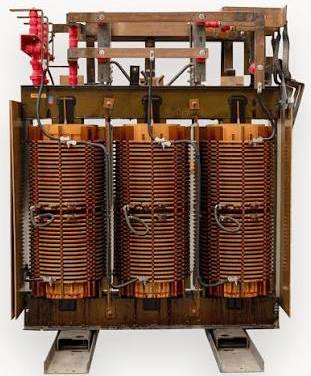
A transformer is an electrical device that transfers electrical energy from one circuit to another through the process of mutual induction. Unlike many electrical devices, a transformer has no moving parts, making it highly efficient and reliable.
It consists of two separate coils of insulated copper wire wound around a common laminated soft iron core:
The primary coil, which is connected to an alternating current (AC) power source.
The secondary coil, from which electrical energy is obtained.
When an alternating current flows through the primary coil, it produces a continuously changing magnetic field in the iron core. This changing magnetic field links the secondary coil, inducing an alternating e.m.f. across it according to Faraday’s Law of Electromagnetic Induction. Since the coils are electrically isolated but magnetically linked, energy is transferred without direct electrical contact.
Why Must a Transformer Use Alternating Current?
A transformer only works with alternating current (AC) because electromagnetic induction requires a changing magnetic field.
When direct current (DC) is supplied, the magnetic field remains constant after a brief moment, so no continuous e.m.f. is induced in the secondary coil. In contrast, AC continuously changes its magnitude and direction, creating a changing magnetic flux that induces a voltage in the secondary coil.
This explains why transformers are essential components of AC power systems but cannot operate normally on a steady DC supply.
Why Are Transformers So Important?
Modern civilization would be almost impossible without transformers. They allow electrical energy to be transmitted over long distances with minimal power loss by increasing the transmission voltage. Near consumers, transformers reduce the voltage to safe levels suitable for homes, schools, hospitals, and industries.
Transformers are found in countless applications, including:
National electricity transmission and distribution networks.
Phone and laptop chargers.
Televisions and audio systems.
Medical equipment.
Industrial machines.
Renewable energy systems such as solar and wind power installations.
Without transformers, electrical power transmission would be highly inefficient and extremely expensive.
Construction of a Simple Transformer
By the end of this chapter, you will understand not only how transformers work, but also why they are among the most important inventions in electrical engineering and modern technology.
The diagram below illustrates the basic parts of a transformer.
Main Components
1. Primary Coil
The primary coil receives electrical energy from an alternating current (AC) source.
As AC flows through the coil, the current continually changes direction, producing a continuously changing magnetic field.
2. Soft Iron Core
The soft iron core performs two important functions:
It provides a closed magnetic path.
It transfers almost all the magnetic flux produced by the primary coil to the secondary coil.
Soft iron is chosen because it:
magnetizes easily,
demagnetizes quickly,
has low hysteresis loss.
3. Secondary Coil
The secondary coil is not directly connected to the primary circuit.
Instead, the changing magnetic flux passing through it induces an alternating e.m.f.
This induced voltage supplies electrical energy to the external circuit.
Principle of Operation
A transformer works according to Faraday’s Law of Electromagnetic Induction.
The sequence of events is as follows:
Alternating current flows through the primary coil.
A changing magnetic field is produced.
The magnetic field passes through the soft iron core.
The changing magnetic flux links the secondary coil.
An alternating e.m.f. is induced in the secondary coil.
If a load is connected, current flows in the secondary circuit.
Notice that there is no electrical connection between the two coils.
Energy is transferred entirely through the magnetic field.
Why Doesn’t a Transformer Work with Direct Current?
A transformer requires a changing magnetic field.
Alternating current continuously changes its direction and magnitude, producing a continuously changing magnetic flux.
Direct current behaves differently.
After the circuit is switched on, the current becomes constant.
A constant current produces a constant magnetic field.
Since the magnetic field no longer changes,
there is
no changing magnetic flux,
no induced e.m.f. in the secondary coil.
Therefore,
Transformers only operate with alternating current (AC).
Classroom Experiment
Aim
To determine how the induced secondary e.m.f. varies with the number of turns in the secondary coil.
Apparatus
Long insulated copper wire
Soft iron rod
Low-frequency AC source
AC voltmeter
Electric bulb
Switch
Connecting wires
Experimental Setup
The apparatus is arranged as shown in the figure.
The primary coil is connected to the AC supply through switch K.
The secondary coil is connected to
an AC voltmeter
a small bulb.
Both coils are wound around the same soft iron rod.
This allows magnetic flux from the primary coil to pass efficiently through the secondary coil.
Procedure
Wind 20 turns of insulated copper wire around the soft iron rod to form the primary coil.
Wind another insulated copper wire to form the secondary coil with 10 turns. Ensure that the coils are wound close together.
ii. Connect. the primary coil to the low AC source, the secondary coil to the voltmeter and bulb.
iv. Close switch K.
v. observe
the voltmeter reading,
the brightness of the bulb.
vi. Increase the number of turns in the secondary coil while keeping the primary coil unchanged.
Record
the voltmeter reading,
the brightness of the bulb.
Repeat for several values of secondary turns.
Sample Results
Primary Turns (Np)
Secondary Turns (Ns)
Secondary Voltage (Vs)
Bulb Brightness
20
10
Low
Dim
20
20
Equal to input
Normal
20
30
Higher
Bright
20
40
Much higher
Very bright
Observation
As the number of turns in the secondary coil increases,
the induced secondary e.m.f. increases,
the bulb glows more brightly.
Explanation
Each turn of wire cuts the changing magnetic flux.
The more turns present,
the greater the total change in magnetic flux linkage.
Consequently,
a larger e.m.f. is induced.
This agrees with Faraday’s Law, which states that induced e.m.f. is proportional to the rate of change of magnetic flux linkage.
Mathematically,Flux linkage=NΦ
where
is the number of turns,
is the magnetic flux.
Increasing N increases the total flux linkage and therefore increases the induced voltage.
Relationship Between Voltage and Number of Turns
Experiments show that
the secondary voltage is directly proportional to the number of turns on the secondary coil.
The transformer equation is therefore
where
= secondary voltage
= primary voltage
= number of turns on the secondary coil
= number of turns on the primary coil
This equation applies to an ideal transformer, where no energy losses occur.
Types of Transformers
(i) Step-Up Transformer
A transformer is called a step-up transformer when
Since the secondary has more turns,
The output voltage is greater than the input voltage.
Current decreases correspondingly.
Applications include:
electricity transmission
X-ray machines
television power supplies
Step-Down Transformer
A transformer is called a step-down transformer when
The secondary voltage becomes lower than the primary voltage.
Current increases correspondingly.
Applications include:
mobile phone chargers
laptop adapters
doorbells
household electronic devices
Practical Applications of Transformers
Transformers are found in nearly every electrical system. Some common applications include:
National electricity transmission lines.
Distribution substations.
Mobile phone chargers.
Laptop power adapters.
Television sets.
Audio amplifiers.
Welding machines.
Medical equipment.
Renewable energy systems.
Transformer Equations
From the experiment carried out in the previous lesson, it was observed that increasing the number of turns in the secondary coil increases the induced secondary voltage. Careful experiments show that the ratio of the secondary voltage to the primary voltage is equal to the ratio of the number of turns on the two coils. This relationship is known as the turns rule.
For an ideal transformer;
$$\frac{V_s}{V_p}=\frac{N_s}{N_p}$$
where:
Vs = Secondary voltage
Vp = primary voltage
Ns = Number of turns on the secondary coil
Np = Number of turns on the primary coil
This equation is called the turns ratio equation and assumes that the transformer has negligible resistance and no energy losses.
Understanding the Turns Rule
The turns rule shows that the output voltage depends entirely on the ratio of the number of turns in the two coils.
If the secondary coil has more turns than the primary coil, the output voltage becomes greater than the input voltage. Such a transformer is called a step-up transformer.
If the secondary coil has fewer turns than the primary coil, the output voltage becomes less than the input voltage. Such a transformer is known as a step-down transformer.
If both coils have the same number of turns, the output voltage is equal to the input voltage. This arrangement is called an isolation transformer.
Worked Example 1
A transformer has 250 turns on the primary coil and 1000 turns on the secondary coil. If the primary voltage is 24 V, determine the secondary voltage.
Solution
Using the turns ratio;
$$\frac{V_s}{24} = \frac{1000}{250}$$
Therefore,
$$V_s = \frac{1000}{250} \times 24 = 96V$$
Answer: The secondary voltage is 96 V.
Electrical Power in a Transformer
Electrical power is the product of voltage and current.
For the primary coil,
$$P_{\text{in}} = V_p \times I_p$$
For the secondary coil;
$$P_{\text{out}} = V_s \times I_s$$
where:
Pin = Input power
pout = output power
Ip primary current
Is = secondary current
Transformer Efficiency
No transformer is perfectly efficient because some electrical energy is always lost as heat or magnetic losses.
This equation is one of the most useful relationships in transformer calculations.
Current in Step-Up and Step-Down Transformers
A common misconception among students is that both voltage and current increase simultaneously. This is not true.
For an ideal transformer, electrical power remains constant.
Consequently:
Step-Up Transformer
When the voltage increases,
the current decreases.
Therefore,
Secondary voltage > Primary voltage
Secondary current < Primary current
Step-Down Transformer
When the voltage decreases,
the current increases.
Therefore,
Secondary voltage < Primary voltage
Secondary current > Primary current
This explains why electricity is transmitted over long distances at very high voltages and relatively low currents. Lower current reduces the amount of energy lost as heat in transmission cables.
Worked Example 2
A transformer has an efficiency of 95%. If the input power is 500 W, calculate the output power.
Although transformers are highly efficient devices, they are not perfect. During operation, some of the electrical energy supplied to the primary coil is lost before it reaches the secondary coil. These losses reduce the transformer’s efficiency and produce unwanted heating.
There are four main causes of energy loss in a transformer:
Flux leakage
Copper (winding) losses
Eddy current losses
Hysteresis losses
Revision Exercise
Test Your Knowledge: Transformers
Answer the following questions based on transformer principles and equations.
1. Why can’t a transformer operate continuously when connected to a steady Direct Current (DC) supply?
2. In an ideal transformer, if the secondary coil has more turns than the primary coil (Ns > Np), what happens to the voltage and current?
3. A transformer has an efficiency of 95%. If the input power is 500 W, what is the output power?
Interactive Quiz: Transformers & Power Transmission
Answer the following 20 questions to test your complete understanding of transformer principles, equations, and applications.
1. Who discovered the principle of electromagnetic induction in 1831?
2. What process does a transformer use to transfer electrical energy between circuits?
3. Which component of a transformer is directly connected to the alternating current (AC) power source?
4. Why are transformer cores typically "laminated"?
5. Why must a transformer use alternating current (AC) instead of steady direct current (DC)?
6. What happens immediately after a steady DC supply is switched on to a transformer primary circuit?
7. Why is soft iron specifically chosen for making the transformer core?
8. In the classroom experiment, what happens to the secondary voltmeter reading as the number of turns in the secondary coil is increased?
9. Mathematically, what does the formula Flux Linkage = NΦ represent?
10. Which condition identifies a step-up transformer?
11. Which device uses a step-down transformer in daily household applications?
12. What is an isolation transformer?
13. A transformer has 250 primary turns and 1000 secondary turns. If the primary voltage is 24 V, what is the secondary voltage?
14. What is the formula for calculating the electrical input power (Pin) of a transformer?
15. In an ideal transformer, what is the relationship between input power and output power?
16. Why is electricity transmitted over long distances at very high voltages?
17. Energy lost due to the electrical resistance within the copper wire coils is known as what?
18. What is "flux leakage" in a transformer?
19. Energy lost due to the continuous reversal of magnetic domains in the iron core is called:
20. If a transformer has an output power of 475 W and an input power of 500 W, what is its percentage efficiency?
Rotation is one of the most important transformations in Geometry. It is used in Mathematics, Engineering, Architecture, Computer Graphics, Robotics, Astronomy, and many other scientific fields.
Whenever an object turns about a fixed point, the transformation is called a rotation.
Examples of rotation in everyday life include:
Opening and closing a door
The hands of a clock
A ceiling fan
A bicycle wheel
A spinning top
A propeller
A merry-go-round
In each case, the object turns about a fixed point known as the centre of rotation.
What is Rotation?
Rotation is a transformation that turns an object about a fixed point called the centre of rotation through a specified angle and direction.
Unlike enlargement, rotation does not change the size of an object.
The shape, size and distances between corresponding points remain unchanged.
Rotation is therefore classified as an isometry.
Key Terms
Term
Meaning
Centre of Rotation
Fixed point about which an object turns
Angle of Rotation
Amount of turning measured in degrees
Direction of Rotation
Clockwise or Anticlockwise
Image
New position of the object after rotation
Object
Original figure before rotation
Measuring Rotation
The angle of rotation is measured in degrees.
Common Rotations
Rotation
Angle
Quarter Turn
90°
Half Turn
180°
Three-Quarter Turn
270°
Full Revolution
360°
Illustration
Observe how the arrow changes direction after each turn.
Quarter Turn = 90°
Half Turn = 180°
Three Quarter Turn = 270°
Full Revolution = 360°
Direction of Rotation
There are two possible directions of rotation.
1. Clockwise Rotation
A rotation in the same direction as the hands of a clock.
2. Anticlockwise Rotation
A rotation opposite to the direction of the hands of a clock.
the figure below illustrates rotation of clockwise and anticlockwise rotation of 90o about the origin
Sign Convention
Mathematicians use signs to indicate the direction.
Direction
Sign
Anticlockwise
Positive (+)
Clockwise
Negative (-)
Examples:
+90° means 90° anticlockwise
-90° means 90° clockwise
+180° means 180° anticlockwise
-150° means 150° clockwise
Rotation Through 90°
A rotation through 90° is called a quarter turn.
Construction Procedure
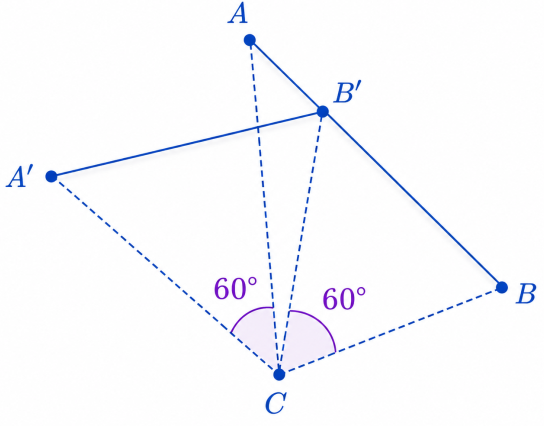
Suppose triangle ABC in the figure below is rotated through +90° about point P.
Join P to A.
Measure PA.
Draw a 90° angle from PA.
Mark point A’ such that:
PA = PA’
Repeat for points B and C.
Join A’, B’ and C’.
The figure A’B’C’ is the image of triangle ABC.
Important Observation
When a figure is rotated:
A’B’ = AB
B’C’ = BC
A’C’ = AC
Therefore:
Rotation preserves size and shape.
Illustration
Rotation Through 180°
A rotation through 180° is called a half turn.
Construction Procedure
Suppose triangle PQR is rotated through 180° about point O.
Join P to O.
Extend line PO.
Mark P’ such that:
PO = OP’
Repeat for Q and R.
Join P’, Q’ and R’.
The resulting triangle is the image of triangle PQR.
Electromagnetic induction is a fundamental concept in physics that explains how electricity can be generated from a changing magnetic field. Whenever the magnetic flux linking a conductor changes, an electromotive force (EMF) is induced in the conductor. However, the magnitude of the induced EMF is not always the same; it depends on several factors that influence the rate at which the magnetic flux changes. Understanding these factors is essential for explaining the operation of electrical devices such as generators, transformers, and induction coils. In this article, we will explore the key factors that affect the magnitude of an induced EMF and examine how each factor contributes to the efficiency of electromagnetic induction.
The amount of current produced from changing magnetic flux depends on a number of factors which includes:
Rate of change of magnetic flux
strength of magnetic field
number of turns in a coil
i. Rate of change of magnetic flux
The faster the rate of change of magnetic field, the higher the magnitude of the induced current.
Consider a coil of about 200 turns of a wire, sensitive galvanometer and a magnet arranged as shown in figure below.
To investigate how rate of change of magnetic flux, you move the magnet towards the coil and away at various speeds such as very fast, moderately fast and slowly.
You observe that the faster the magnet is moved to and from the coil, the higher the deflection on the galvanometer. This shows that induced EMF is highest when the rate of change of magnetic flux is highest.
Magnetic flux could be interpreted as the number of magnetic field touching the coil at any given moment.
Explanations
Magnetic flux Φ is the strength of magnetic field threading a given area.
The magnetic flux Φ changes when the magnet is withdrawn from the coil where a faster withdrawal gives rise to a higher rate of change in magnetic flux linking the coil which then gives an increased induced Electromotive force(e.m.f)
see the diagram below that shows magnetic field lines:
ii. strength of magnetic field
Moving a stronger magnetic towards or away from the coil causes increase of the induced current when the speed of movement remains constant.
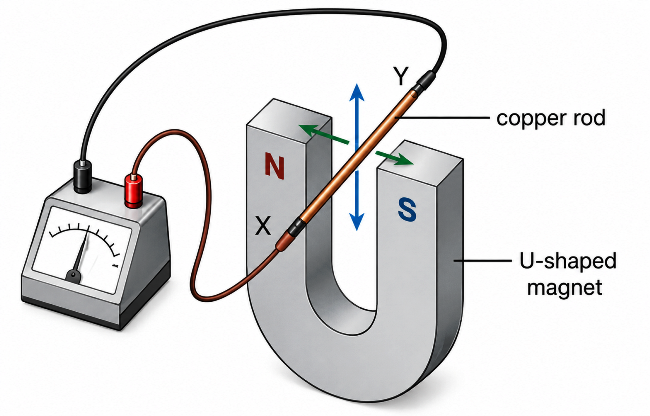
Consider a u-shaped electromagnet and a variable resistor connected to a circuit shown such that an electromagnet can have it’s strength varied by changing current passing through using the variable resistor.
After the setup, you can do the following to investigate the current induced with strength of the magnet:
Adjust the variable resistor so that minimum current flows.
Move the conductor PQ in a direction perpendicular to the magnetic field of the electromagnet and note deflection on the galvanometer.
change values of current and record corresponding readings on the galvanometer when wire cuts across the magnetic field.
Observations
Whenever current through the ammeter is increased, a greater deflection is obtained on the galvanometer when the conductor wire cuts across the magnetic field.
Explanations
Higher current passing through a coil of wire leads to a stronger electromagnet that will produce stronger magnetic field .
We can therefore conclude that the magnitude of the induced current is directly proportional to the strength of the magnetic field from which it is being produced.
iii. number of turns in a coil
If all other factors are held constant but the number of turns of wire on the coil increased, the induced current is observed to increase proportionately to increased number of turns.
Having at your disposal insulated copper wire, sensitive galvanometer, magnet and connecting cables, you make a coil of numbered turns of wire and set up the apparatus as shown
to investigate how number of turns in a coil affects magnitude of the induced emf, do the following:
Insert a magnet in the coil and then withdraw it at a steady speed and then observe and record the maximum reading on the galvanometer.
Increase number of turns on the coil at equal intervals says 50, 100,150,200,250 etc and repeat the above procedure noting the maximum deflection each time.
Observations
Each time the number of turns of the coil is increased and all other factors held constant, a higher deflection on the galvanometer is recorded. The deflection is proportional to the number of turns used.
Explanations
Increased deflection indicates more current is produced in the coil. The induced emf is proportional to the number of turns and so we can say that each turn on the coil induces it’s own e.m.f. The total induced e.m.f is therefore a summation of all emfs produced by individual turns.
Infact by application of calculus, we can be able to express summation mathematically, but we will do that later in more advanced lessons.
Conclusions
Experiments shows that an e.m.f is induced in a circuit whenever magnetic flux linkage changes and the magnitude of the induced e.m.f increases with increase in the rate of change of the flux linkage and the number of turns of the coil.
The observations from experiments can be summarized in a Faraday’s law of electromagnetic induction which states that:
The magnitude of the induced e.m.f is directly proportional to the rate of change of magnetic flux linkage.
Electricity powers our homes, devices, and industries, yet many students find electrical concepts difficult to understand. Two of the most important ideas in electricity are Electromotive Force (E.M.F) and Potential Difference (P.D). These concepts explain how electrical energy is supplied and how electric current flows in a circuit.
One of the easiest ways to understand E.M.F and P.D is by comparing an electric circuit to the flow of water through pipes. Just as a pump pushes water through a system, a battery pushes electric charges through a circuit. This simple analogy helps explain how voltage is produced, why current flows, and why some energy is lost inside a battery.
In this article, you will learn:
What Electromotive Force (E.M.F) means
The meaning of Potential Difference (P.D)
The difference between E.M.F and P.D
How batteries supply electrical energy
The role of internal resistance and lost volts
Real-life examples of voltage in electric circuits
By the end of this guide, you will have a clear understanding of how electrical energy moves through a circuit and why voltage behaves differently in open and closed circuit
What is Potential Difference?
Potential difference is the work done in moving a unit charge from one point to another in a circuit. It is commonly called voltage and is measured in volts (V).
A simple way to understand potential difference is by comparing it to water flowing between two containers.
Water Flow Analogy
Imagine two containers connected by a pipe:
If one container has a higher water level than the other, water flows from the higher level to the lower level.
The greater the difference in water levels, the faster the flow.
When the water levels become equal, the flow stops.
see the figure below:
Water Flow Analogy Animation
(a) Water flows to lower level
A
B
This difference in water levels is similar to potential difference in electricity. Charges only flow when there is a difference in electrical potential between two points.
Potential Energy in Water Flow
Water at a higher position possesses gravitational potential energy.
If water is raised to a height , it can flow down to a lower level . The larger the height difference, the greater the energy available to move the water.
Similarly, electric charges move from a point of higher electrical potential to a point of lower electrical potential.
The figure below shows water falling under gravitational force:
A useful way to understand electric potential difference is by comparing it to the flow of water in a closed circuit. Water raised to a higher level possesses gravitational potential energy. The higher the water is raised, the greater its potential energy and the faster it can flow to a lower level. A pump is needed to lift the water back to the higher level and maintain continuous flow. In the same way, a battery supplies energy to electric charges, creating a potential difference that causes them to move through a circuit from a region of higher potential to a region of lower potential.
Let us study the flow of water in figure below, which can be referred to as a water circuit because water flows round a complete ring.
Water Flow with Rotating Pump
Pump
h₁
h₀
Potential Difference
Water at a height h₁ from the ground level has potential energy because of its position. The greater the height, the higher the potential energy. The rate of flow will depend on the height at which the water had initially been raised. A higher water level results in a faster rate of flow.
The potential energy can be calculated as:
Potential energy = mgh, where m is the mass of water falling and g the gravitational pull on water.
At a height h₀, the water has no potential energy.
If the water is to be raised to h₁, a pump has to be used. So long as the pump in the water circuit is working, the water will move round the complete path, from a point of higher potential energy to a point of lower potential energy.
The pump creates a difference in potential.
The Role of a Pump and a Battery in e.m.f
In a water circuit, a pump raises water to a higher level so that it continues flowing around the system. In an electric circuit, the battery performs a similar role:
The battery pumps charges to a higher electrical potential.
These charges then move through the conductor and electrical devices such as bulbs or lamps.
The movement of charges forms an electric current.
The battery therefore creates the potential difference needed for current to flow.
consider the setup below:
Battery Pumping Charges
For the charges to move through the conductor, there must be a battery which produces an electrical potential difference at the ends of the conductor. The battery does the work of pumping charges to a high potential so that they can flow. The higher the potential difference (p.d.), the stronger the current in the circuit, if other factors like opposition to flow of current (resistance) are kept constant. The model of the circuit shown in the figure above can help suggest that the function of a battery is to cause a potential difference across a conductor.
Not all the energy supplied by the pump is used to drive the water round the circuit. Some of the energy is lost in moving or raising parts of the pump. Similarly, for the battery, some energy is lost in moving charges through the battery itself. The total energy supplied by the battery is called its electromotive force (e.m.f.).
Potential difference is measured in volts, by an instrument called voltmeter.
Although both e.m.f. and p.d. are measured in volts, the potential difference of a cell is different from its e.m.f. The e.m.f. of a cell is the voltage across its terminals when it is supplying no current in the circuit (an open circuit), while the p.d. of a cell is the voltage across the cell in a closed circuit. in the Figure below: (a) and (b) shows the e.m.f. of the cell as 1.5 V and the p.d. as 1.45 V respectively.
illustrating e.m.f and p.d in a battery
Interactive Circuit Animation
Close the switch to complete the circuit
Circuit OPEN
Open circuit
No current flows
Bulb is OFF
Voltmeter reads the emf
V₁ = 1.50 V
Closed circuit
Current flows
Bulb shines brightly
Voltage drops slightly
V₂ = 1.45 V
When the switch is open No current flows in the circuit (a), therefore the voltmeter reads the full e.m.f of the cell.
When the switch is closed Current flows through the circuit. Some energy is lost inside the cell because of internal resistance. The terminal voltage becomes slightly lower.That is, 1.45V.
The difference between the readings is known as the lost volts, in this case 0.05 V. This voltage is lost because of the opposition to the flow of charges within the cell (internal resistance).”
Electromotive Force (E.M.F)
The total energy supplied by a battery to move charges around a complete circuit is called the electromotive force (e.m.f).
Although both e.m.f and potential difference are measured in volts, they are not exactly the same.
by definition; E.m.f is the voltage across the terminals of a cell when the circuit is open, and no current is flowing.
Difference Between E.M.F and Potential Difference
Electromotive Force (E.M.F)
Potential Difference (P.D)
Energy supplied by the cell
Energy used between two points
Measured when no current flows
Measured when current flows
Occurs in an open circuit
Occurs in a closed circuit
Represents total supplied energy
Represents useful energy delivered
e.m.f and the Lost Volts
The difference between the e.m.f and the terminal potential difference is known as the lost volts.
Example:
This loss in voltage occurs because of the opposition to the flow of charges within the cell. This resistance is referred to as the internal resistance.
Key Points to Remember
Charges flow only when there is a potential difference.
A battery creates the potential difference in a circuit.
E.m.f is the total energy supplied by a cell.
Potential difference is the energy used between two points in a circuit.
Internal resistance causes some voltage to be lost inside the cell.
Conclusion
The concepts of e.m.f and potential difference are fundamental in electricity. Using the water-flow analogy helps simplify these ideas:
Water level difference corresponds to electrical potential difference.
A pump corresponds to a battery.
Water flow corresponds to electric current.
Understanding these concepts provides a strong foundation for studying electric circuits and electrical energy transfer.
Revision exercise
Prepared for physics learners and teachers as a simple guide to understanding electromotive force and potential difference.
The function of a cell in a circuit is to supply electrical energy. By definition, the electromotive force (e.m.f.) of a cell is the potential difference between its terminals when no charge is flowing out of the cell (cell in open circuit).
Electric cells and batteries are essential sources of electrical energy in everyday life. From powering flashlights and radios to running vehicles and electronic devices, cells convert chemical energy into electrical energy. However, no cell is perfect. Every cell possesses a small internal resistance that affects the voltage supplied to an external circuit.
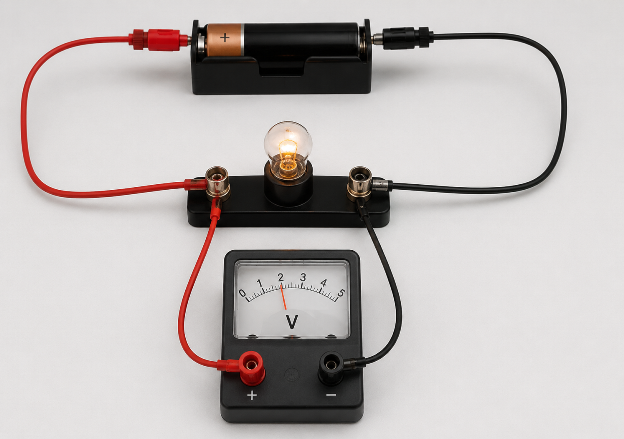
Figure below shows a circuit that may be used to demonstrate the difference between e.m.f. of a cell and terminal voltage.
illustrating reading of an e.m.f
The reading of the voltmeter when the switch is open is the e.m.f. of the cell.
Once a cell supplies current to an external circuit, the potential difference across it drops by a value referred to as ‘lost voltage’. This loss in voltage is due to the internal resistance of the cell.
The potential difference across the cell when the circuit is closed is referred to as the terminal voltage of the cell.
Relationship Between electromotive force and Internal Resistance
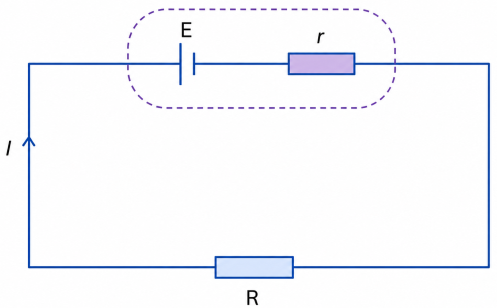
If a resistor is connected in series with a cell as shown in figure below, the internal resistance of the cell , is considered to be connected in series with the external resistor .
illustrating internal resistance of a cell
The current flowing in the circuit is therefore given by the equation;
where is the e.m.f. of the cell.
Thus,
=V+Ir
is the voltage drop across the external resistor R while Ir is the voltage drop across the internal resistance.
The voltage across the external resistor is called the terminal voltage while the p.d. drop across the internal resistance is called the lost voltage.
Battery Internal Resistance Animation
Battery Internal Resistance Animation
Explanation of the Animation:
The blue moving dots represent electric current flowing through the circuit.
Inside the battery, the battery emf (E) pushes charges through the
internal resistance r.
The orange glowing effect inside the resistor r shows that some
electrical energy is lost as heat inside the battery.
The external resistor R receives the remaining energy from the battery.
Increasing internal resistance causes greater voltage loss inside the battery.
Experiment to determine the internal resistance and electromotive force of a cell
Switch on the circuit and set the current to the minimum value possible.
Increase the current in steps and record the corresponding terminal voltage in table below.
Table of current against voltage
current I(A)
Voltage (V)
Plot a graph of voltage against current.
Internal Resistance Simulation
Determining Internal Resistance of a Cell
set current with the slider
Control Current Using Rheostat
Ammeter
0.0 A
Voltmeter
1.50 V
Current I (A)
Voltage V (V)
Results and Conclusion
The graph of voltage against current is as shown below.
Using the equation and hence V=E-Ir; the gradient of the graph gives the internal resistance of the cell.
If the graph is extrapolated so as to cut the voltage axis, the point at which it does so gives the electromotive force(e.m.f) of the cell.
Method 2
Apparatus
Ammeter
voltmeter
variable resistor
cells
connecting wires.
Procedure
Set the apparatus as shown:
Determining of internal resistance of a cell
Switch on the circuit and increase the current in step from a minimum value.
Record the corresponding voltage .
Complete table
Current I (A)
Voltage(V)
R=V/I
1/I
Plot a graph of against
Results and Observation
The graph is a straight line with a positive gradient. see the diagram below
The gradient of the graph gives
Internal resistance can be obtained in two ways:
(i) Extrapolating the graph to cut axis gives as can be observed on the diagram above.
(ii) If the intercept on axis is , then,
So,
But:
Therefore,
Example 20
A battery consisting of four cells in series, each of e.m.f. 2.0 V and internal resistance 0.6 Ω, is used to pass a current through a 1.6 Ω resistor. Calculate the current through the battery.
Solution
Current through battery =
The electromotive force(e.m.f) of the battery is the sum of the e.m.f. of all the cells while the internal resistance of the battery is the sum of all internal resistances of the cells.
Therefore, current through the batter
Example 22
A cell drives a current of 2.0 A through a 0.6 Ω resistor. When the same cell is connected to a 0.9 Ω resistor, the current that flows is 1.5 A. Find the internal resistance and the electromotive force(e.m.f) of the cell.
Solution
The first connection is as shown with it's internal resistance.
when connected to 0.9 ohm resistor, the circuit is as shown:
Taking E as the electromotive force(e.m.f) of the cell and r the internal resistance.
E = IR+Ir
from the below figure:
E = (2.0 x 0.6)+2.0r = 1.2+2r --------(i)
using the figure below:
E = (1.5 x 0.9)+1.5r
E = 1.35 + 1.5r ---------(ii)
since e.m.f is the same in both circuits:
1.2+2r = 1.35+1.5r
2r-1.5r = 1.35-1.2
=.5r = 0.15
r = 0.3Ω
substituting for r in the first equation:
E = 1.2+2r = 1.2+2(0.3)
E= 1.2+0.6 = 1.8V
Example problem
A battery consists of two identical cells, each of e.m.f. 1.5V and internal resistance 0.6Ω, connected in parallel. Calculate the current the battery drives through a 0.7Ω resistor.
Solution
When identical cells are connected in parallel,the equivalent e.m.f. is equal to that of only one cell.
The figure below represents the arrangement:
The equivalent internal resistance is equal to that of two such resistors connected in parallel as shown in the diagram above. Figure (a) is simplified to figure (b).
Equivalent e.m.f.
Equivalent internal resistance will be given by:
substituting:
Current through the will be given by:
Example 23
In an experiment to determine the electromotive force and internal resistance of a cell, the following results were obtained.
I (A)
0.5
1.0
1.5
2.0
2.5
V (V)
1.25
1.0
0.75
0.5
0.25
Plot a graph of against . From the graph, determine the values of and .
Solution
A table for and is generated from the values given as follows:
2.0
1.0
0.67
0.5
0.4
2.5
1.0
0.5
0.25
0.1
A plot of against is as follows:
The graph is a straight line whose gradient is
Thus,
Hence,
The value for is found by extrapolating the graph until it cuts the R-axis and reading off as indicated on the graph.
Thus, r=0.48Ω
Alternatively
Thus,
Practice Questions
State the physical quantities whose units are;
ampere,
ohm,
volt,
coulomb and watt.
State Ohm’s law and describe an experiment to verify it.
For the resistor network given, determine (a) the total resistance (b) the voltage drop across each resistor. (c) the current through each resistor.
The figure below shows four resistors and a source of voltage of with internal resistance
(a) Find the effective resistance of the circuit. (b) Calculate the current through .
Six resistors are connected in a circuit as shown in the figure below.
Calculate the: (a) total resistance of the circuit. (b) total current in the circuit. (c) current through the resistor. (d) current through the resistor.
(a) You are provided with two resistors of values and . (i) Draw a circuit diagram showing the resistors in series with each other and with a battery. (ii) Calculate total resistance of the circuit (assume negligible internal resistance).
(b) Given that the battery has an e.m.f of 6V and an internal resistance of 1.33Ω:
calculate the current through:
(i) 8Ω
(ii) 4Ω resistor when the two are in parallel.
practice questions
Quick Check: Electromotive Force & Internal Resistance
1. What does EMF represent?
2. A battery has an EMF of 12 V and an internal resistance of 2 Ω. If the current is 3 A, what is the terminal voltage?
3. Calculate the current when a battery of EMF 9 V and internal resistance 1 Ω is connected to a 8 Ω resistor.
Trigonometry becomes much easier when you understand the unit circle. The unit circle helps us define trigonometric ratios for all angles, including positive, negative, and angles greater than 90°.
What Is the Unit Circle?
A unit circle is a circle with:
Centre at O(0,0)
Radius equal to 1
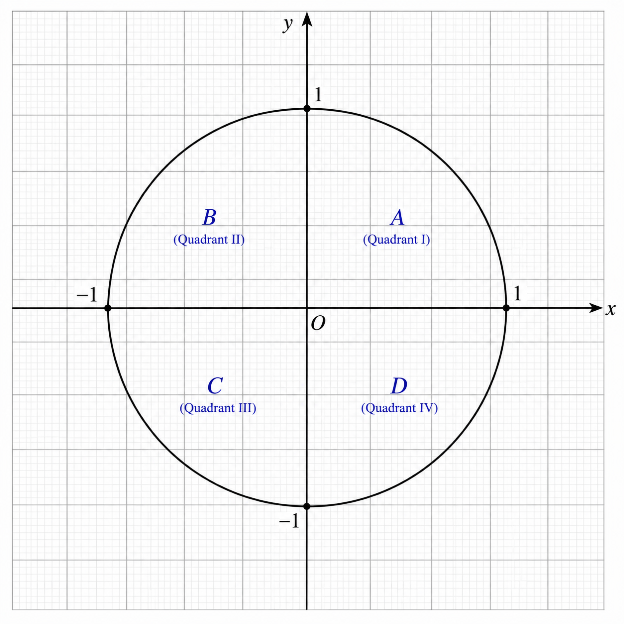
The circle is drawn on the Cartesian plane with the x-axis and y-axis crossing at the centre. see the figure below
The Four Quadrants
The unit circle is divided into four sections called quadrants:
First Quadrant (Quadrant I) → top right
Second Quadrant (Quadrant II) → top left
Third Quadrant (Quadrant III) → bottom left
Fourth Quadrant (Quadrant IV) → bottom right
Positive and Negative Angles
Angles are measured from the positive x-axis.
An angle measured anticlockwise is positive.
An angle measured clockwise is negative.
Examples:
120° is a positive angle and lies in the second quadrant.
-50° is a negative angle and lies in the fourth quadrant.
Determining Quadrants of Angles
To know where an angle lies:
First Quadrant
Angles between 0° and 90°
Example: 30° lies in Quadrant I
Second Quadrant
Angles between 90° and 180°
Example: 140° lies in Quadrant II
Third Quadrant
Angles between 180° and 270°
Example: 240° lies in Quadrant III
Fourth Quadrant
Angles between 270° and 360°
Example: 330° lies in Quadrant IV
Negative Angles
Negative angles move clockwise.
Example: -70° lies in Quadrant IV -120° lies in Quadrant III
The figure below shows angles of 120o and -50o marked on the unit circle. They are in the second and fourth quadrants respectively.
Determine which quadrants where 35o, 45o, 190o, 280o, 330o,235o are found.
Coordinates on the Unit-Circle
One important idea about the unit circle is that every point on the circle represents:
(x, y) = (cos θ, sin θ)
This means:
x-coordinate = cos θ
y-coordinate = sin θ
Figure below is a unit-circle and angle PON=30°. Determine the values of x and y at point P.
Angle AON is a right-angled at N. Therefore:
A right-angled triangle is formed inside the circle.
Since the radius of the unit circle is 1:
OP = 1
Using trigonometric ratios:
$$sin 30^o = \frac{NP}{OP}=\frac{0.5}{1}$$
$$=\text{0.5 is the value of y co-ordinate of p}$$
Now for cosine:
$$cos 30^o = \frac{adjacent}{hypotenuese}$$
$$cos 30^o =\frac{ON}{OP} = \frac{0.86}{1}$$
$$\text{o.86 is the x cordinate of p}$$
Therefore, the coordinates of point P are:
P(0.86, 0.5)
$$tan 30^o = \frac{NP}{ON}=\frac{0.5}{0.86} = 0.5814$$
$$=\frac{y \ co-ordinate}{x \ co-ordinate} \ on \ the \ unit \ circle$$
Therefore, for a unit circle:
sinθ = y co-ordinates of P
cosθ = x co-ordinates of P.
$$tan\theta = \frac{y \ co-ordinates \ of \ P}{x \ co-ordinate \ of \ P} =\frac{sin\theta}{cos\theta}$$
Key Ideas to Remember
The unit circle has radius 1.
Positive angles move anticlockwise.
Negative angles move clockwise.
Every point on the unit circle represents: (cos θ, sin θ)
The x-coordinate gives cosine.
The y-coordinate gives sine.
The unit-circle is the foundation for understanding trigonometric functions, graphing, and solving advanced trigonometry problems.
Ohm’s Law and Electrical Resistance are fundamental concepts in electricity explaining the relationship among voltage, current, and resistance. Electrical resistance describes how strongly a material opposes the flow of electric current. Understanding these concepts is essential for analyzing circuits, designing electrical systems, and explaining how electronic devices operate in everyday life.
One of the most important principles that helps us understand how electricity behaves in a circuit is Ohm’s Law. This law explains the relationship between voltage, current, and resistance in an electrical conductor.
Electricity powers almost every device we use today, from mobile phones and televisions to electric cars and industrial machines.
In this lesson, we shall explore Ohm’s Law and the electrical resistance, how it is verified experimentally, the meaning of electrical resistance, and the factors that affect resistance in conductors.
What is Ohm’s Law?
Ohm’s Law states that:
The current flowing through a conductor is directly proportional to the potential difference across it, provided temperature and other physical conditions remain constant.
This means that when the voltage across a conductor increases, the current flowing through it also increases proportionally.
The mathematical expression of Ohm’s Law is:
V=IR
$$I=\frac{V}{R}$$
some of the physical conditions includes pressure and tensional forces on the conductor.
Where:
V = Voltage (Volts)
I = Current (Amperes)
R = Resistance (Ohms)
Investigating the Relationship Between Current and Voltage in ohm’s law
To verify Ohm’s Law, a simple experiment can be carried out using a nichrome wire.
Apparatus Required
Two-metre nichrome wire
Two dry cells
Ammeter
Voltmeter
Rheostat
Switch
Connecting wires
Experimental Setup to study ohm’s law and electrical resistance
Using a nichrome wire, make a coil of as many turns as possible
Set up the circuit as shown in figure below
Set the current flowing in the circuit to the least possible value
with help of the rheostat, vary in steps the current flowing in the circuit and not e the corresponding voltage drop across the coil.
Record the results in the table below
Current (A)
Voltage (V)
Observation of ohm’s and electrical resistance
As the current flowing through the nichrome wire increases, the voltage across the wire also increases. When voltage is plotted against current, the graph obtained is a straight line passing through the origin.
The table below represents a sample data from such an experiment.
Current (A)
0.1
0.2
0.3
0.4
Voltage (V)
1.2
2.4
3.6
4.8
when this data is plotted on a grid, a graph as shown is obtained.
Points to note:
The circuit is connected such that:
The ammeter measures the current flowing through the wire.
The voltmeter measures the voltage across the nichrome wire.
The rheostat is used to vary the current in the circuit.
from the graph, the following observations can be obtained:
As the current increases, the voltage across the coil also increases.
The graph obtained when voltage is plotted against current is a straight line passing through the origin.
Therefore:
voltage is directly proportional to current
gradient of the graph is a constant. This constant gives the resistance of the conductor used.
This straight-line graph confirms that voltage is directly proportional to current.
Understanding Resistance
From the experiment, the ratio of voltage to current remains constant. We can verify the ohm’s law with the same procedure described above when we replace a coil with a standard resistor. The graph of current against voltage is a straight line through the origin.
$$\text{The gradient of the graph,} \ \frac{\Delta I}{\Delta V} \text{ gives the reciprocal of resistance }$$
$$\text{The reciprocal of resistance is what is known as the conductance (S)
}$$
$$\text{conductance is measured in Siemens }(\Omega^{-1})$$
From the graph above:
$$resistance = \frac{1}{Gradient}$$
From V ∝ I:
V=constant(K)x I
The constant which we represent with K is the resistance of the conductor.
hence;
V=IR where V is the potential difference across the conductor.
Resistance can therefore be calculated using:
$$Resistance R = \frac{Volatge(V)}{Current(I)}$$
The SI unit of resistance is the ohm (Ω).
An ohm is defined as the resistance of a conductor when a current of 1A flowing through it produces a voltage drop of 1 V across it’s ends.
A conductor is said to have a resistance of 1 ohm if a current of 1 ampere flows through it when a potential difference of 1 volt is applied across it.
an ohm have some other units like:
1 kilo ohm(KΩ) = 1000Ω
1 mega ohm(MΩ) = 1 000 000Ω
Worked Examples
Example 1
A current of 2 mA flows through a conductor of resistance 2 kΩ. Calculate the voltage across the conductor.
solution:
Using Ohm’s Law:
V=IR
$$2 \times 10^{-3} \times 2 \times 10^3 = 4V$$
Example 2
Calculate the current flowing through a 50 Ω resistor connected to a 10 V battery.
solution
from ohm’s law:
$$I= \frac{V}{R} = \frac{10}{5} = 2.0A$$
Example 3
A starter motor requires a current of 50 A from a 12 V battery. Determine the resistance of the motor.
solution
$$I = \frac{V}{R} = \frac{12}{50} = 0.4\Omega$$
Ohmic and Non-Ohmic Conductors
Ohmic Conductors
Conductors that obey Ohm’s Law are called Ohmic conductors.
Examples include:
Nichrome wire
Metallic resistors
For these conductors, the graph of voltage against current is a straight line.
Non-Ohmic Conductors
Some conductors do not obey Ohm’s Law. These are known as Non-Ohmic conductors.
Examples include:
Filament lamps
Thermistors
Semiconductor diodes
Electrolytes
Their voltage-current graphs are curved instead of straight.
Electrical Resistance
Electrical resistance is the opposition offered by a conductor to the flow of electric current.
Resistance occurs because electrons moving through a conductor collide with atoms and impurities inside the material. These collisions reduce the flow of charge and produce heat energy.
Electrical Resistance Animation
Electrical Resistance Animation
This animated illustration demonstrates how electrical resistance occurs inside a conductor.
Electrons flowing through the wire collide with vibrating atoms, causing opposition to current flow.
Electrons collide with vibrating atoms, producing resistance and heat.
V = IR
How Electrical Resistance Works
In a metallic conductor, electric current is carried by moving electrons. As these electrons move through the wire,
they collide with atoms and impurities present in the conductor.
These collisions oppose the movement of electrons and reduce the flow of electric current. This opposition is called
electrical resistance.
When temperature increases, atoms vibrate more strongly, causing more collisions and therefore increasing resistance.
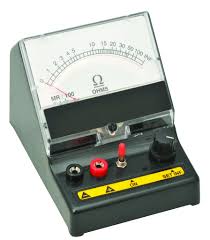
An instrument used to measure resistance is called an ohmmeter.
An ohmmeter
5
Factors Affecting Resistance
Several factors determine the resistance of a conductor.
1. Length of the Conductor
The resistance of a conductor increases with its length.
that is: R ∝ l
hence; resistance = constant x length
i.e = R = Kl ————————(i)
for a given conductor:
$$\frac{R}{l} = constant$$
As the length of the conductor increases, the resistance increases because of the increased number of atoms that are available to hinder the flow of electrons.
A longer wire contains more atoms that obstruct the movement of electrons, leading to greater resistance.
2. Cross-Sectional Area
Resistance decreases when the cross-sectional area increases A.
That is: resistance is inversely proportional to cross section area(A) of the conductor.
$$R \propto \frac{l}{A}$$
A conductor with a larger cross-section area(A) has many free electrons for conduction, hence better conductivity.
$$RA = K———————-(ii)$$
Thicker wires allow more electrons to flow easily and therefore have lower resistance.
Combining (i) and (ii) for a conductor with uniform cross-section area;
$$R = K(\frac{l}{A})$$
The constant value in the equation above is referred to as the resistivity(ρ)of a material. It is practically the resistance of sample of a material of unit length and unit cross-section area at a given temperature. The unit of measurement for resistivity(ρ) known as ohmmeter(Ωm).
The table below shows resistivity of some common materials
Material
Resistivity (Ωm)
Common Uses
Silver
1.6 × 10⁻⁸
Contacts on some switches
Copper
1.7 × 10⁻⁸
Connecting wires
Aluminium
2.8 × 10⁻⁸
Power cables
Tungsten
5.5 × 10⁻⁸
Lamp filaments
Constantan
49 × 10⁻⁸
Resistance boxes, variable resistors
Nichrome
100 × 10⁻⁸
Heating elements
Carbon
3,000 × 10⁻⁸
Radio resistors
Glass
10¹⁰ – 10¹⁴
Electrical insulators
Polystyrene
10¹⁵
Electrical insulators
Example problem in resistance
Two wires of A and B are such that the radius of A is twice that of B and the length of B is twice that of A. if the two are of the same material, determine the ratio:
$$\frac{resistance \ of \ A}{resistance \ of \ B}$$
For metallic conductors, resistance increases with temperature.
Heating causes atoms in the conductor to vibrate more vigorously. This increases collisions between electrons and atoms, making it more difficult for current to flow.
Resistivity of Materials
Resistivity is a property that shows how strongly a material opposes electric current.
Materials such as:
Silver and copper have low resistivity and are good conductors.
Glass and polystyrene have high resistivity and act as insulators.
Temperature also affects resistance:
In metals, resistance increases with temperature.
In semiconductors, resistance decreases with temperature.
Resistors
A resistor is an electrical component designed to provide resistance in a circuit.
Resistors are used to:
Control electric current
Reduce voltage
Protect circuit components
Produce heat in appliances
Most wire-wound resistors are made using materials such as:
Manganin
Constantan
These materials are preferred because their resistance changes very little with temperature.
Fixed Resistors
Fixed resistors have a constant resistance value.
Types of Fixed Resistors
1. Wire-Wound Resistor
This resistor is made by winding resistance wire around an insulating core.
Features:
High durability
Can handle large currents
Common in power circuits
2. Carbon Resistor
Made using carbon material.
Features:
Cheap and widely used
Small in size
Used in electronic circuits
Resistor Symbol
The electrical symbol of a resistor is represented by a zigzag or rectangular shape depending on the standard used.
Variation of Resistance with Temperature
Different materials respond differently to temperature changes.
Metals
Resistance increases as temperature rises.
Thermistors
Resistance decreases as temperature rises.
Constantan
Resistance remains nearly constant despite temperature changes.
This behavior is important in designing temperature-sensitive circuits.
Variable Resistors
A variable resistor allows resistance to be adjusted manually.
The resistance changes when a sliding contact moves along the resistance track.
Applications include:
Volume controls in radios
Light dimmers
Fan speed regulators
Rheostat
A rheostat is a variable resistor with two terminals.
It is used to control current in a circuit.
As the slider moves:
The effective length of the resistance wire changes
Resistance changes accordingly
Increasing the resistance reduces current flow.
Potentiometer
A potentiometer is a variable resistor with three terminals.
It is used to:
Divide voltage
Control signal levels
Adjust volume in audio systems
How It Works
A sliding contact moves along the resistor track, selecting different voltage levels.
Potentiometers are commonly used in:
Audio amplifiers
Electronic control systems
Non-Linear Resistors
These resistors do not obey Ohm’s Law strictly because their resistance changes non-linearly with voltage, temperature, or light.
Examples include:
Thermistors
Light-dependent resistors (LDRs)
Thermistor
A thermistor is a temperature-dependent resistor.
Characteristics
Resistance decreases as temperature increases.
Used in heat-sensitive circuits.
Applications
Temperature sensors
Fire alarms
Electronic thermometers
Light-Dependent Resistor (LDR)
An LDR changes resistance according to the amount of light falling on it.
Characteristics
High resistance in darkness
Low resistance in bright light
Applications
Automatic street lights
Camera light sensors
Burglar alarms
Importance of Resistors in Daily Life
Resistors are found in almost every electrical and electronic device.
They help to:
Protect circuits from excessive current
Control electrical energy
Improve device performance
Enable automatic sensing systems
Without resistors, modern electronics would not function safely or efficiently.
Resistors play a vital role in electrical and electronic circuits. From fixed resistors to thermistors and LDRs, these components help control current, voltage, temperature, and light sensitivity in devices we use every day.
Understanding how resistors work gives students a strong foundation in physics and electronics, preparing them for more advanced studies and practical applications in technology.
Conclusion
Ohm’s Law is one of the most fundamental principles in electricity and electronics. It helps us understand how voltage, current, and resistance are related in electrical circuits. Through experiments and graphical analysis, students can clearly observe the direct relationship between voltage and current in Ohmic conductors.
Understanding electrical resistance and the factors affecting it is essential in designing safe and efficient electrical systems used in homes, schools, laboratories, and industries.
Whether you are studying basic physics or advanced electronics, mastering Ohm’s Law provides the foundation for understanding the behavior of electric circuits.
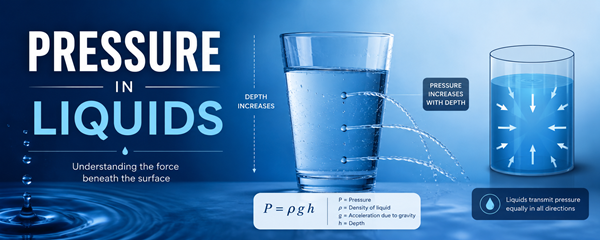
Pressure in liquids is a fascinating concept that explains why divers feel greater force underwater and why dams are built thicker at the bottom than at the top. As depth increases, the pressure exerted by a liquid also increases because more liquid presses down from above.
This principle plays an important role in everyday life, engineering, and natural water systems. Understanding how depth affects pressure helps us explain many real-world phenomena, from submarine design to the flow of water in oceans and rivers.
At the same depth in a given liquid, differences in levels obtained is the same regardless of the direction which the funnel faces.
To investigate the variation of liquid pressure with depth and density
Apparatus
A tall jar, liquids of different densities, thistle funnel, U-tube, rubber tubing.
Procedure
Using the nail, make three holes, A, B and C, of the same diameter along a vertical line on one side of the tin.
Fill the tin with water as shown in figure 4.3.
With the tin full of water, observe the jets of water from the holes A, B and C.
Observation
The lower hole, A, throws water farthest, followed by B
Conclusion
Pressure in liquids increases with density and depth.
In summary:
Pressure in a liquid increases with depth below its surface.
Pressure in a liquid at a particular depth is the same in all directions.
Pressure in a liquid increases with the density of the liquid.
Fluid Pressure Formula
Consider a liquid in a container, as shown in figure 4.8.
If A is the cross-sectional area of the column, h the height of the column and ρ the density of the liquid, then:
Volume of the liquid= cross-sectional area × height = Ah
Mass of the liquid=volume of the liquid × density = Ahρ
Therefore, weight of the liquid = mass of the liquid × gravitational force per unit mass = Ahρg
From the definition of pressure:
$$
P = \frac{F}{A} = \frac{Ah\rho g}{A}
$$
So fluid pressure becomes:
P=hρg
EXPERIMENT To show the distribution of pressure at a point in a liquid
Apparatus
A tall jar, water, thistle funnels, U-tube, rubber tubing.
Procedure
Fill the glass vessel G with water.
Connect one of the thistle funnels to a U-tube filled to some level with water.
Lower the funnel to a depth from the surface of water and notice the difference in levels, h, of the water in the U-tube.
Replace the funnel with others, in turn, whose mouths are pointing in different directions.
Lower the funnel into the water so that the mouth of the funnel is at the same point as the straight one. Observe the difference in levels of the water in the U-tube.
Figure 4.6: Pressure variation in a liquid
Procedure
Fill the glass vessel G with water.
Connect the thistle funnel to a U-tube filled to some level with water.
Lower the funnel to different depths from the surface and notice the difference in levels, h, of water in the U-tube.
Replace water in G with a denser liquid, such as sodium chloride solution (brine).
Lower the funnels to the same depths as above and compare the heights obtained.
Observations
The deeper the funnel goes below the surface, the greater the difference in levels, h.
The differences in levels, h, obtained with brine at a particular depth is greater than that obtained with water at that depth.
Liquid Levels in a U-tube
When water is poured into a U-tube, it will flow into the other arm. The water will settle in the tube with the levels on both arms being the same, see figure 4.5(a).
When one arm of the U-tube is blown into with the mouth, the level moves downwards, while on the other arm it rises, see figure 4.5(b). This is caused by the pressure difference between the two arms. The pressure increases on the arm that is blown into and causes water to rise on the other arm.
Effect of pressure on liquid levels
Pressure of water at A is greater than pressure at B and pressure at B is greater than at C. Hence, pressure increases with depth.
For this reason, a diver at the bottom of the dam experiences pressure due to the weight of water above him. The deeper the diver goes, the greater the pressure.
Liquid Levels
When a liquid is poured into a set of connected tubes with different shapes, it flows until the levels are the same in all the tubes, as shown in figure 4.4.
Contains information related to marketing campaigns of the user. These are shared with Google AdWords / Google Ads when the Google Ads and Google Analytics accounts are linked together.
90 days
__utma
ID used to identify users and sessions
2 years after last activity
__utmt
Used to monitor number of Google Analytics server requests
10 minutes
__utmb
Used to distinguish new sessions and visits. This cookie is set when the GA.js javascript library is loaded and there is no existing __utmb cookie. The cookie is updated every time data is sent to the Google Analytics server.
30 minutes after last activity
__utmc
Used only with old Urchin versions of Google Analytics and not with GA.js. Was used to distinguish between new sessions and visits at the end of a session.
End of session (browser)
__utmz
Contains information about the traffic source or campaign that directed user to the website. The cookie is set when the GA.js javascript is loaded and updated when data is sent to the Google Anaytics server
6 months after last activity
__utmv
Contains custom information set by the web developer via the _setCustomVar method in Google Analytics. This cookie is updated every time new data is sent to the Google Analytics server.
2 years after last activity
__utmx
Used to determine whether a user is included in an A / B or Multivariate test.
18 months
_ga
ID used to identify users
2 years
_gali
Used by Google Analytics to determine which links on a page are being clicked
30 seconds
_ga_
ID used to identify users
2 years
_gid
ID used to identify users for 24 hours after last activity
24 hours
_gat
Used to monitor number of Google Analytics server requests when using Google Tag Manager