Category: Physics

  • An inclined plane as simple machines

    An inclined plane as simple machines

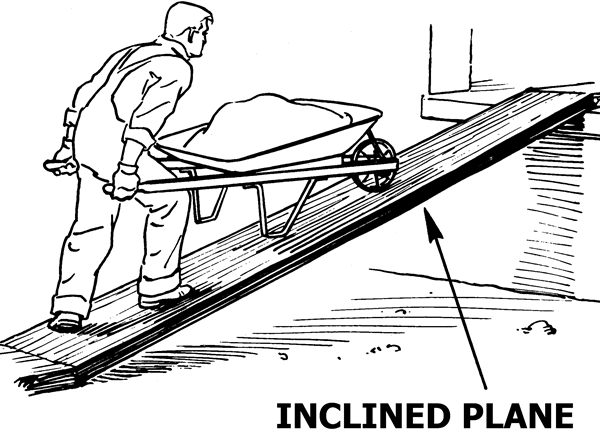
    An inclined plane is one of the simplest yet most useful machines in everyday life. It is a flat surface set at an angle to help move heavy objects from a lower level to a higher level with less effort. Instead of lifting a load straight upward, an inclined plane allows force to be applied over a longer distance, making work easier and more efficient. Common examples include ramps, staircases, sloping roads, and playground slides. Inclined planes have been used since ancient times in construction, transportation, and engineering, and they continue to play an important role in modern technology and daily activities.

    solving problems involving inclined plane

    Consider an inclined sheet of metal placed to form a slope to ease the process of loading heavy luggage onto a truck as in the diagram below:

    The velocity ratio of the inclined plane will be given by:

    $$Velocity \ \ ratio(V.R) = \frac{\text{distance travelled by effort}}{\text{distance travelled by load}}$$ $$ =\frac{\text{length l of the plank}}{\text{vertical height h}} = \frac{l}{h}$$

    From trigonometric ratios:

    $$sin \theta = \frac{h}{l}$$ $$hence; \ h = lsin \theta$$

    substituting for h in the denominator:

    $$V.R = \frac{l}{lsin \theta} = \frac{1}{sin \theta}$$
    Experiment To find the mechanical advantage of an inclined plane
    Apparatus
    • A pulley
    • string
    • two metre rules
    • weighing balance
    • flat plane
    • five blocks of wood of different masses
    • pan
    • sand

    Procedure of find the mechanical advantage of an inclined plane
    • Fix the flat plane at an angle of inclination of about
    • Place the load L in on an inclined plane and tie it with a string running over a pulley and attached to a pan, as in figure below:
    • Add sand to the pan until the load moves steadily up the incline.
    • Measure the load and the effort (pan + sand) using a weighing balance. Record the results on the table shown in table.
    Table 2.1: Finding M.A. of an inclined plane
    Load L(N)Effort E (N)M.A = E/L

    • Repeat the experiment for other values of LL and EE.
    • Calculate the M.A. for each pair of values.


    Observation

    The ratio of load to effort is found to be a constant, i.e.

    $$M.A = \frac{L}{E}$$


    Experiment To find the velocity ratio of an inclined plane

    Apparatus
    • A pulley
    • two metre rules
    • two blocks of wood
    • one small and the other big
    • pan
    • sand.

    Procedure of finding the velocity ratio of an inclined plane
    • Fix a flat plane at an angle of inclination of 30∘.
    • Place a block of wood on the plane and tie it with a string running over the pulley and attached to the pan, as shown in figure below:
    Determining the velocity ratio of an inclined plane
    • Add sand to the pan until the load moves steadily up the incline.
    • When the load stops moving, record lengths DLD_L​ and DED_E.
    • Add more sand so that the effort (pan with sand) moves further down.
    • Measure the DLD_LDL​ and DED_EDE​ for the new positions.
    • For each pair of values, calculate the velocity ratio, as shown below;
    $$V.R = \frac{D_E}{D_L}$$
    Distance moved by effort DE(cm)Distance moved by load DL(cm)V.R = DE\DL

    Example 20

    A man uses the inclined plane to lift a 50 kg load through a vertical height of 4.0 m. The inclined plane makes an angle of 30° with the horizontal. If the efficiency of the inclined plane is 72%, calculate:

    (a)The effort needed to move the load up the inclined plane at a constant velocity.

    (b) The work done against friction in raising the load through the height of 4.0 m.

    Take: g = 10Nkg-1

    solution

    (a)

    picture the setup as in the figure below:

    showing an inclined plane being used as a simple machine

    /

    $$V.R = \frac{1}{sin \theta} =2$$ $$M.A = effecicency \ \times V.R = \frac{72}{100} \ \times 2 = 1.44$$ $$Effort = \frac{load}{M.A} = \frac{50 \times 10}{1.44}$$ $$=347.2N$$

    (b)

    Work done against friction = work input – work output

    work output = mgh = 50 x 10 x 4 = 2000J

    work input = effort x distance moved by effort

    = 327.2 x AC

    $$347.2 \ \times \frac{4}{sin 30^o}$$

    Therefore, the work done against friction = 2777.6 – 2000 = 777.6J
    Related Topics

  • Measuring  Resistance in Electric Circuits

    Measuring Resistance in Electric Circuits

    Electric resistance is one of the most important concepts in current electricity. Resistance determines how easily electric current flows through a conductor. In physics laboratories, several methods are used to measure resistance accurately, including the voltmeter-ammeter method, the Wheatstone bridge method, and the metre bridge method. These techniques form the foundation for understanding electrical circuits and practical electrical measurements.


    The Voltmeter-Ammeter Method of Measuring Resistance in Electric Circuits

    Aim of the Experiment

    To determine the resistance of a resistor using a voltmeter and an ammeter.


    Apparatus Required

    • Two cells
    • Switch
    • Voltmeter
    • Ammeter
    • Variable resistor
    • Resistor (R)

    Circuit Arrangement for Measuring Resistance in Electric Circuits

    In this method:

    • The ammeter is connected in series with the resistor to measure current.
    • The voltmeter is connected across the resistor to measure potential difference.
    • A variable resistor is used to vary the current flowing through the circuit.
    Image
    Image
    Image
    Image
    Image
    Image

    Procedure
    1. Set up the circuit as shown in the diagram.
    2. Keep the switch open and note the voltmeter reading (V) and the corresponding ammeter reading (I).
    3. Close the switch.
    4. Adjust the variable resistor and record several values of voltage and current.
    5. Calculate the value of (\frac{V}{I}) for each reading.
    6. Plot a graph of voltage (V) against current (I).
    7. Determine the slope (gradient) of the graph.

    Observation

    When the switch is open, no current flows through the resistor. Therefore:

    • Ammeter reading = 0
    • Voltmeter reading = 0

    As current increases, the voltage across the resistor also increases.

    According to Ohm’s law:

    $$R = \frac{V}{I}$$

    in other words; The resistance is obtained by dividing the voltage across the resistor by the current flowing through it.


    Graph of Voltage Against Current

    The graph of (V) against (I) is a straight line passing through the origin.

    V=IR

    The slope (gradient) of the graph gives the resistance of the resistor.


    Limitation of the Method

    This method is not perfectly accurate because the voltmeter draws a small amount of current. Therefore, not all the current measured by the ammeter passes through the resistor.


    The Wheatstone Bridge Method

    The Wheatstone bridge is a more accurate method of measuring resistance.

    It consists of:

    • Four resistors
    • A galvanometer
    • A cell
    Image
    lab setup for measuring electrical resistance using Wheatstone metre bridge

    operation of the Wheatstone bridge

    Wheatstone bridge operations involves making adjustments to one or two of the resistors until there is no deflection in the galvanometer. The four resisters K,L,M and N are joined as shown.

    measuring resistance by use of Wheatstone bridge setup

    If K is the unknown resistance, the value of L, M and N must be known. Alternatively, the ratio of M to N must be known. A galvanometer G and a cell are connected as in figure above.

    Variable resistor L(resistance box) is adjusted till there is no deflection in the galvanometer G. The bridge is then said to be balanced. At the state of balance, no current is flowing through G, hence the potential difference across BD is zero. When this happens, the potential difference across AB = potential difference across AD. The same current I1 flows through K and L and current I2 flows through M and N. then:

    I1 = I3 and I2 = I4

    I1k = I2M and I3L = I4N

    $$\frac{I_1K}{I_1L} = \frac{I_2M}{I_2N}$$

    As one can see, the currents are cancelling each other. hence when the bridge is balanced:

    $$\frac{K}{L} = \frac{M}{N}$$
    Image
    Image

    points to note

    The four resistors are connected in a bridge arrangement.

    When the galvanometer shows no deflection:

    • The bridge is said to be balanced.
    • No current flows through the galvanometer.
    • This equation is used to determine an unknown resistance.

    Wheatstone bridge is more accurate in measuring resistance compared to voltmeter-ammeter method because the value obtained does not depend on the accuracy of the current measuring instrument.


    Advantages of the Wheatstone Bridge

    • It gives more accurate measurements.
    • The result does not depend greatly on the accuracy of the galvanometer.
    • It is suitable for measuring small resistances precisely.

    The Metre Bridge method of Measuring Resistance in Electric Circuits

    The metre bridge is a practical form of the Wheatstone bridge.

    It uses:

    • A uniform wire one metre long
    • Two resistors
    • A galvanometer
    • A jockey (movable contact)
    Image
    Image
    Image

    Working Principle

    A typical setup of the metre bridge is shown in the figure below:

    The wire AC of uniform cross-section area and length 1 m with a resistance of several Ohm’s and made of an alloy such as constantan. The length AD represents resistor M while the length CD represents resistor N. The ratio of M to N is altered by changing the position D on the wire of the movable contact D called ‘jockey’.

    The other arm of the bridge contains an unknown resistor K and a known resistor L. The copper strips of low resistance connect the various parts. The position of D is adjusted until there is no deflection in G. Then;

    $$ \frac{K}{L} = \frac{M}{N} = \frac{\text{resistance of AD}}{\text{resistance of DC}} $$

    Since the wire is uniform cross-section, its resistance will be proportional to its length hence:

    $$ \frac{K}{L} = \frac{AD}{DC} = \frac{X_1}{X_2} \ \ \ \ \ \ Thus, K = \frac{L X_1}{X_2} $$

    The resistor L should be chosen to give balance points near the centre of the wire. This gives a more accurate result. After obtaining the balance, K and L should be interchanged and a second pair of values for X1X_1​ and X2X_2​ obtained. This average of the value eliminates errors due to non-uniformity of the wire and end corrections. In finding the balance point, the cell key or switch should be closed before the jockey makes contact with the wire. This is necessary because of the effect known as ‘self-induction’ in which the currents in the circuit take a short time to grow to their steady values. A high resistance should always be joined in series with the galvanometer to protect it from damage whilst the balance is being sought.

    Precautions in Using the Metre Bridge

    • Choose balance points near the centre of the wire for greater accuracy.
    • Close the switch before the jockey touches the wire.
    • Use a high resistance in series with the galvanometer to protect it from damage.

    Worked Example

    In an experiment to determine the resistance of a nichrome wire using the metre bridge, the balance point was found to be at 38 cm mark. If the value of the resistance in the right hand gap needed to balance the bridge was 25 Ω, calculate the value of the unknown resistor.

    solution

    picture the setup to be as shown in the diagram below:

    Since AB = 100 cm and AC = 38 cm, BC = 100 − 38 = 62 cm;

    $$ \frac{R}{38} = \frac{25}{62} $$ $$ R = \frac{38 \times 25}{62} $$ $$ R = 15.32\Omega $$

    Resistors Connected in Series

    When resistors are connected end to end, they form a series circuit.

    Characteristics of series connection:

    • The same current flows through all resistors.
    • The total voltage equals the sum of individual voltages.
    Image
    Image
    Image
    Image
    Image

    Using Ohm’s law:

    [
    V_T = V_1 + V_2 + V_3
    ]

    The total resistance in series is:

    genui{“math_block_widget_always_prefetch_v2”:{“content”:”R_T=R_1+R_2+R_3″}}


    Conclusion

    The measurement of resistance is an important practical skill in electricity. The voltmeter-ammeter method provides a simple way to determine resistance using Ohm’s law, while the Wheatstone bridge and metre bridge offer greater precision. Understanding these methods helps students appreciate how electrical measurements are carried out in laboratories and real-world electrical systems.

    Related topics

  • The consumption and cost of electrical energy

    The consumption and cost of electrical energy

    Energy is measured in joules (J). Power is measured in watts (W). You will recall that power is the rate of energy transfer or power = energy ÷ time and that 1 W is the power when 1 J of energy is being transferred every second.

    $$1W =1Js^{-1}$$

    The amount of energy used by a consumer depends on:

    (i) Power rating of appliances.
    (ii) Time for which they have been used.

    Therefore, it follows that the amount of energy consumed by a device (an electric lamp, for example) is equal to its power multiplied by the time for which it has been operating:Energy=power×time\text{Energy} = \text{power} \times \text{time}

    An alternative unit for energy is thus the watt-second (Ws) since 1 J = 1 W × 1 s.

    In 10 seconds, a 100 watt light bulb consumes:100W×10s=1000Ws100 W \times 10 s = 1\,000 Ws

    But watt-second is too small a unit for practical use. The unit used in practice is the kilowatt-hour (kWh). This is not an SI unit but is used all over the world.

    One kWh is the amount of electrical energy used in one hour (3 600 s) at a power of 1 kW (1 000 W):1kWh=1000W×3600s=3.6×10⁶J1 kWh = 1\,000 W \times 3\,600 s = 3.6 \times 10^6 J

    If we know the power rating of an appliance and the time for which it is used, the consumption in kWh is easily calculated.

    Electricity companies charge by the kilowatt-hour for the use of the power they produce — they call 1 kWh a unit. So the cost of using an appliance for a certain length of time is worked out using total cost = number of kWh × cost per unit.

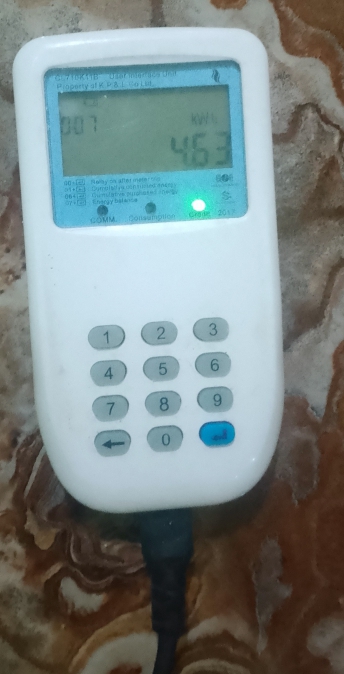
    An electricity meter records the total number of units consumed on the premises where it is located.

    An electricity meter reading units (kWh) is as illustrated below:


    Example 5

    A 1 200 W hair dryer is used for 15 mins. What is the energy used by the dryer?

    Answer

    $$Energy = power(p) \times time(t)$$ $$time = 15 \times 60$$ $$Energy = 1200 \times 15 \times 60 = 1080000J$$

    Example 6

    Two 40 W bulbs are left on for 6 hours. How much energy will they consume?

    Answer

    time in seconds = 6hours x 60min x 60secs = 21600 seconds

    E = power x times

    power = 40W x 2 = 80W

    Energy(E) = 80 x 21600 = 2028000J

    $$Energy \ in \ kilowatts = \frac{2028000}{1000}=2028Kw$$


    Example 7

    An electric heater is used for 45 minutes. If it consumes 2 250 kJ of energy within this time, calculate its power rating.

    Answer

    E=ptP=EtE = pt \therefore P = \frac{E}{t}P=2250J45/60P = \frac{2\,250 J}{45/60}P=2250×6045P = \frac{2\,250 \times 60}{45}=3000W= 3\,000 W=3kW= 3 kW


    Problems on mains electricity

    Example 8

    If one unit of electricity costs sh 3.5, calculate the cost of using:

    a) a 60 W light bulb
    b) a 1 kW heater

    for 30 minutes each.

    Answer

    a)

    Power = 60 W=601000kW= \frac{60}{1\,000} kW

    Time = 30 min=3060h= \frac{30}{60} h

    Energy consumed=601000kW×3060h= \frac{60}{1\,000} kW \times \frac{30}{60} h=0.03kWh= 0.03 kWh

    Cost = number of kWh × cost per unit=0.03×3.5=sh0.105= 0.03 \times 3.5 = sh 0.105

    b)

    Power = 1 kW

    Time = 30 min=3060=0.5h= \frac{30}{60} = 0.5 h

    Energy consumed:=1kW×0.5=0.5kWh= 1 kW \times 0.5 = 0.5 kWh

    Cost = number of kWh × cost per unit=0.5×3.5=sh1.75= 0.5 \times 3.5 = sh 1.75


    Example 9

    A home has the following appliances:

    a) A heater (5 kW)
    b) Iron box (2.5 kW)
    c) Home heater system (1 kW)

    What fuse would be required for each appliance if the appliance draws power from 240 V mains supply?

    Answers

    a) 5 kW heater

    P=VIP=PVP = VI \therefore P = \frac{P}{V}I=5000240=20.83AI = \frac{5\,000}{240} = 20.83 A

    Fuse should be 25 A.

    b) 2.5 kW iron box

    I=PVI = \frac{P}{V} =2500240= \frac{2\,500}{240}=10.42A= 10.42 A

    Fuse should be 15 A.

    c) 1 kW home heater

    I=1000240I = \frac{1\,000}{240} =4.2A= 4.2 A

    Fuse should be 5A.

    Example 4

    A consumer has the following appliances operating in his house for the times indicated in one day:

    ApplianceTime
    Two 40 W bulbs30 min
    One 500 W fridge10 hrs
    Four 75 W bulbs3 hrs
    One 3 kW electrical heater45 min
    One 100 W television5 hrs

    Calculate:

    (a) the total power of the appliances used.
    (b) the total electrical power consumed in kWh in 30 days, assuming that the power consumption per day is the same.


    Solution

    (a)

    Total power=(2×40)+(1×500)+(4×75)+(1×3000)+(1×100)= (2 \times 40) + (1 \times 500) + (4 \times 75) + (1 \times 3000) + (1 \times 100)=(2×40)+(1×500)+(4×75)+(1×3000)+(1×100) =3980W= 3\,980 W=3980W


    (b)

    Total energy consumed in one day equals the sum of energy consumed by each appliance.

    Two 40 W bulbs for 30 minutes:

    2×401000×30602 \times \frac{40}{1000} \times \frac{30}{60}2×100040​×6030​ =0.04 kWh= 0.04 \text{ kWh}=0.04 kWh

    One 500 W fridge for 10 hours:

    1×5001000×101 \times \frac{500}{1000} \times 10 =5 kWh= 5 \text{ kWh}=5 kWh

    Four 75 W bulbs for 3 hours:

    4×751000×34 \times \frac{75}{1000} \times 3 =0.90 kWh= 0.90 \text{ kWh}

    One 3 kW heater for 45 minutes:

    1×3×45601 \times 3 \times \frac{45}{60}=2.25 kWh= 2.25 \text{ kWh}

    One 100 W television for 5 hours:

    1×1001000×51 \times \frac{100}{1000} \times 5 =0.50 kWh= 0.50 \text{ kWh}

    Total energy consumed in one day:=8.69 kWh= 8.69 \text{ kWh}

    Hence, the electrical energy used in 30 day will be given by:

    8.69 x 30= shs 260.7

    Revision exercise

    “`html

    Electrical Energy & Power Quiz

    Test your understanding of electrical energy, power, kilowatt-hour and mains electricity.
    1. What is the SI unit of energy?
    2. Power is defined as:
    3. A 100 W bulb operates for 10 seconds. How much energy does it consume?
    4. One kilowatt-hour is equal to:
    5. A 1 200 W hair dryer is used for 15 minutes. What is the energy used?
    6. Electricity companies charge consumers using which unit?
    7. Two 40 W bulbs are left on for 6 hours. How much total power do they use together?
    8. A 1 kW heater is used for 30 minutes. How many kilowatt-hours are consumed?
    9. Which formula is used to calculate electric power?
    10. A 5 kW heater is connected to a 240 V supply. Approximately what current does it draw?

    Related topics

  • Interference of Light Waves

    Interference of Light Waves

    Interference of light waves is a phenomenon that occurs when two or more light waves overlap as they travel through the same medium. The study of interference provides strong evidence that light behaves as a wave and is clearly demonstrated in experiments such as Young’s double slit experiment, where alternating bright and dark fringes are formed on a screen.

    Notes

    • Interference occurs when two waves merge.
    • According to the principle of superposition, the resultant effects of two waves travelling at a given point in the same medium which is the vector sum of their respective displacements.
    • Suppose the amplitudes of the two wave pulses are A1A_1​ and A2A_2​, when the pulses are travelling in the same direction, the amplitude AA of the resulting wave is given by:

    A=A1+A2A=A_1+A_2

    where AA is the vector sum of A1A_1​ and A2A_2

    • The amplitude of the resulting pulses is the sum of the individual amplitudes of the initial pulses.
    • If the resulting pulse has zero amplitude, then the pulses are said to have undergone complete destructive interference.
    • Constructive interference occurs when the amplitude of the resulting pulse is bigger than that of the individual pulses.
    • In destructive interference, the amplitude of the resulting pulse is smaller than that of the individual pulses.
    • Two waves interfere as shown.
    illustrating constructive and destructive interference

    The Young’s Double Slit Experiment

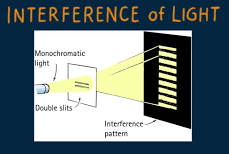
    double slit experiment illustrating interference of light

    A single slit SS is placed in front of a monochromatic light source.

    Because it is narrow, it diffracts light that falls on it, illuminating both slits S1S_1​ and S2S_2​ which are narrow, very close together and parallel to SS.

    S1S_1​ and S2S_2​ diffract the light which once more spreads out, superposing in the shaded area.

    A series of alternate bright and dark vertical bands are formed on the screen.


    • The fringes are equally spaced and the light intensity at the bright fringe is maximum while at the dark fringe it is minimum.

    How Interference Fringes are Formed

    From the descriptions above, interference is a phenomenon which is exhibited by progressive waves and results from the interaction of wavetrains of same frequency and constant phase (coherent wave trains).

    In an ordinary light source, light is produced as a result of electron transitions in the atoms of the source. The emitted bursts of waves last within 10-9 to 10-8 seconds and are out of phase with each other. Hence, two such light sources cannot be coherent owing to the random emission of light waves. They produce a uniform illumination instead of bright and dark fringes because the interference pattern that forms changes so rapidly.

    In the two slits experiment, slits S1S_1 and S2S_2​ are equidistant from SS. As a wavefront from SS reaches S1S_1​ and S2S_2​, each slit is considered as a new light source, such that the two slits form two coherent source as shown:

    illustrating interference to form dark and bright fringes
    • S1S_1​ and S2S_2​ are equidistant from SS.
    • As a wavefront from SSS reaches S1S_1​ and S2S_2​, each slit is irradiated as a new light source, such that the two slits form two coherent sources.
    • A central bright fringe forms at OO when S1O=S2OS_1O = S_2O such that the path difference is zero.
    • Moving outward on one side of the central bright fringe, the first bright forms at PPP where:

    S2PS1P=λS_2P-S_1P=\lambda

    • For the dark fringe at RRR:

    S2RS1R=12λS_2R-S_1R=\frac{1}{2}\lambda

    Related topics

  • Opener Math Exams: MATH CAT 1

    Opener Math Exams: MATH CAT 1

    FORM II MATHEMATICS
    CAT 2 – 2019

    Intsructions:

    • Answer all the questions: 50 marks
    • show all your working
    • non programmable electronic calculators may be used

    1. The exterior angles of a hexagon are:
    $$2x^o, 1\frac{1}{2}x^o, x+40^o, 110^o, 130^o \ \ and \ 160^o.$$

    Find the value of the smallest angle.(2 marks)


    2.

    Simplify:p4+2p2q2+q4p3p2q+pq2q3\frac{p^4 + 2p^2q^2 + q^4}{p^3 – p^2q + pq^2 – q^3}

    (2 marks)


    3.

    Simplify the expression:4x9x23x24x4\frac{4x – 9x^2}{3x^2 – 4x – 4}

    (3 marks)


    4. Evaluate using logarithms:

    14.3×0.009076.543\sqrt[3]{\frac{14.3 \times 0.0090}{76.54}}

    (4 marks)


    5.

    Three business partners, Atieno, Wambui and Mueni contributed shs. 50,000, 40,000 and 25,000 respectively to start a business. After sometime, they made a profit which they decided to share in the ratio of their contributions. If Mueni’s share was shs. 10,000, by how much was Atieno’s share more than Wambui’s? (3 marks)


    5.

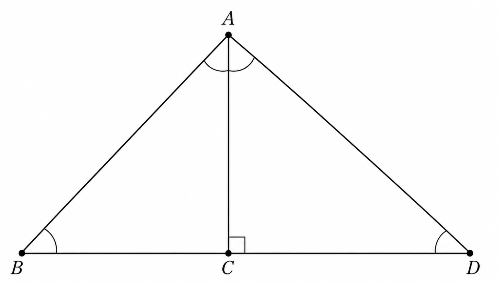
    In the figure below, angles ABC and ADC are equal. Angle ACD is a right angle. The ratio of the sides: AC:BC = 4:3

    f the area of triangle ABC is 2 .Find the area of triangle ACD.3 mks

    6.

    The angle of elevation of the top of a cliff from point P is 4545^\circ. From a point Q, which is 10 m from P towards the foot of the cliff, the angle of elevation is 4848^\circ.Calculate the height of the cliff.(4 mks)


    7.

    1. A solid S is made up of a cylindrical part and a conical part. The height of the solid is 4.5 m. The common radius of the cylindrical part and the conical part is 0.9 m. The height of the conical part is 1.5 m.

    a) Calculate the volume of solid S, correct to 1 decimal place.4 mks

    8.

    In the figure below, CA=k, AX=AY=17AB, CB=a\overrightarrow{CA}=k,\ \overrightarrow{AX}=\overrightarrow{AY}=\frac{1}{7}\overrightarrow{AB},\ \overrightarrow{CB}=a

    Triangle ABC with vector K and vector a labelled AC and CB respectively and point X and Y on line AB

    Express CX\overrightarrow{CX}CX in terms of aaa and kkk. (3 mks)(3 \text{ mks})(3 mks)

    9.

    A bus left a petrol station at 9:20 a.m and travelled at an average speed of 75 km/h75 \text{ km/h} to a town NNN. At 9:40 a.m, a taxi travelling at an average speed of 95 km/h95 \text{ km/h} left the same petrol station and followed the route of the bus. Determine the distance from the petrol station covered by the taxi at the time it caught up with the bus. (3 mks)(3 \text{ mks})

    10. Solve the simultaneous equations:

    $$x^2 +y^2=26$$ $$x-y =4$$

    11.

    The hire purchase (H.P) price of a public address system was Ksh 276,000. A deposit of Ksh 60,000 was paid followed by 18 equal monthly instalments. The cash price of the public address system was 10% less than the H.P price.

    Calculate:

    (i) the monthly instalment. (6mks)(6 \text{mks})

    (ii) the cash price. (2mks)(2 \text{mks})


    11 (b)

    The cost of a car outside Kenya is US $5,000. You intend to buy one such car through an agent who deals in Japanese Yen. The agent will charge you 20% commission on the price of the car and a further 80,325 Japanese Yen for shipment of the car.

    How many Kenya shillings will you need to send to an agent to obtain the car given that:

    • 1 US $ = 65.00 Yen
    • 1 US $ = 100.00 shillings (3mks)(3 \text{mks})


    11 (c)

    A salesman earns a basic salary of Ksh 9,000 per month. In addition, he is also paid a commission of 5% for sales above Ksh 15,000. In a certain month, he sold goods worth Ksh 120,000 at a discount of 212%2\frac{1}{2}\%.Calculate his total earnings that month.(3marks)

    12.

    The frequency distribution table below represents the number of kilograms of meat sold in a butchery.

    Mass in kg1–56–1011–1516–2021–2526–3031–35
    Frequency2368321

    (a) State the modal frequency. (1mk)(1 \text{mk})


    (b) Calculate the mean mass. (5mks)(5 \text{mks})


    (c) Calculate the median mass. (4mks)(4 \text{mks})

    Related pages

  • Introduction to Quantity of Heat and Capacity.

    Introduction to Quantity of Heat and Capacity.

    Heat is a form of energy that is transferred from one body to another due to a difference in temperature. The study of quantity of heat and heat capacity helps us understand how substances absorb, store, and transfer thermal energy. Quantity of heat refers to the amount of thermal energy gained or lost by a substance, while heat capacity is the measure of the amount of heat required to raise the temperature of a body by one degree Celsius or one Kelvin. These concepts are important in explaining everyday phenomena such as heating water, cooking food, and the functioning of heating systems. Understanding quantity of heat and capacity provides a foundation for studying thermal physics and helps in analyzing how different materials respond to heating and cooling processes.

    Heat is a form of energy that flows from a region of higher temperature to a region of lower temperature.

    When heat is supplied to a substance, two things may happen:

    • The temperature of the substance increases
    • The substance changes its state (for example, melting or boiling)

    Understanding how heat affects matter is important in physics, engineering, and everyday life.


    Heat and Temperature Change

    The rise in temperature of a substance depends on:

    • The mass of the substance
    • The type of material
    • The amount of heat supplied

    This explains why water heats more slowly than metals.


    Heat Capacity

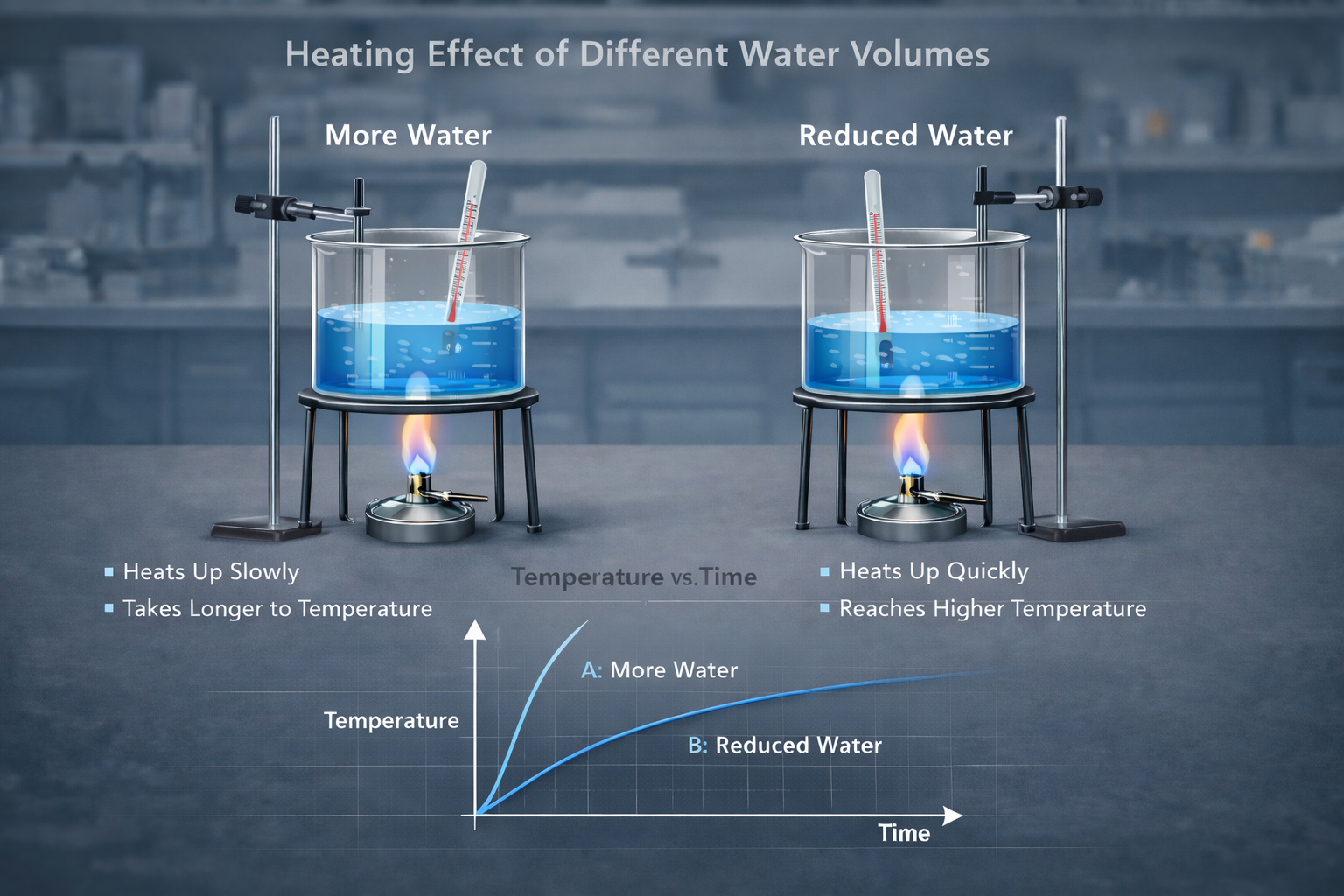
    The figure below illustrates comparing of different capacity of water being heated for sometimes by a bunsen burner. The beakers are identical and the graph shows how their temperature changes with time.

    Definition:
    Heat capacity is the amount of heat required to raise the temperature of a body by 1°C (or 1 K).

    Formula:

    Q = Cθ

    Where:
    Q = heat energy (J)
    C = heat capacity (J K⁻¹)
    θ = temperature change (°C or K)


    Specific Heat Capacity

    Definition:
    Specific heat capacity is the amount of heat required to raise the temperature of 1 kg of a substance by 1 K.

    Formula:

    Q = mcθ

    Where:
    m = mass (kg)
    c = specific heat capacity (J kg⁻¹ K⁻¹)
    θ = temperature change


    Key Concept

    Different materials respond differently to heat:

    • Water has a high specific heat capacity → heats slowly
    • Metals have low specific heat capacity → heat quickly

    Relationship Between Heat Capacity and Specific Heat Capacity

    C = mc

    This means total heat capacity depends on both:

    • Mass
    • Type of material

    Heating Experiment

    Aim:
    To observe how heat affects temperature change in water.

    Procedure:

    1. Measure a fixed volume of water
    2. Record its initial temperature
    3. Heat the water
    4. Record time taken to reach a higher temperature
    5. Repeat using different volumes

    Observation:

    • Larger volume → heats more slowly
    • Smaller volume → heats faster

    Conclusion:
    The quantity of heat required depends on the mass of the substance.


    Worked Examples

    Example 1

    Heat capacity = 460 J K⁻¹
    Temperature change = 45°C − 15°C = 30°C

    Q = Cθ
    Q = 460 × 30
    Q = 13,800 J


    Example 2

    Power = 50 W
    Time = 9 minutes = 540 s

    Q = Pt
    Q = 50 × 540
    Q = 27,000 J


    Example 3

    Mass = 60 g = 0.06 kg
    Specific heat capacity = 390 J kg⁻¹ K⁻¹
    Temperature change = 50°C

    Q = mcθ
    Q = 0.06 × 390 × 50
    Q = 1170 J


    Table of Specific Heat Capacities

    SubstanceValue (J kg⁻¹ K⁻¹)
    Water4200
    Alcohol2400
    Kerosene2200
    Ice2100
    Aluminium900
    Copper390
    Lead130

    Related topics

    watch this video:

  • PRINCIPLES OF MOMENTS: A Complete Guide to Forces, Rotation, and Equilibrium

    The principle of moments is a fundamental concept in physics that explains how forces cause objects to rotate and how balance is achieved. Whether it is a seesaw, a door, or a bridge, understanding how forces act at different distances from a pivot helps us predict and control motion. By studying moments, we learn not only how to calculate turning effects but also how real-world structures remain stable under various forces. This topic forms an important foundation for mechanics and is widely applied in engineering, construction, and everyday problem-solving.


    ???? Introduction

    From opening a door to balancing a seesaw, rotation is part of everyday life. The principle of moments helps us understand how and why objects turn, balance, or remain stable under the action of forces.

    This concept is fundamental in physics and engineering, forming the basis for analyzing structures such as bridges, cranes, beams, and even the human body.


    ⚙️ What is a Moment?

    A moment is the turning effect produced by a force about a fixed point called a pivot (or fulcrum).

    ???? The larger the force or the further it is from the pivot, the greater the turning effect.

    Mathematical Definition of principles of moments:

    $$Moment = F \times d$$

    Where:

    • M = Moment (Newton metre, Nm)
    • F = Applied force (Newtons, N)
    • d = Perpendicular distance from pivot to the line of action of the force (metres, m)

    Understanding Perpendicular Distance ????

    It is not just the distance—it must be the shortest distance from the pivot to the line of action of the force. This is called the perpendicular distance.

    Important:

    • If the force is applied at an angle, you must resolve it or find the perpendicular component.
    • Using the wrong distance is one of the most common mistakes.

    ???? Direction of Rotation

    Moments can act in two directions:

    • Clockwise moment → turns the object to the right
    • Anticlockwise moment → turns the object to the left

    In calculations:

    • Choose one direction as positive (commonly anticlockwise)
    • The other becomes negative

    ⚖️ Equilibrium of a Body

    A body is said to be in equilibrium when it satisfies two conditions:

    1. Translational Equilibrium

    • No movement in any direction
    • Resultant force = 0

    2. Rotational Equilibrium

    • No turning effect
    • Resultant moment = 0

    ???? Principle of Moments

    This principle combines rotational equilibrium into a simple rule:

    For a body in equilibrium, the sum of clockwise moments about a point equals the sum of anticlockwise moments about the same point.

    Mathematically:

    $$
    \text{Sum of clockwise moments} = \text{Sum of anticlockwise moments}
    $$


    ???? Why the Principle Works

    If clockwise moments were greater, the object would rotate clockwise.
    If anticlockwise moments were greater, it would rotate anticlockwise.

    ???? Therefore, equality ensures balance.


    ????️ Real-Life Applications

    The principle of moments is used in:

    • Seesaws → balancing children of different weights
    • Spanners (wrenches) → longer handles produce more turning effect
    • Door handles → placed far from hinges for easier opening
    • Bridges and buildings → ensuring stability under loads
    • Human body → muscles create moments around joints

    ???? Worked Examples


    Example 1: Finding Distance

    A force of 20 N produces a moment of 100 Nm.

    $$
    d = \frac{100}{20} = 5 , m
    $$

    ???? Distance = 5 m


    Example 2: Multiple Forces on a Beam

    A beam is in equilibrium:

    • Left side: 30 N at 3 m
    • Right side: 10 N at 2 m and another force (F) at 1 m

    $$
    30 \times 3 = (10 \times 2) + F
    $$

    $$
    90 = 20 + F
    $$

    $$
    F = 70N
    $$

    ???? Missing force = 70 N


    Example 5: Taking Moments About Different Points

    A beam has forces acting at different positions. Choosing the pivot wisely simplifies calculations.

    Always take moments about a point where unknown forces act to eliminate them from the equation.


    ⚠️ Common Mistakes to Avoid

    • Using wrong distance (not perpendicular)
    • Ignoring direction of moments
    • Forgetting to include all forces
    • Not choosing a convenient pivot
    • Mixing up units (always use Nm)

    ???? Advanced Insight

    Moment as Torque

    In more advanced physics, moment is also called torque, especially in rotational dynamics.

    Sign Convention

    You may use:

    • Anticlockwise = positive
    • Clockwise = negative

    This helps when solving complex equations.


    ???? Practice Questions

    1. A force of 18 N acts 2.5 m from a pivot. Find the moment.
    2. A moment of 72 Nm is produced by a force of 12 N. Find the distance.
    3. A beam balances with:
      • 40 N at 3 m (left)
      • F at 6 m (right)
        Find F.
    4. A uniform beam is supported at a pivot. Forces act at different points—determine the unknown force required for equilibrium.
    5. Explain why a long spanner is more effective than a short one.

    ???? Summary

    • A moment is the turning effect of a force
    • It is calculated using:
      $$
      M = F \times d
      $$
    • A body is in equilibrium when:
      • Resultant force = 0
      • Resultant moment = 0
    • Principle of moments ensures balance:
      • Clockwise moments = Anticlockwise moments

    Final Thought

    Understanding moments allows you to analyze and design systems that remain stable under forces. Whether in engineering, construction, or daily life, this principle is essential for solving real-world problems involving balance and rotation.


    Related topics

    illustrating principles of moments and it's role in a rotating spanner
  • Mass, weight and density

    Mass, weight and density

    Mass, weight and density are fundamental physical quantities that help us understand how matter behaves, how heavy objects are under gravity, and how compact substances are.

    Mass

    Mass of an object is the quantity of matter in it. it remains constant regardless of location or the force of gravity acting on it.

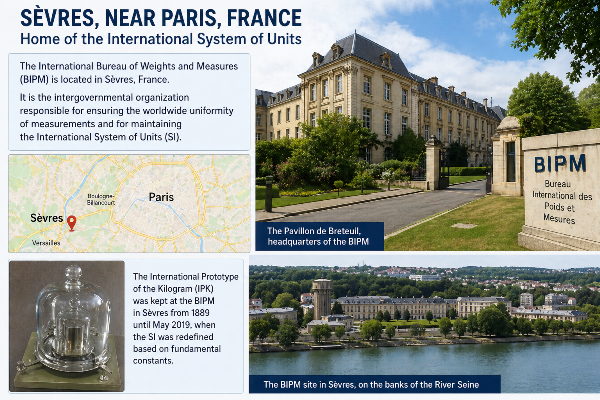
    The SI unit of mass is Kilogram. The symbol for Kilogram is Kg. A kilogram is the mass of a piece of metal that is stored at Sevres, near Paris. It is used as the standard for measuring masses. Sevres is where the International office of weights and Measurements is located.

    Kilogram can be broken into smaller units so that with have a sub-multiples of a kilogram which we can represent with prefixes.

    the table below shows some sub-units of a gram, which is the most common unit of measuring masses. 1000 grams = 1 Kilogram.

    sub unit and symbolequivalent in grams
    picogram (pg)10-12
    nanogram (ng)10-9
    microgram (μg)10-6
    milligrams (mg)10-3
    centigrams(cg)10-2
    decigram (dg)10-1

    The table belows sub units of kilogram as multiples of gram

    sub unitequivalence in gramsequivalent in kilograms
    Decigram(Dg)100.01
    Hectogram(Hg)1000.1
    Kilogram10001.0
    tonne10000001000

    Revision exercise

    1. Convert 0.02 g to milligrams.
    2. Convert 0.75 kg to grams.
    3. Express 250 cg as grams.
    4. what is 0.6 g in centigrams.
    5. Convert 8000 ng to micrograms.
    6. Convert 5 µg to nanograms.

    Weight

    Weight of an object is the pull of gravitational force on it. The pull of the earth, sun and moon on an object is called the force of gravity due to the earth, sun and moon respectively. The SI unit of weight is newton.

    Weight of an object = mass x gravitational force

    in other words: Weight(N) = mass(kg) x g (N/kg)

    Density

    Density of a substance is the mass of a unit cube of the substance, that is; density is mass per unit volume.

    $$Density \ (\rho) =\frac{mass(m)}{volume(V)} $$

    The SI unit of density is kilogram per cubic metre (kgm-3).

    Another common unit of expressing density is grams per cubic centimeters (gcm-3).

    Example problems

    1. Find the mass in Kilograms of an ice cube of side 6cm If the density of ice is 0.92gcm-3 .

    solution

    volume of the cube = 6cm x 6cm x 6cm = 216cm3

    mass = density x volume

    mass = 216cm3 x 0.92gcm-3 = 198.72 g

    $$=\frac{198.72g}{1000g/kg} = 0.19872Kg$$

    2. Find the volume of cork in cubic metre of mass 48g given that density of cork is 0.24gcm-3.

    solution

    $$Volume = \frac{mass}{density} = \frac{48}{0.24gcm^{-3}} = 200cm^3$$

    1 cubic metre = 1000000 cm3

    That is:

    $$1m^3 = 1000000cm^3$$ $$hence \ \text{volume in cubic metre } = \frac{200cm^3}{1000000cm^3} = 0.0002 m^3$$

    Related pages

  • Uniform circular motion with 5 examples

    Uniform circular motion with 5 examples

    Uniform Circular Motion refers to the motion of an object traveling at a constant speed along a circular path. The object’s speed remains constant. However, its velocity is constantly changing. This change occurs due to the continuous change in direction as the object moves along the curve.

    Key characteristics of uniform circular motion includes:

    1. Constant Speed: The object moves with a constant speed along the circle. However, because the direction is always changing, the velocity, which is a vector, changes continuously.
    2. Centripetal Force: An object follows a circular path only if a force acts toward the circle’s center. This is called the centripetal force.

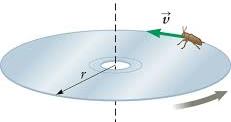
    Consider a particle moving along a circular path when it moves from point A to point B as in figure below.

    illustrating uniform circular motion on a circle

    The reference point OA makes an angle with the line OB that represents the line joining the new position of the object and the center of the circle. The object has covered a distance S along the circle making an arc with θ.

    Angular displacement is the angle swept by a line joining end of an object in a circular path with the center of the path when it moves from one point to another in a circular motion.

    Angles in circular motion are usually expressed in radians θc.

    $$\text{Angle θ in radians}=\frac{arc \ length \ s (AB)}{radius \ r \ (OA)}$$

    That is:

    $$\theta(radians) = \frac{s}{r}$$

    θ(radians)=Sr

    it therefore follows that S = rꝊc

    A radian is defined as an angle subtended at the center of a circle by an arc length equal to the radius of the circle.

    Therefore angle θ subtended by the circumference at the center of a circle of radius r is therefore given by;

    θ=circumferenceradius

    and we can write circumference in terms of π such that:

    2πr=2πc

    We can relate the degrees from 2πc = 360o .

    Problem

    An object traces an arc of length 10.98 while attached to a cord of length 3.2 m that is fixed on a fixed surface on a flat smooth surface. Determine the angular displacement by the object.

    Solution

    We visualize the setup as in figure below:

    from the equation S = rꝊc

    θc=Sr=10.983.2=3.43 radians

    if we can express answers in degrees, then 3.43 radians = 196.52o .

    Practice Question

    An object moves a distance of 80.12 π along a circular path of radius 3.8m. Determine it’s angular displacement.

    Angular velocity for a uniform circular motion

    Angular velocity is defined as the rate of change of angular displacement with time.

    we can shorten the equation by using symbols alone:

    ω=ΔθΔt

    The SI Units of angular velocity is radians per second (rads-1)

    Consider the equation that relates angular displacement in radians with the arc length made by the object:

    θ=Sr

    to get the rate of change of speed, we divide both sides with t as they both represent displacement of the object.

    θt=Srt=1r(St)

    but distance s when divided by time gives velocity. That is;

    v=St

    where v is the linear velocity representing the velocity of the object along the circular path.

    ω=θt

    Hence the equation above becomes:

    hence, the angular velocity can be expressed in terms of linear velocity and radius as show in equation below:

    ω=vr

    similarly, linear velocity can be expressed in terms of angular velocity as v=ωr.

    An object in circular motion has both linear and angular velocity. The time taken to make one complete circle is called the periodic (T) and is given by T= circumstances/speed.

    Let us now consider the time taken for a body to make one complete circle in a circular path. At that one circle, it will have covered the circumference of a circle. The time taken to complete such one revolution is called periodic time (T).

    from the equation :

    time=distancespeed

    and that:

    T=circumferencespeed

    and circumference = 2πr, hence

    T=2πrωr=2πω

    Hence T in the above equation becomes:

    T=2πω

    but

    1T=ω2π

    therefore:

    ω=2πT

    but since:

    1f=T

    ω=2π1f=2πf

    Example question

    A metallic ball is whiled in a horizontal circle making 5 revolution s per second.Determine:

    • Period T
    • angular velocity and
    • linear speed v

    Centripetal force

    Consider on object m held by a cord om positioned at A. The Object is whirled in a circular motion and after some time Δt, the object is at position B. The velocity of the object in linear direction changes from VA to VB. If there was no force acting on the body, the object will not change directions but will go in a straight line. There must be a force that maintain the body at a constant distance distance from the center o.

    Centripetal force Fc refers to the force that keeps a body in circular motion. A body in a circular motion is accelerating and from newton’s second law of motion, there must be a force acting on it to cause acceleration. Centripetal force is usually directed towards the center of the circular path. The Centripetal force is the force responsible for the constant change of direction otherwise the body would naturally follow a straight line if there was no force acting to keep the body in circular motion.

    The value of the centripetal force is derived from newton’s second law of motion which states that: the rate of change of momentum of a body is directly proportional to the resultant force in the direction of force.

    Momentum means mass multiplied by velocity.

    Because velocity of a body in circular motion is changing, it’s momentum must also be changing.

    The newton’s second law can be described as F=ma, where a = acceleration and m is the mass.

    but the acceleration of the body of the body is given by a= v2/r, where v is the linear speed of the object while it is in circular motion. hence

    From definition of angular velocity we had shown that, ω is given by v/r, and hence v=ωr.

    it follows that Fc = m(ωr)2/r = mω2r2/r = mω2r .

    Tension from circular motion

    If a body is attached to a string and swung around on a horizontal circle, the centripetal force that keeps the body in the circular orbit is kept as tension in the string. For the body to remain in circular motion, the centripetal force is equal to the tensional force.

    From the equation Fc = mω2r , it shows that centripetal force is directly proportional to the angular velocity meaning that a larger force will be required to maintain the body in motion if it is swung faster.

    Related Topics

    Share this:

    Customize buttons

    Like this:

    https://widgets.wp.com/likes/?ver=14.2.1#blog_id=249100342&post_id=994&origin=mav.lzf.mybluehost.me&obj_id=249100342-994-69ca06e5d32da&n=1

    Discover more from precisestudy

  • Trigonometric Questions

    Trigonometric Questions

    Trigonometric questions are math problems that involve angles and ratios using trigonometry. They usually test how well you understand relationships between angles and sides of triangles.

    1.Solve the equation 2 cosθ= √3 in the range 0oθ≤360o

    2. Solve for x in the equation -3xsinx=1 in the range 0oθ≤360o

    3. Solve for x in the equation sin2x = 0.25 for 0oθ≤360o giving your answer in πc

    4.$$\text{Given that } tan \theta = \frac{sin \theta}{cos \theta}$$

    5. solve the equation 2 sinθ = cosθ in the range 0oθ≤360o to the nearest whole number

    6. Calculate without using log table:

    $$\frac{sin 225^o \times cos360^o \times tan 30^o}{sin 120^o \times cos 315^o}$$

    7.Triangle ABC is inscribed in a circle as in figure below. AB = 9.2cm, AC = 7.9 and BC=4.4cm

    Trigonometric question

    Find: (a) Angle A (2 marks)

    (b) The radius of the circle correct to 1 d.p (2 marks)

    Related pages