Tag: dailyprompt

  • Mutual Induction


    Mutual induction is a phenomenon in physics where a changing magnetic field in one coil of wire induces a voltage across another nearby coil. When the magnetic field passing through one coil changes, it induces a voltage in the other coil, according to Faraday’s law of electromagnetic induction.

    This principle is fundamental to the operation of transformers, where two or more coils of wire are used to transfer electrical energy from one circuit to another by means of a changing magnetic field.

    Mutual induction is a key concept in the functioning of many electrical devices and is utilized in various applications, including power transmission, signal coupling, and wireless power transfer.

    Demonstrating mutual Induction

    • To investigate mutual induction, set two coils close to each other as shown

    Using the variable resistor, put the current to minimum and observe the behavior on the galvanometer from the following actions:

    • closing the switch K
    • opening the switch K
    • Increasing the current using variable resistor when the switch is closed
    • decrease the current using variable resistor when the switch is closed
    • replace the D.C power supply with A.C power supply.

    when the switch K is closed, the pointer deflects in one direction and then comes back to zero. When K is opened, the pointer deflects to the opposite direction and then falls back to zero.

    Increasing current in the primary coil causes deflection while decreasing it causes deflection to the opposite direction.

    If direct current (d.c) is replaced with an alternating current source, the pointer of the galvanometer vibrates continously about the zero point.

    Explanations

    When the switch is closed, the current in the primary coil increases from zero to maximum value within a very short time and so the magnetic flux in the primary coil linking with the secondary coil increases from zero to maximum at the same interval of time inducing an e.m.f in the secondary coil.

    The induced emf in the secondary coil causes flow of current hence deflection on the galvanometer.

    The induced e.m.f lasts only for a period where current is transiting from zero to maximum and so the pointer on the galvanometer returns to zero after a very short time. This is because after the current in primary coil builds up to it’s maximum value, there is no further change in magnetic flux in the primary coil and so induced e.m.f in the secondary coil stops.

    When the switch is opened, the current in the primary coil takes a very short time to fall from maximum to zero hence the magnetic flux in the primary coil linking with the secondary coil also falls from maximum value to zero inducing an e.m.f in the secondary.

    The current in the circuit takes much shorter time to fall off from maximum to zero than it takes to build up from zero to maximum and therefore induced e.m.f is much higher when current is being switched off than when it is switched on.

    When the current is increased continously, the magnetic flux in the primary coil which links with the secondary coil also increases at the same rate causing an e.m.f to be induced in the secondary.

    When current in the primary is decreased continously, an e.m.f is induced in the secondary due to the decreasing magnetic flux of the primary coil linking with the secondary coil

    The direction of current in the secondary coil is to the opposite direction to that of primary coil so that the polarities in the secondary and primary coil are such that they oppose each other. The direction of current on each coil can be determined by Lenz’s law.

    When the switch is closed and current is building up, the direction of current in primary and secondary coil is as illustrated below:

    when the current is decaying after switch is opened, the direction of the induced e.m.f in the secondary coil is as shown.

    most often the e.m.f induced in the secondary coil is less than what was produced in the primary coil. This is mostly because of what is called flux leakage where all the magnetic flux from primary coil does not link with the secondary coil.

    The induced e.m.f in the secondary coil can be increased by ensuring more flux from primary coil are linking with the secondary coil.Some of the techniques used includes:

    In this method, the primary and secondary coil are linked together on one soft iron which helps to concentrate magnetic flux in both coils. Typical arrangement is as shown.

    In the above arrangement, both primary and secondary coil are wound on the same iron core.

    Magnetic flux tends to form circular loop and so a circular ring makes them work better . The arrangements is as illustrated.

    The ring enables all the magnetic flux of the primary to form concentric loops within it thus reaching the secondary coil more efficiently.

    we saw earlier that the total induced e.m.f in the coil is the summation of all the e.m.fs induced by individual turns in the coil. When there are more turns in a coil, it then means there will be more e.m.f in that coil. Consider the setup illustrated below.

    The e.m.f is induced in each turn of the secondary coil since the magnetic flux of the primary coil links with each .

    Related Topics


    References

    • Secondary Physics Student’s Book Four. 3rd ed., Kenya Literature Bureau, 2012.
    • Tom D., and Heather K. Cambridge IGCSE Physics. 3rd ed., Hodder Education, 2018.
    • Abbot A. F. (1980), Ordinary Level Physics, 3rd Edition, Heinemann Books International,
      London.
    • Nelkon M. and Parker P., (1987), Advanced Level Physics, Heinemann Educational
      Publishers, London.

  • future proofing our careers

    What is your career plan?

    The careers we used to admire 15 years ago are no longer selling. We have seen people in such careers becoming jobless in the wave of technological advancements and artificial intelligence. Artificial intelligence is taking jobs that initially we thought could be done by human beings. Jobs like waiters and coding are done very well by machines.

    Most of industrialists and entrepreneurs are for profit maximization and so they seek to automate whatever that can be automatized so as to replace the human labor with machines because machines can work 24 hours without needing motivations like salary, days off, time with family all human needs a normal human resource should ensure for human labor.

    Even computer scientists after developing cutting edge technologies are edged out of job market because they developed systems that replaces hundred of them with 5. It is a game of numbers in the corporate world where money matters the most beyond the need of any human needs.

    We have seen extreme changes in career in the last one decade or so where the way of doing business has changed. Even knowledge workers and experts are being replaced by machines. So the future of work is not predictable and the traditional practices of working hard in school and getting a career to earn a living and as a mean of success in life may not apply in many circumstances. We no longer need to attend schools to learn about anything, AI can guide us to any knowledge at any moment and we can acquire skills and knowledge without attending schools. Employers are not interested with papers but what value you can give to their business. So we have college graduates that are frustrated because what they thought was great to pursue in college is no longer working. In this regard, it is not wise to chase college degree and career with aim of looking for a job but we should pursue knowledge and skills to be innovative and aim at being a producer and manufacturer of things. Only people that produces goods and services can have economic freedom and free from fear of loosing their jobs. Only doing business in the modern life can guarantee quality and prosperous life and not chasing of higher education.

    Am not saying we stop schooling, but the purpose of chasing education should be to fulfill curiosity and self discovery but not to seek employment. We should focus more on creating employment but not on being offered one.

    However, the world of employment is not as gloomy as it may sound. Here are few careers of the future that will guarantee a job for those inclined to formal employment.

    Some careers for the future

    • Cyber-security Experts
    • machine learning
    • Biotechnologists
    • Healthcare professionals
    • Engineering
    • Agriculture
    • Water resources
    • Data Science
    • Data analysis
    • Digital marketing specialists
    •  Mental health jobs
    • Game designer
    • Physician assistants

    Related topics


  • Using Lens formula to find focal length

    The mirror describes the relationship that exists between the focal length, image distance and the object distance. By use of mirror formula that had been derived earlier, the unknown focal length of a lens can be determined experimentally. We describe the experiment here and explains how to extract the the focal length from the relationship.

    Apparatus

    • Metre rule
    • lens and a lens holder
    • source of light
    • screen
    • cardboard with a cross wire
    procedure
    • set the apparatus as shown
    • You place the object at the zero centimetre mark
    • set the object distance by placing the lens at a reasonable distance from the object like 80cm from the object.
    • Adjust the screen until a sharp image is obtained
    • Record a distance between the screen and the lens when a sharp image is formed on the screen. That is the image distance.
    • Record the image and the object distance
    • Reduce the object distance u by about 5 cm and then adjust the screen until another sharp image is formed on the screen.
    • reduce the distances distance again by 5 cm and repeat the procedure above.
    • Fill the table as shown below

    From the data obtained, a graph of 1/u against 1/v can be plotted.

    A typical graph will be as shown:

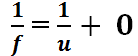
    Now the lens formula is stated as:

    at the (1/v) intercept, the value of (1/u)= 0

    hence :

    and hence

    and therefore the value of f-1 (1/f) is equal to 1/v.

    similarly at the (1/u) intercept, the the value of (1/v) =0

    and so the lens formula becomes

    hence

    from the graph, we can deduce that 1/u and 1/v gives 1/f at the intercepts.

    we can get two values of f from the 1/v and 1/u intercepts such that:

    f1 = (1/v)-1 and f2 = (1/u)-1

    the focal length f is thus the average of f1 and f2 such that

    Related Topics


    References:
    • Secondary Physics Student’s Book Four. 3rd ed., Kenya Literature Bureau, 2012. pp. 1-42.
    • Abbot A. F. (1980), Ordinary Level Physics, 3rd Edition, Heinemann Books International,
      London.
    • Nelkon M. and Parker P., (1987), Advanced Level Physics, Heinemann Educational
      Publishers, London.
    • Tom D., and Heather K. Cambridge IGCSE Physics. 3rd ed., Hodder Education, 2018, https://doi.org/978 1 4441 76421. pp. 106-142.

    1. Abi Carter: Top 7 Adele Night

      What was the last live performance you saw?

      Last sunday 5th may 2024 i watched her performance and was blown away by Carter’s captivating performance in the singing competition. She was performing  Adele’s “Hello”.

      Abi Carter possesses a captivating presence and ability to deeply connect with her audience on an emotional level. She is usually calm on stage and sitted behind the piano, her performance can be mesmerizing. She commands attention effortlessly, drawing the audience into her world with a magnetic presence.

      Through her lyrics and delivery, she convey profound emotions, touching the hearts of everyone in the room. One feels as if she is singing just for you and her performance creates a sense of intimacy, forging a connection with each member of the audience.

      Her Musical Mastery is evident, as she effortlessly weave melodies on the piano that complement her vocals, creating a rich tapestry of sound.

      One cannot fail to see sincerity on her performance that resonates with the audience.She is actually sharing pieces of herself with each stroke on the keyboard. Her music has a ripple effect, stirring emotions and inspiring us listeners. Even in moments of stillness, her impact is palpable, leaving a lasting impression on me…..am sorry but it is like am crushing on her:;;

      Related topics


    2. Direction of induced current in a straight conductor

      Direction of induced current in a straight conductor

      consider the setup below

      To investigate direction of current on the straight conductor AB, you can do the following:

      • Move the condutor to cut the magnetic fields vertically upwards and note the direction of the magnetic field.
      • Move the condutor to cut the magnetic fields vertically downwards wards and note the direction of the magnetic field.
      • Hold the wire stationary in the magnetic field and note the deflection

      when the wire is moved upwards, the deflection on the galvanometer goes right showing that the current is flowing from A to B. To represent that on a paper, the induced current is envisioned to be moving into the page away from the eye as in the following illustration.

      when moved and when the wire is moved downwards deflections goes left showing that the current is moving from A to B . The current flow can be represented on a paper with current fl0wing out of the page towards the eye as in figure below.

      Fleming’s Right-hand rule

      Direction of an induced current in a straight conductor can be determined by Fleming’s right-hand rule which states that:

      The figure below shows how your right hand should be held to determine the direction of the induced current by use of Flemings’s right hand rule.

      Fleming’s right hand rule is also known as the dynamo rule and it agrees with the Lenz’s law.

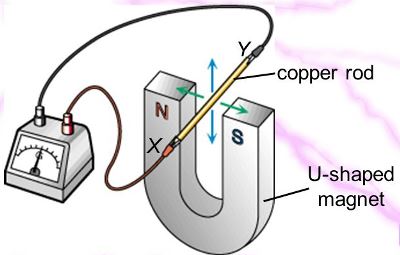
      Consider a horizontal magnet held as shown in figure below:

      The direction of the magnetic field is downward. The downward direction of the above magnetic field can be represent by a section of an arrow tail to show that the magnetic field is going down into the paper.

      Suppose we have a conductor that is held horizontally between the two poles, the conductor will slide away or towards the magnet if it has some current flowing in it.

      The figure below shows current through a certain conductor XY inside a magnetic field moving into the paper and the likely motion for such a setup.

      According to Fleming’s rule which is consistent with the lenz’s law, the current must flow from X to Y in order to produce an electromotive force that is to push the rod XY to the right.

      Related topics


      References

      • Secondary Physics Student’s Book Four. 3rd ed., Kenya Literature Bureau, 2012.
      • Tom D., and Heather K. Cambridge IGCSE Physics. 3rd ed., Hodder Education, 2018.

    3. Engaging in Community: The Power of Individual Involvement

      What do you do to be involved in the community?

      Introduction

      In a world where digital connections often overshadow face-to-face interactions, the concept of community remains as vital as ever. But what exactly is a community? At its core, a community is more than just a group of people occupying the same space; it’s a network of individuals bound together by shared interests, values, or goals. Whether it’s a neighborhood, a sports team, an online forum, or a professional association, communities provide a sense of belonging and support that is essential for personal well-being and societal cohesion.

      What is a Community?

      Communities come in various forms and sizes, from tight-knit neighborhoods to global online networks. What distinguishes a community is its shared identity and sense of belonging. Whether it’s bonding over a common hobby, a shared cultural heritage, or a mutual cause, communities provide a space where individuals can connect with like-minded peers, find support, and collaborate towards common goals.

      How to Ensure Individual Involvement

      While communities offer numerous benefits, their impact depends largely on individual participation. Engaging with your community doesn’t require grand gestures; even small acts of involvement can make a difference. Here are some ways individuals can ensure they are actively involved in their communities:

      Whether it’s lending a hand at a local soup kitchen, participating in a beach cleanup, or mentoring a student, volunteering is a powerful way to contribute to your community and make a positive impact.

      From neighborhood associations to hobby clubs, joining groups and organizations related to your interests is a great way to meet like-minded people and build connections within your community.

      Keep an eye out for community events such as festivals, fundraisers, workshops, and town hall meetings. Attending these events not only helps you stay informed about local happenings but also provides opportunities to connect with fellow community members.

      In today’s digital age, online communities play a significant role in connecting people with shared interests or identities. Participating in online forums, social media groups, and virtual communities allows individuals to engage with a broader network of peers and contribute to meaningful discussions.

      The Importance of Community

      The benefits of community involvement extend far beyond personal satisfaction; they have a profound impact on both individuals and society as a whole. Here are some reasons why communities matter:

      Communities provide a crucial source of social support, offering a network of friends, neighbors, and peers who can offer assistance, encouragement, and empathy during challenging times.

      Belonging to a community fosters a sense of identity and belongingness, helping individuals feel connected to something larger than themselves and reducing feelings of isolation and loneliness.

      Communities offer valuable networking opportunities, allowing individuals to forge professional connections, discover new opportunities, and advance their careers.

      Engaging with diverse perspectives and experiences within a community promotes personal growth and development, challenging individuals to step outside their comfort zones, learn new skills, and broaden their horizons.

      How Community Affects Us

      Our involvement in communities shapes not only our individual experiences but also the broader social fabric. Here’s how community affects us:

      Communities play a crucial role in shaping our identities, influencing our values, beliefs, and behaviors from an early age.

      The norms, values, and social dynamics within a community influence our attitudes and behaviors, shaping our decisions and actions in various contexts.

      Communities have the power to drive societal change by mobilizing collective action, raising awareness about important issues, and advocating for social justice and equality.

      Conclusion

      In a world that often emphasizes individualism and self-interest, the importance of community cannot be overstated. By actively engaging with our communities, we not only enrich our own lives but also contribute to the well-being and vitality of society as a whole. Whether it’s through volunteering, joining groups, attending events, or participating online, each of us has the power to make a difference and build stronger, more connected communities.

      So, let’s embrace the power of community and work together to create a world where everyone feels valued, supported, and connected.

      Related topics

      References

      • Akers, A. S. (2014, September 30). 7 Simple Ways You Can Get Involved in Your Community. Psychcentral. Retrieved May 7, 2024, from https://psychcentral.com/blog/your-mind/2014/09/

    4. The Lenz’s law

      Consider the setup illustrated in the diagram below

      When the magnet is moved towards the coil, the galvanometer deflects and when moved away, the deflection happens in the opposite direction. This shows that the direction of change of the magnetic flux linkage determines direction of the induced current.

      Galvanometer deflection according to direction of current

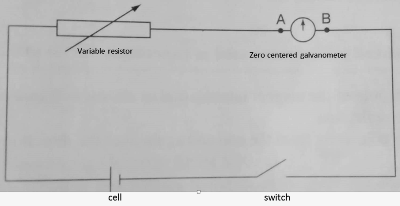
      We need to investigate how the current flows depending on the direction of the magnetic flux change and so we setup an experimental apparatus as shown.

      To investigate about current direction, we manipulate the apparatus in the following ways:

      • Adjust the variable resistor to a high value in order to limit the current through the sensitive galvanometer.
      • Close the switch and note the deflection on the galvanometer when current flows from A to B.

      When current direction is from enter galvanometer through A and leave at B, The deflection on the galvanometer is to the right. From the diagram, the current leaves the cell towards A.

      If the cell is reversed such that the current enters the galvanometer through B, the deflection happens to the left.

      Determining direction of the induced current

      Consider a coil of wire and a galvanometer connected as shown with a magnet being moved towards the coil.

      When the north pole of the magnet is moved towards the coil, the galvanometer deflects to the left indicating that the direction of the induced current is clockwise as in the direction DCBA.

      When the north pole of the magnet is moved away from the coil, the pointer deflects to the right indicating that current flow is in the anticlockwise direction or direction DABC.

      As the north pole of the magnet moves towards the coil, the induced current flows in the coil in an attempt to form an electromagnet with a north pole at the end near the incoming magnetic pole. This is meant to resist movement of the incoming north pole. From the clock rule studied in magnetic Effect of electric current, The current flow in the conductor will be as illustrated below so that the end near the north pole forms an opposing north pole.

      Remember the basic law of magnetism states that:

      When the North pole of the magnet is moved away from the coil, the induced current in the coil flows in such a way that a south pole is formed at the end of the coil near the leaving magnet so as to oppose movement of the receding magnet. Using the clock rule, the direction of induced current flow is as illustrated in the diagram below.

      From the above experiments and observations, the direction of the induced current in a coil can be determined in Lenz’s law which states that:

      Lenz’s law applies the principle the principle of conservation of energy. The mechanical energy used to move the magnet to the coil is converted to electrical energy in the form of an induced current. Work is done by the hard pushing the magnet towards the coil against the repulsive force from the induced pole of the coil if the current has to flow.

      Related topics


    5. System administrator

      As a system administrator, my role revolves around ensuring the smooth operation and security of an organization’s IT infrastructure. My main duties and responsibility will includes:

      System Maintenance

      This is a primary responsibility of a system admin thats involves installing, configuring, and maintaining hardware, software, and networking systems. This includes servers, routers, switches, operating systems, and various applications critical to the organization’s operations.

      Security Management

      Protecting the organization’s IT assets from cyber threats is paramount. I implement security measures such as firewalls, intrusion detection systems, and encryption protocols. Regularly updating security patches and conducting vulnerability assessments are also essential tasks.

      User Support

      Providing technical support to users is a crucial aspect of the System admin. It involves troubleshooting hardware and software issues, assisting with user account management, and provide training and guidance on IT best practices.

      Backup and Recovery

      Data and information is one of the most important resources in an organization. Ensuring data integrity and availability is vital and so I should implement backup and disaster recovery plans to safeguard against data loss and minimize downtime in the event of system failures or disasters.

      Monitoring and Performance Optimization

      Monitoring system performance and capacity planning are continuous tasks. I use monitoring tools to track system health, identify bottlenecks, and optimize performance to ensure optimal reliability and efficiency.

        Challenges Faced by System Administrators

        Despite these challenges, being a system administrator can be highly rewarding. Solving complex technical problems, ensuring the reliability and security of critical IT systems, and contributing to the success of the organization are fulfilling aspects of the role. Adapting to new technologies, honing problem-solving skills, and fostering strong teamwork and communication are essential for success in this dynamic and challenging career. Some of the challenges to expect as a system administrator includes:

        Security Threats

        One headache for a system admin is keeping the system information safe and free from theft and damage. Enemies of an organization can target it’s system if they want to creamble it. Cybersecurity threats are constantly evolving, posing significant challenges to system administrators. Protecting against malware, phishing attacks, ransomware, and other cyber threats requires constant vigilance and proactive measures.

        Complexity and Scale

        Managing large-scale IT infrastructures with numerous interconnected systems can be complex and challenging. Ensuring compatibility, scalability, and interoperability across diverse platforms and technologies requires careful planning and coordination.

        Time Pressure

        System administrators often face tight deadlines and high-pressure situations, especially when resolving critical issues or implementing system upgrades. Balancing multiple tasks and priorities while meeting deadlines can be demanding.

        Continuous Learning

        The field of IT is constantly evolving, with new technologies, tools, and best practices emerging regularly. Keeping up with these changes and staying current with certifications and training programs is essential but can be time-consuming.

        Work-Life Balance

        System administrators may be required to work outside regular business hours, especially during system upgrades, maintenance windows, or in response to emergencies. Achieving a healthy work-life balance can be challenging in such environments.

          Trends in system administration

          Technological advancements such as cloud computing, virtualization, and automation are reshaping the role of system administrators. Here are some key trends likely to impact the field:

          Automation tools and scripts are increasingly automating routine tasks, allowing system administrators to focus on more strategic initiatives.

          The shift towards cloud-based infrastructure is changing the way IT systems are managed, requiring system administrators to adapt their skills to cloud environments.

          With the growing sophistication of cyber threats, system administrators must prioritize cybersecurity measures to protect against data breaches and cyber attacks.

          AI-powered tools are emerging to assist with system monitoring, predictive analytics, and threat detection, augmenting the capabilities of system administrators.

          System administratration and AI

          AI technologies enable the automation of routine system administration tasks such as monitoring, maintenance, and troubleshooting. This automation reduces the need for manual intervention, allowing system administrators to focus on more complex and strategic tasks.

          AI-driven systems can analyze large volumes of data and identify patterns or anomalies much faster and more accurately than humans. This efficiency leads to improved system performance, increased uptime, and quicker problem resolution.

          AI can predict potential system failures or performance issues by analyzing historical data and trends. System administrators can proactively address these issues before they escalate, thereby minimizing downtime and disruptions.

          AI algorithms can optimize resource utilization by dynamically allocating computing resources based on demand. This helps in maximizing efficiency and reducing costs associated with over-provisioning or under-utilization of resources.

          AI-powered security tools can detect and respond to security threats in real-time, helping system administrators to enhance the security posture of their systems and networks. AI can identify patterns of malicious behavior and swiftly mitigate risks.

          With the integration of AI technologies, the role of system administrators is evolving. They are required to have a deeper understanding of AI systems, including how to configure, monitor, and maintain them effectively.

          While some routine tasks may be automated by AI, system administrators are increasingly focusing on tasks that require human intuition, creativity, and problem-solving skills. This includes strategic planning, designing complex systems, and collaborating with other teams to optimize business operations.

          With the rapid advancement of AI technologies, system administrators need to continuously update their skills and knowledge to stay relevant in the field. This includes learning about new AI tools, algorithms, and best practices for integrating AI into system administration tasks.

              Related topics


            1. What makes a good brand

              What are your favorite brands and why?

              A brand is much more than just a logo or a product. It encompasses the entire experience and perception that customers have about a company, its products, and its services. A brand is the sum total of all interactions and impressions a customer has with a company, including its visual identity, messaging, reputation, and customer service.

              Think for a moment all those brands that you are fond of. what makes you like them. If you like Dell like me, think about everything about it, from name, model, touch e.t.c. If you love nike, the same.

              What to Look for in a Brand

              Here are few things to check in a brand

              A strong brand should have a clear identity that reflects its values, mission, and unique selling proposition (USP).

              Consistency across all touchpoints is crucial for a brand’s credibility and memorability. This includes visual elements like logo, color palette, and typography, as well as messaging and tone of voice.

              A good brand should have a positive reputation built on trust, reliability, and authenticity. Customer reviews, testimonials, and word-of-mouth recommendations can provide insights into a brand’s reputation.

              Brands that prioritize customer satisfaction and understand their audience’s needs tend to be more successful. Look for brands that actively engage with their customers, gather feedback, and strive to improve their products and services.

              There are soo many brand there, to maintain a good following, you must have a unique identity that distinguish you from others hence need to think out the box. Successful brands often demonstrate innovation and adaptability, staying ahead of industry trends and continuously improving their offerings to meet changing customer demands.

              For all things human look for, they need to find happiness, so make sure people are happy with your blood and find satisfaction from it. Does it give value for money?, people have strong attachment to their money. A strong brand creates an emotional connection with its customers, fostering loyalty and advocacy. This connection can be built through storytelling, shared values, and memorable experiences.

              In today’s socially conscious landscape, consumers are increasingly drawn to brands that prioritize sustainability and corporate responsibility. Look for brands that demonstrate a commitment to environmental and social causes.

                What Makes a Good Brand

                A good brand stands out from its competitors by offering something unique and valuable to its customers. This could be in the form of innovative products, exceptional customer service, or a compelling brand story.

                Authenticity is key to building trust and credibility with customers. A good brand stays true to its values and promises, avoiding empty marketing gimmicks or deceptive practices.

                A memorable brand is more likely to stay top-of-mind with consumers. This can be achieved through distinctive visual elements, catchy slogans, or memorable advertising campaigns.

                Brands that withstand the test of time demonstrate longevity and adaptability. They evolve with changing market trends and consumer preferences while staying true to their core values.

                All aspects of a brand should work together harmoniously to create a cohesive brand experience. From the logo and packaging to advertising and customer service, every touchpoint should reinforce the brand’s identity and message.

                  conclusion

                  a good brand is one that has a clear identity, maintains consistency across all touchpoints, prioritizes customer satisfaction, demonstrates innovation and adaptability, fosters an emotional connection with customers, and upholds principles of authenticity and sustainability.

                  Related Topics


                1. Admirable people

                  List the people you admire and look to for advice…

                  You attract people that are your kind and mostly we admire people that looks like what we would like to become or have what we desire.

                  Personally I admire people that have stable and working business because that is what I value most.

                  I admire kind people that are rich because I grew up sorrounded by rich and successful people yet they were very mean and stingy.

                  I admire people in authority that are not driven by desire to get wealth and enrich themselves.

                  You note that after we have acquired wealth, education, wealth or status, we continue feel empty inside us and sometimes lonely especially when we caused suffering to people in our pursuit to acquire whatever we wanted to have.

                  Ladies and gentlemen, in a world often enamored by the glitz and glamour of wealth, intelligence, and beauty, it’s crucial to take a moment to reflect on what truly defines greatness. Today, I write yo you to celebrate not the achievements measured in material possessions or academic accolades, but the noble character traits that enrich our lives and uplift humanity.

                  We live in a time where educated minds and successful careers are highly revered. Yet, amidst this admiration, we often overlook the quiet strength of a peaceful mind and a calm spirit. These virtues, though subtle, possess immense power to navigate life’s storms with grace and resilience. Think of the individuals whose mere presence exudes serenity, whose unwavering composure inspires those around them to find solace in the midst of chaos.

                  Kindness and compassion, too often dismissed as mere niceties, are the cornerstones of a thriving society. It’s the small acts of kindness, the compassionate gestures extended to strangers, that weave the fabric of our interconnectedness. Let us not underestimate the profound impact of a compassionate heart, capable of healing wounds and bridging divides.

                  Humility and selflessness, virtues often overshadowed by ambition and self-promotion, are the hallmarks of true greatness. In a world that celebrates individualism, let us not forget the power of humility to foster genuine connections and the selflessness to uplift others without seeking recognition.

                  Love and moral uprightness serve as guiding lights in a world fraught with moral ambiguity. It’s the love that compels us to stand up for justice, the moral compass that steers us toward ethical choices even in the face of adversity. Let us honor those who lead with love and integrity, who remind us that true success is measured not by wealth amassed but by the lives touched and the values upheld.

                  As we reflect on the impact of these admirable character traits, let us reevaluate our own priorities and commitments. Let us strive not only for personal success but also for the enrichment of our communities and the betterment of humanity. For it is in cultivating these virtues that we unlock the true potential for greatness within ourselves and inspire others to do the same.

                  In closing, let us remember that true greatness is not found in the accumulation of accolades or wealth, but in the depth of our character and the impact we have on the lives of others.

                  The world cannot be made better by improved technology, artificial intelligence, stronger economies or whatever, but by embracing the original design of humanity that was engrossed with love, kindness, compassion, peaceful coexistence, honest and humility.

                  Let us celebrate and emulate these admirable traits, for they are the pillars upon which a brighter, more compassionate world is built.

                  Related Topics