
Trigonometry becomes much easier when you understand the unit circle. The unit circle helps us define trigonometric ratios for all angles, including positive, negative, and angles greater than 90°.
What Is the Unit Circle?
A unit circle is a circle with:
- Centre at O(0,0)
- Radius equal to 1
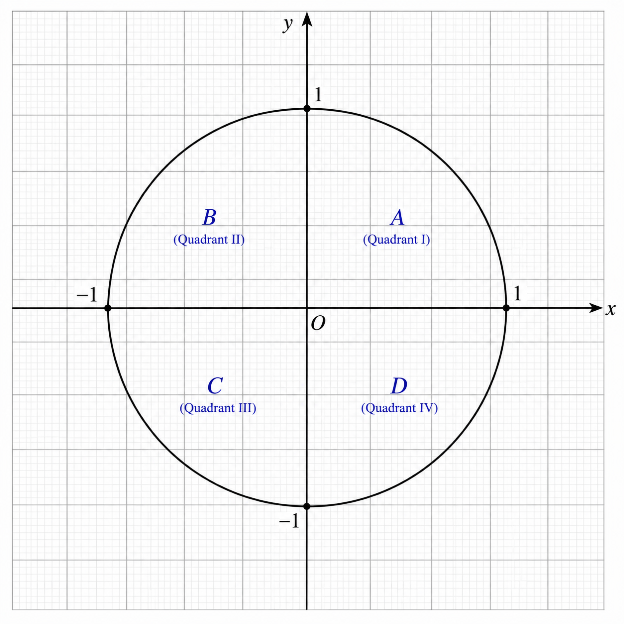
The circle is drawn on the Cartesian plane with the x-axis and y-axis crossing at the centre. see the figure below

The Four Quadrants
The unit circle is divided into four sections called quadrants:
- First Quadrant (Quadrant I) → top right
- Second Quadrant (Quadrant II) → top left
- Third Quadrant (Quadrant III) → bottom left
- Fourth Quadrant (Quadrant IV) → bottom right
Positive and Negative Angles
Angles are measured from the positive x-axis.
- An angle measured anticlockwise is positive.
- An angle measured clockwise is negative.
Examples:
- 120° is a positive angle and lies in the second quadrant.
- -50° is a negative angle and lies in the fourth quadrant.
Determining Quadrants of Angles
To know where an angle lies:
First Quadrant
Angles between 0° and 90°
Example:
30° lies in Quadrant I
Second Quadrant
Angles between 90° and 180°
Example:
140° lies in Quadrant II
Third Quadrant
Angles between 180° and 270°
Example:
240° lies in Quadrant III
Fourth Quadrant
Angles between 270° and 360°
Example:
330° lies in Quadrant IV
Negative Angles
Negative angles move clockwise.
Example:
-70° lies in Quadrant IV
-120° lies in Quadrant III
The figure below shows angles of 120o and -50o marked on the unit circle. They are in the second and fourth quadrants respectively.

Determine which quadrants where 35o, 45o, 190o, 280o, 330o,235o are found.
Coordinates on the Unit-Circle
One important idea about the unit circle is that every point on the circle represents:
(x, y) = (cos θ, sin θ)
This means:
- x-coordinate = cos θ
- y-coordinate = sin θ
Figure below is a unit-circle and angle PON=30°. Determine the values of x and y at point P.

Angle AON is a right-angled at N. Therefore:
A right-angled triangle is formed inside the circle.
Since the radius of the unit circle is 1:
OP = 1
Using trigonometric ratios:
Now for cosine:
Therefore, the coordinates of point P are:
P(0.86, 0.5)
Therefore, for a unit circle:
sinθ = y co-ordinates of P
cosθ = x co-ordinates of P.
Key Ideas to Remember
- The unit circle has radius 1.
- Positive angles move anticlockwise.
- Negative angles move clockwise.
- Every point on the unit circle represents: (cos θ, sin θ)
- The x-coordinate gives cosine.
- The y-coordinate gives sine.
The unit-circle is the foundation for understanding trigonometric functions, graphing, and solving advanced trigonometry problems.