From topics on linear motion, speed v is usually given as rate of change of distance with time. i.e. speed (v) =distance(s)/time(t)
Speed of a wave is the distance covered by a wave in one second.
The SI unit of a wave speed is metres per second.
Consider a particle on a wave motion that gets displaced from point A to B such that distance AB makes one wavelength as shown
For the particle to cover a distance of exactly one wavelength, it means it has completed exactly one oscillation.
The time taken to complete one oscillation is called the periodic time (T) and so the speed of the particle can be expressed in terms of wavelength (λ) and periodic time T as in the equation below.
λ is a greek letter known as lambda which means wavelength in english.
but T = 1/f. hence
Multiplying both numerator and denominator by f, we get v=fλ.
v=fλ is a relationship that helps determine speed of a wave given it’s frequency and wavelength.
In a given media, the speed of a wave motion is constant and so frequency is inversely proportional to the the wavelength such that:
The above equation shows that an increase in frequency results in decrease of wavelength.
The relationship between frequency and wavelength is represented graphically as shown in figure below.
If a wavelength covers λ distance, then the total distance covered by the wave profile can be determined as λ x number of oscillations and the total time taken as periodic time x number of oscillations..
Example Question
The figure below shows a wave form in a string.The wave is moving at 30.0ms-1 and the grid is in centimeters.
Detrmine:
(a) Amplitude
(b) Wavelength
(c) frequency
(d) Period
solution
(a) amplitude is the largest displacement of the wave profile. It is the crest in the wave motion. In our diagram, the largest displacement is ±5. hence the amplitude of the wave is 5.0 cm
(b) we can determine wavelength by determining distances between two points that are in phase. (40-0)cm or (50-10)cm or (60-20)cm. Hence the wavelength is 40cm.
(c) v=fλ
hence
v= 30.0ms-1 and λ = 40 cm = 0.4m
hence
(d) Period T = 1/f
Practice Question 1
Waves on a spring are produced at the rate of 200 wavelengths every 10 seconds.
(a) Find the frequency of the wave motion. (Answer: 20 Hz)
(b) If the wavelength of the waves is 0.15m, find the speed of the waves (Answer: 3ms-1)
(c) Find the period of the waves (Answer: 0.05s)
Practice Question 2
A water wave travels at 24m in 3 s. If source of the water waves vibrates at 5Hz, determine:
The table below shows density of some common substances.
Please note that density of water being 1.0gcm-3 can be used as a relative density to compare densities of other substances. For example , density of gold is 19.3 times that of water.
Take a spring balance and hang some mass on it. Determine the weight of the mass and then push the mass up slightly with your hand. What have u observed?
When you place some upward force on a mass hanging on the spring, it’s weight is seemed to reduce as observed by lesser leading of the spring balance.
When you apply a force upward on the object hanging on a spring balance, you are providing some force that is acting opposite to the weight of the object. Weight is always acting downward on a straight line that is directed towards the center of the earth.
When you push the object upward, you are reduce the overall resultant downward force by providing some force acting opposite to the weight.
From the law of addition of forces, when two forces are acting in opposite direction on the same object, then one force is considered positive force and the other one taken as negative force . The total resultant force acting on the object is the algebraic sum of the forces acting on that object Consider the setup below that shows some weight acting on an object hanging freely on air.
Spring balance measuring some weight
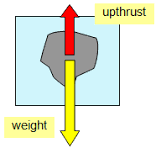
We consider the force acting on the object which is it’s weight as W and any force applied upward as U as shown.
Illustrating forces acting on an object hanging on air
The resultant force will be given as W’=W-U. Where W’ represents the reduced weight.
If U is greater than W’, then the object will accelerates upward, otherwise it will accelerates downward with reduced force.
The downward acceleration force is balancing with tensional forces on the spring causing some extension, hence the object remains on the spring balance but causing it to extend in length.
Upthrust Force
When an object is immersed in a fluid, the upward forces on the object are provided by pressure in the fluid. That is why objects weighs less in water because some weight of the object is being cancelled out by the upward forces in water. This upward forces produced by fluid on an object is known as the upthrust force. It is the same force that causes object to float in water.
However, it is important to note that, for heavier objects falling in air, the upthrust by air is soo small such that it cannot be notices. We say that upthrust of air on an object is negligible.
Paper and Stone
If you release a piece of paper and a stone from some distance above the ground, you will notice that the stone reaches the ground faster than the paper. This is because upthrust force on paper is comparable to that of paper, because a piece of paper has very small weight. However, the stone weight is much more than the upthrust that can be provided by paper hence the total resultant downward forces is larger than that of paper hence causing more acceleration downward.
Later on, we will see that upthrust fall is a characteristic of both volume of the object and density of the fluid.
The characteristics of a wave motion can be explained with reference to the oscillatory motion of mass attached to a spring or by use of a bob on a swinging pendulum.
The figure below shows a mass that is attached to a spring and one end and fixed on the other end as shown
illustrating mass oscillating on a spring
Initially, the mass is at rest at the end of the spiral spring at position M. The mass is then depressed slightly to position L and released and is then observed that it oscillates up and down about the mean position M.
One complete oscillation occurs when the mass moves through positions N-M-L-M-N. That is, it makes one complete oscillation when it has returned to it’s starting position and is moving in the same direction. For example if the mass starts at M the move to M-N-M, it will not have moved a complete oscillation because although it has returned to it’s starting position, it is moving in the opposite direction.
Consider a swing pendulum shown below
illustrating swinging pendulum
For the pendulum, the bob makes a complete oscillation when after an initial displacement from position X, the pendulum swings through position X-Y-Z-Y-X. If the mass in the above diagram takes two seconds to make a complete oscillation, a sketch of it’s time-displacement graph for the motion will be as shown below.
Displacement time graph for a swinging pendulum
As can be seen from the above diagram, the displacement time graph for an oscillatory motion is a sine curve similar to the transverse wave profile.
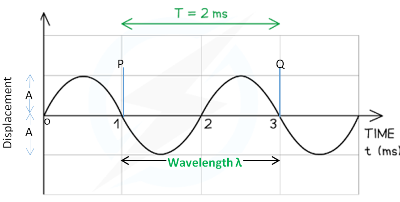
To describe the general characteristics of a wave motion, consider the motion-time graph representing a certain wave motion as shown below
To illustrate wave characteristics
The Displacement value A shows the maximum displacement A from the mean position o.
P and Q are said to be points in phase because the wave pattern is repeating itself at Q and P.
The distance between two points in phase is called the wavelength λ. The distance between P and Q represents on wavelength.
The wave starts repeating itself at P before repeating itself again at Q. Hence when the wave moves from P to Q, it is said to make one complete oscillation.
The time taken to complete one oscillation is known as the Periodic time T. In the motion-time graph above, the periodic time is two milliseconds(ms) as it has taken 2ms to make one complete oscillation.
Two points in a wave are said to be in phase, if they are in the same position, relative to the wave profile. P and Q are in phase.
The number of oscillations that can be made by a wave motion in one second is called the frequency f of the wave and is usually the reciprocal of the periodic time.
from the above diagram, it takes 2ms to make one complete revolution which is equivalent to (2/1000)s = 0.002 Seconds.
The frequency of the wave can then be determined as follow:
It can be shown that:
Where T is the periodic time and f the frequency of a given wave
Wave is a propagation of disturbances from place to place in a regular and organized way.
It can also be defined as a disturbance or variation that transfers energy progressively from point to point in a medium and that may take the form of an elastic deformation or of a variation of pressure, electric or magnetic intensity, electric potential, or temperature.
There are various ways we can categorize waves:
Electromagnetic waves
This are kind of waves that can travel in vacuum and do not require material medium for their transmission. They can also be explained as a form of radiation that travel though the universe and results from oscillation of electric and magnetic fields perpendicularly to each other.
Sun is a huge producer of electromagnetic waves.
Illustrations showing production of electromagnetic waves
Mechanical waves
They are waves that requires material medium for transmission where their transmission is determined by vibration of the particles in the medium. Mechanical waves can be either transverse or longitudinal
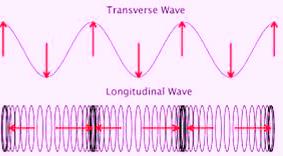
Mechanical waves are produced by a disturbance, such as a vibrating object, in a material medium and are transmitted by the particles of the medium vibrating to and fro. Such waves can be seen or felt and include waves on a rope or spring, water waves and sound waves in air or in other materials. The figure below shows a a helical spring vibrated to produce both longitudinal and transverse waves.
A helical spring used to produce longitudinal and transverse waves.
Transverse waves
This are waves whose transmission is such that the angle of vibration of the particles is at right angles to the direction of the wave progression.
A transverse wave can be sent along a rope (or a spring) by fixing one end and moving the other rapidly up and down such that The disturbance generated by the hand is passed on from one part of the rope to the next.
Consider the diagram below.
Illustrating formation of transverse wave
To further illustrate the formation of a transverse waves, consider a slinky spring stretched along a smooth bench while one of it’s end is attached to a rigid support while the other end is held by a hand. The end held by the hand is swung up and down at right angles to the spring or rope as in figure below;
illustrating transverse waves using a slinky spring
The wave created above is said to travel as a series of crests and troughs.
The displacement of an individual particle in relation to the direction of wave motion is as shown.
Particle displacement in a transverse wave
Longitudinal waves
In longitudinal wave that are progressive waves, the particles of the transmitting medium vibrate to and fro along the same line as that of wave travel. A longitudinal wave can be created along a spring by stretching out a slinky spring on a bench when it is fixed at one end and the free end repeatedly pushed and pulled continuously. see the figure below:
illustrating formation of longitudinal waves
Compressions and rarefactions are formed on a longitudinal waves.
Compressions(C)are where the coils are closer together and rarefactions (R) are where the coils are further apart along the spring.
In longitudinal waves , the vibration of particles are said to be in a parallel direction to the direction of wave travel.
A good example of longitudinal waves is the sound wave where particles of air vibrates in the same direction as the movement of sound energy.
Continous to and fro movements at one end results in the formation of sections of compression and alternating with rarefaction along the length of the string as shown.
illustrating longitudinal waves on a slinky spring
The displacement of a particle in a longitudinal wave in relation to the direction of wave motion is as shown
An illustration of a particle vibration in longitudinal wave
Individual particles in the slinky spring are set into periodic vibrations in line with the directions of the wave motion.
The wave motion affects the inner particle spacing where particles in the compression part are pushed closed together while particles in rarefaction part are pulled slightly further apart.
Variation in inter-particle separation is accompanied by variation in pressure such that sections under compression are at higher pressure while those under rarefaction are at low pressure. This pressure variation is the one causing the longitudinal wave motion.
Progressive waves
These are waves that moves continually away from the source.
Progressive waves are found in both longitudinal and transverse wave and they are described as waves that are continously moving forward from the source carrying energy of the vibration along as they move.
Consider a case when you drop a small stone on a surface of calm water; The impact of the stone creates water waves that moves outwards carrying the energy of the impact away from the source as shown.
Illustrating water waves
as illustrated in the above figure, the water waves moves away from the source and as they move that way, the energy is spread over an increasingly large area causing gradual increase in energy.
Pulses
A pulse is generated when a single vibration is sent through medium. A pulse can be generated for both transverse or longitudinal waves. A pulse from a transverse vibration is as shown below.
an illustration of transversal pulse
A pulse from a longitudinal vibration is as shown below
Illustration of a longitudinal pulse
Wave trains are generated as a result of continous vibrations at a constant rate in a medium where the medium is distorted into repeated patterns of crests that are alternating with troughs in a transverse wave .
For longitudinal waves, the medium is set into repeated patterns of compression sections that are alternating with rarefaction sections as shown.
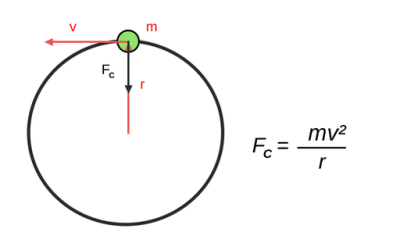
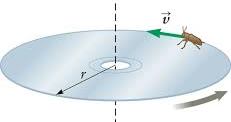
Consider on object m held by a cord om positioned at A. The Object is whirled in a circular motion and after some time Δt, the object is at position B. The velocity of the object in linear direction changes from VA to VB. If there was no force acting on the body, the object will not change directions but will go in a straight line. There must be a force that maintain the body at a constant distance distance from the center o.
Centripetal force Fc refers to the force that keeps a body in circular motion. A body in a circular motion is accelerating and from newton’s second law of motion, there must be a force acting on it to cause acceleration. Centripetal force is usually directed towards the center of the circular path. The Centripetal force is the force responsible for the constant change of direction otherwise the body would naturally follow a straight line if there was no force acting to keep the body in circular motion.
The value of the centripetal force is derived from newton’s second law of motion which states that: the rate of change of momentum of a body is directly proportional to the resultant force in the direction of force.
Momentum means mass multiplied by velocity.
Because velocity of a body in circular motion is changing, it’s momentum must also be changing.
The newton’s second law can be described as F=ma, where a = acceleration and m is the mass.
but the acceleration of the body of the body is given by a= v2/r, where v is the linear speed of the object while it is in circular motion. hence
From definition of angular velocity we had shown that, ω is given by v/r, and hence v=ωr.
it follows that Fc = m(ωr)2/r = mω2r2/r = mω2r .
Tension
If a body is attached to a string and swung around on a horizontal circle, the centripetal force that keeps the body in the circular orbit is kept as tension in the string. For the body to remain in circular motion, the centripetal force is equal to the tensional force.
From the equation Fc = mω2r , it shows that centripetal force is directly proportional to the angular velocity meaning that a larger force will be required to maintain the body in motion if it is swung faster.
Angular velocity is defined as the rate of change of angular displacement with time.
we can shorten the equation by using symbols alone:
The SI Units of angular velocity is radians per second (rads-1)
Consider the equation that relates angular displacement in radians with the arc length made by the object:
to get the rate of change of speed, we divide both sides with t as they both represent displacement of the object.
but distance s when divided by time gives velocity. That is;
where v is the linear velocity representing the velocity of the object along the circular path.
Hence the equation above becomes:
hence, the angular velocity can be expressed in terms of linear velocity and radius as show in equation below:
similarly, linear velocity can be expressed in terms of angular velocity as v=ωr.
An object in circular motion has both linear and angular velocity. The time taken to make one complete circle is called the periodic (T) and is given by T= circumstances/speed.
Let us now consider the time taken for a body to make one complete circle in a circular path. At that one circle, it will have covered the circumference of a circle and the time taken to complete such one revolution is called periodic time (T).
from the equation time = distance / speed
and circumference = 2πr, hence
Example question
A metallic ball is whiled in a horizontal circle making 5 revolution s per second.Determine:
Consider a particle moving along a circular path when it moves from point A to point B as in figure below.
Illustrating circular motion
The reference point OA makes an angle with the line OB that represents the line joining the new position of the object and the center of the circle. The object has covered a distance S along the circle making an arc with θ.
Angular displacement is the angle swept by a line joining end of an object in a circular path with the center of the path when it moves from one point to another in a circular motion.
Angles in circular motion are usually expressed in radians θc.
That is:
it therefore follows that S = rꝊc
A radian is defined as an angle subtended at the center of a circle by an arc length equal to the radius of the circle.
Therefore angle θ subtended by the circumference at the center of a circle of radius r is therefore given by;
and we can write circumference in terms of π such that
We can relate the degrees from 2πc = 360o .
Problem
An object traces an arc of length 10.98 while attached to a cord of length 3.2 m that is fixed on a fixed surface on a flat smooth surface. Determine the angular diaplacement by the object.
Solution
We visualize the setup as in figure below:
from the equation S = rꝊc
Ꝋc = S/r = 10.98/3.2 = 3.43 radians
if we can express answers in degrees, then 3.43 radians = 196.52o .
Practice Question
An object moves a distance of 80.12π along a circular path of radius 3.8m. Determine it’s angular displacement.
Parallax is a displacement or difference in the apparent position of an object viewed along two different lines of sight and is measured by the angle of inclination between those two lines.
Non-parallax is therefore when there is no difference in apparent position when an object is viewed along two different lines of sight.
An optical pin fixed on a cork that is supported by a clamp is placed above a lens that is on the mirror as shown below. The cork is such that it slides up and down the glass rod.
Adjust height of the pin until it’s image is seen on the mirror.
The position of the pin is adjusted until the image from the mirror and the object pin seems to be moving together when you move your eyes.
The distance between the lens and the pin when there is no parallax between it’s image and the object is the focal length of the lens.
A white screen, convex lens on a lens holder and ruler are arranged such that rays of light from a distance object are incident on a lens that is close to the white screen. See the diagram below
Lens focusing a distance object on a screen
The lens position is adjusted to and fro until a sharp image of a distance object is obtained on the screen.
Distance object means an object that is at large distance relative to the focal length of the lens. For instance an object 30 metres from a lens whose focal length is 21cm. The object position is many times longer compared to the focal length of the lens.
The distance between the lens and the screen where the sharp image of a distance object is formed is the focal length and the area occupied by the image is the focal plane of the lens.
Please note that the estimated focal length is not exact but can be 2 cm plus or minus the real focal length of the lens.
This method of estimating focal length depends on the fact that parallel rays from infinity converges at the focal point on the screen.
Contains information related to marketing campaigns of the user. These are shared with Google AdWords / Google Ads when the Google Ads and Google Analytics accounts are linked together.
90 days
__utma
ID used to identify users and sessions
2 years after last activity
__utmt
Used to monitor number of Google Analytics server requests
10 minutes
__utmb
Used to distinguish new sessions and visits. This cookie is set when the GA.js javascript library is loaded and there is no existing __utmb cookie. The cookie is updated every time data is sent to the Google Analytics server.
30 minutes after last activity
__utmc
Used only with old Urchin versions of Google Analytics and not with GA.js. Was used to distinguish between new sessions and visits at the end of a session.
End of session (browser)
__utmz
Contains information about the traffic source or campaign that directed user to the website. The cookie is set when the GA.js javascript is loaded and updated when data is sent to the Google Anaytics server
6 months after last activity
__utmv
Contains custom information set by the web developer via the _setCustomVar method in Google Analytics. This cookie is updated every time new data is sent to the Google Analytics server.
2 years after last activity
__utmx
Used to determine whether a user is included in an A / B or Multivariate test.
18 months
_ga
ID used to identify users
2 years
_gali
Used by Google Analytics to determine which links on a page are being clicked
30 seconds
_ga_
ID used to identify users
2 years
_gid
ID used to identify users for 24 hours after last activity
24 hours
_gat
Used to monitor number of Google Analytics server requests when using Google Tag Manager