A mango is an edible stone fruit produced by a tropical tree known as Mangifera indica whose origin can be traced to northwestern Myanmar, Bangladesh, and northeastern India. It’s cold juice is refreshing, giving a feeling of relaxation and tranquility, A very pleasant sip during a hot day especially if you live in hot Asian region or tropical Africa.
India is the leading mango producer in the world with an estimated 24.7 million tons of mango production per year followed by Indonesia at 3.6 million tons per year and china at 2.4 million tons per year. Other major producers of mangoes includes Pakistan, Brazil, Mexico and Nigeria. Many other countries produces mangoes and mango tree is a common tree in many places. Therefore, it is not difficult to find mangoes. Mango Juice is therefore cheap to obtain but with numerous health benefits. It is a juice you can easily make because it does not need sophisticated tools or expensive ingredients.
Health benefits of mangoes includes:
Has compounds that shields cells from the DNA damage that can leaf to degenerative diseases like type 2 diabetes and cancer.
supports heart health in terms of managing the levels of lipids you have in your blood
is a great source of carotenoids which is very important in boosting immune system functionality
contains high level of vitamin C which produces collagen tissue that gives our skin elasticity it needs preventing wrinkles and sagging.
It ease constipation
Have an antioxidant called beta-carotene that helps promote eye health
Making of mango Juice
INGREDIENTS
Mangoes
Milk
Sugar
3 ice cubes (optional)
Tools
Blender
Peeler
Tablespoons
Procedure
Wash an rinse your mangoes
pat with a kitchen towel to dry for easy peeling.
peel and dispose of the stones
chopp into chunks and into the blender.
add 3 tablespoons of sugar at this point to add sweetness or 2 tablespoons of honey or palm sugar or coconut sugar.
add 2 ice cubes (optional) which help to thicken the milkshake.
blend till smooth. There should be no chunks of mangoes in the shake. if the shake is too thick you can opt to add more milk to be slightly thinner.
pour in glasses and serve with a topping of diced mango chunks or sprinkles or whipped cream
Java is a type of coffee that contains caffeine, a stimulant substance that is proven to increase the release of fats from the fat tissues and helps boost the resting metabolic activity.
When we were learning programming, we were told that people that developed Java programming language were drinking a lot of coffee as they develop the codes for the language, hence they called it Java. I came to associate computer programming with coffee. So i went to shop and bought 2kg of coffee. After the busy day of work, i will take a cup of coffee and i could feel refreshed and able to stay awake for some 4 hours learning Java.
I wanted to be an expert in computer programming and as i was young and naïve, i imagined that expert programmers have to drink coffee in order to succeed.
One day while in university i developed signs of blood pressure and the doctor recommended that i should reduce my coffee intake. I would have a 2 litre thermo flask with boiled water, have a jar of coffee by me and a jar of sugar. All i could was to make cup after another for coffee and make sip after sip as i went through voluminous books on computer science.
I used to enjoy it very much. By the end of 4-5 hours of study, i could not sleep because i was intoxicated. My blood was rushing and my brain could not settle, it was becoming dangerous, working hard during the day and having sleepless night because of litres of coffee in my body. Most often i would forget to cook or eat, because i was eager to read my next page about Java or C programming, until i became serious sick because of strain.
Nowadays, i don’t take many cups of coffee but a cup of coffee every two hours is in my schedule daily. Java coffee is an important substance in my house. Nowadays s i prefer milky coffee especially in the mornings. Another favorite coffee apart from Java is cappuccino which was very common among team members i briefly worked with on a JavaScript program. They introduced it to me and since then, it is part of my favorite drink.
Before i was introduced to coffee, i used to like tea very much, but the amount of tea i have taken is much much less than coffee that i enjoy very much.
Hope you enjoy a cup of coffee as you read this post:;
Rates are mathematical expressions that shows the relationship between two quantities. It shows how changes of one value is causing change to another variable.
A common examples of rates is when growth is compared with time. Time is an important factor when determining rates. For example when we compare rate of growth of a population over a number of years we are comparing number of people that has been added to the population over a certain period of time, maybe six months or one year, probably through birth or immigration.
A business can determine rate of increase of it’s sales by determine the number of sales across given periods of time like months or years.
Another example of rate is speed that determines how object changes it’s distance from point where it started it’s motion to the change of time.
Example
Calculate the rate of change of flow of oil in a pipeline per minute if an 800000 litres storage tank was filled in 4 hours 10mins.
Solution
The number of minutes in 4 hours and 10mins is (4*60)+10 =250mins.
Rate of flow = numbers of liters flowed/ time taken in minutes
Rate of flow=800000/250 hence
Rate of flow= 3200 liters per min
which we can also write as 3200litres/min.
Note:
The above rate of flow could also be expressed in terms of litres per hour where in that case the number of hours will be 4(1/6) hours which can also be expressed as 25/6 hours.
Hence rate of flow in hours will be:
800000liters/(25/6) hours
Which will be (800000/25)*6 and hence rate of flow=192000liters/hour
if you know the tangent ratio of a given angle, you already know that the ratio is a result of dividing opposite side over tangent. If you know the length of one side, the you can get the other.
let us say there exits an angle θ that has a tan ratio of 0.821 and the side opposite to it is 8.5 cm. Then the adjacent side can be obtained as follow:
Example
Find the length BC in the figure below:
solution
The side BC is the opposite side and line AB which is the adjacent side to angle θ which is equal to 70o is equal to 25cm. Then we proceeds as follows:
Exercise Questions
Use tangents to find the lengths of the side marked x in the below tri-angles.
Q1: Find the unknown side in each of the following
(a)
(b)
Q2: Find the unknown angle θ,α in each of the following triangle
The characteristics of a wave motion can be explained with reference to the oscillatory motion of mass attached to a spring or by use of a bob on a swinging pendulum.
The figure below shows a mass that is attached to a spring and one end and fixed on the other end as shown
illustrating mass oscillating on a spring
Initially, the mass is at rest at the end of the spiral spring at position M. The mass is then depressed slightly to position L and released and is then observed that it oscillates up and down about the mean position M.
One complete oscillation occurs when the mass moves through positions N-M-L-M-N. That is, it makes one complete oscillation when it has returned to it’s starting position and is moving in the same direction. For example if the mass starts at M the move to M-N-M, it will not have moved a complete oscillation because although it has returned to it’s starting position, it is moving in the opposite direction.
Consider a swing pendulum shown below
illustrating swinging pendulum
For the pendulum, the bob makes a complete oscillation when after an initial displacement from position X, the pendulum swings through position X-Y-Z-Y-X. If the mass in the above diagram takes two seconds to make a complete oscillation, a sketch of it’s time-displacement graph for the motion will be as shown below.
Displacement time graph for a swinging pendulum
As can be seen from the above diagram, the displacement time graph for an oscillatory motion is a sine curve similar to the transverse wave profile.
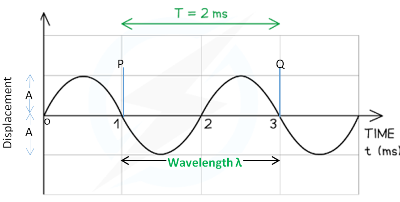
To describe the general characteristics of a wave motion, consider the motion-time graph representing a certain wave motion as shown below
To illustrate wave characteristics
The Displacement value A shows the maximum displacement A from the mean position o.
P and Q are said to be points in phase because the wave pattern is repeating itself at Q and P.
The distance between two points in phase is called the wavelength λ. The distance between P and Q represents on wavelength.
The wave starts repeating itself at P before repeating itself again at Q. Hence when the wave moves from P to Q, it is said to make one complete oscillation.
The time taken to complete one oscillation is known as the Periodic time T. In the motion-time graph above, the periodic time is two milliseconds(ms) as it has taken 2ms to make one complete oscillation.
Two points in a wave are said to be in phase, if they are in the same position, relative to the wave profile. P and Q are in phase.
The number of oscillations that can be made by a wave motion in one second is called the frequency f of the wave and is usually the reciprocal of the periodic time.
from the above diagram, it takes 2ms to make one complete revolution which is equivalent to (2/1000)s = 0.002 Seconds.
The frequency of the wave can then be determined as follow:
It can be shown that:
Where T is the periodic time and f the frequency of a given wave
Wave is a propagation of disturbances from place to place in a regular and organized way.
It can also be defined as a disturbance or variation that transfers energy progressively from point to point in a medium and that may take the form of an elastic deformation or of a variation of pressure, electric or magnetic intensity, electric potential, or temperature.
There are various ways we can categorize waves:
Electromagnetic waves
This are kind of waves that can travel in vacuum and do not require material medium for their transmission. They can also be explained as a form of radiation that travel though the universe and results from oscillation of electric and magnetic fields perpendicularly to each other.
Sun is a huge producer of electromagnetic waves.
Illustrations showing production of electromagnetic waves
Mechanical waves
They are waves that requires material medium for transmission where their transmission is determined by vibration of the particles in the medium. Mechanical waves can be either transverse or longitudinal
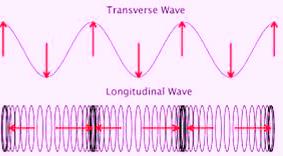
Mechanical waves are produced by a disturbance, such as a vibrating object, in a material medium and are transmitted by the particles of the medium vibrating to and fro. Such waves can be seen or felt and include waves on a rope or spring, water waves and sound waves in air or in other materials. The figure below shows a a helical spring vibrated to produce both longitudinal and transverse waves.
A helical spring used to produce longitudinal and transverse waves.
Transverse waves
This are waves whose transmission is such that the angle of vibration of the particles is at right angles to the direction of the wave progression.
A transverse wave can be sent along a rope (or a spring) by fixing one end and moving the other rapidly up and down such that The disturbance generated by the hand is passed on from one part of the rope to the next.
Consider the diagram below.
Illustrating formation of transverse wave
To further illustrate the formation of a transverse waves, consider a slinky spring stretched along a smooth bench while one of it’s end is attached to a rigid support while the other end is held by a hand. The end held by the hand is swung up and down at right angles to the spring or rope as in figure below;
illustrating transverse waves using a slinky spring
The wave created above is said to travel as a series of crests and troughs.
The displacement of an individual particle in relation to the direction of wave motion is as shown.
Particle displacement in a transverse wave
Longitudinal waves
In longitudinal wave that are progressive waves, the particles of the transmitting medium vibrate to and fro along the same line as that of wave travel. A longitudinal wave can be created along a spring by stretching out a slinky spring on a bench when it is fixed at one end and the free end repeatedly pushed and pulled continuously. see the figure below:
illustrating formation of longitudinal waves
Compressions and rarefactions are formed on a longitudinal waves.
Compressions(C)are where the coils are closer together and rarefactions (R) are where the coils are further apart along the spring.
In longitudinal waves , the vibration of particles are said to be in a parallel direction to the direction of wave travel.
A good example of longitudinal waves is the sound wave where particles of air vibrates in the same direction as the movement of sound energy.
Continous to and fro movements at one end results in the formation of sections of compression and alternating with rarefaction along the length of the string as shown.
illustrating longitudinal waves on a slinky spring
The displacement of a particle in a longitudinal wave in relation to the direction of wave motion is as shown
An illustration of a particle vibration in longitudinal wave
Individual particles in the slinky spring are set into periodic vibrations in line with the directions of the wave motion.
The wave motion affects the inner particle spacing where particles in the compression part are pushed closed together while particles in rarefaction part are pulled slightly further apart.
Variation in inter-particle separation is accompanied by variation in pressure such that sections under compression are at higher pressure while those under rarefaction are at low pressure. This pressure variation is the one causing the longitudinal wave motion.
Progressive waves
These are waves that moves continually away from the source.
Progressive waves are found in both longitudinal and transverse wave and they are described as waves that are continously moving forward from the source carrying energy of the vibration along as they move.
Consider a case when you drop a small stone on a surface of calm water; The impact of the stone creates water waves that moves outwards carrying the energy of the impact away from the source as shown.
Illustrating water waves
as illustrated in the above figure, the water waves moves away from the source and as they move that way, the energy is spread over an increasingly large area causing gradual increase in energy.
Pulses
A pulse is generated when a single vibration is sent through medium. A pulse can be generated for both transverse or longitudinal waves. A pulse from a transverse vibration is as shown below.
an illustration of transversal pulse
A pulse from a longitudinal vibration is as shown below
Illustration of a longitudinal pulse
Wave trains are generated as a result of continous vibrations at a constant rate in a medium where the medium is distorted into repeated patterns of crests that are alternating with troughs in a transverse wave .
For longitudinal waves, the medium is set into repeated patterns of compression sections that are alternating with rarefaction sections as shown.
Reserved words in a language are words that have very special meaning to the language. If python sees any of it’s preserved words, it have only one and only one meaning to it.
The words you will make by yourself as a programmer will be called variables. The words you create by yourself should never consists of any of the reserved words.
Reserved words in python includes
and
and is a logical operator that matches the boolean logic AND that returns true if and only if two operands are true and false otherwise.
as
It is used to define a certain word with a different name which is usually referred as alias. It allow user to define a friendly name in programing activities. For example, consider an programmer that want to import a file called matplotlibray which will be used most of the time in a program.
We can us the as to rename the file mat as as in:
import matplotlibray as mat
now we can be use mat instead of the word matplotlibray
assert
used in debugging where it allows one to test the correctness of a code by checking if some specific conditions remains true.
Until there is a bug in the program, the assertion remains true. for example the statement assert number > 0 tests a condition where a number must be greater than 0 and if not, a debugger throws an AssertionError.
break
It allows you to exit a loop when an external condition is met and allows the program to resume the next statement after the loop.
it terminates the loop that contains it and directs the program to flow to the statement that follows the block.
It is used in for loops and while loops.
For example:
for x in numbers:
    if x =5:
       break
continue
It makes the code skip the current iteration and proceed to the next one
It is useful where we need to skip part of the loop but remain in the same loop block.
Continue skip the statements in the current iteration of the loop and moves the control back to the top of the loop.
For example:
for number in range(30,50):
    if number % 2 ==0:
        continue
    print(number)
In the above code, the if statement checks if the number is divisible by 2 and if it evaluates true, it skips to the next number which is odd. Hence the program print odd numbers between 30 and 50 as shown.
class
used to create a python class. class is a template for objects. Creating a new class creates a new type of object, allowing new instances of that type to be made.
An object is a collection of variables and methods which acts as a blue print for that object.
we use class to create a class in Python. for example
class Student:
    name = " "
    DOB= ""
    EnrollmentDate = ""
    Grade = " "
The code snippet above shows a student class being created.
An object of class student can be created from class as shown:
James = student()
def
it is used to define a function in python. Every code you put between the def function name and it’s end with be considered as a single logical piece of code with statements that can be executed at once by invoking the name of the function.
The following code defines a function called grade that calculates student grade based on marks passed to it:
def grade(marks):
    grade = " "
    if marks >100 or marks < 0:
        grade = "invalid"
    if marks >=80:
        grade = "A"
    elif marks >=60:
        grade = "B"
    elif marks >=40:
        grade = "C"
    elif marks >=20:
        grade = "D"
    else:
        grade = "fail"
    return grade
We can call the function and provide pass some marks to it as an argument as shown below:
marks = 65
print(grade(marks))
del
used to delete object in python. It’s primary goal is to destroy objects in python code. When del is used against an object , the object is removed from the scope of the object.
consider the student class we created earlier..
class Student:
    name = "James bond"
    DOB= "19/01/1999"
    EnrollmentDate = "23/01/2020"
    Grade = "B+"
James = Student()
print(James)
When run, the program gives the following output:
supposed now we delete the object student as in code below:
class Student:

    name = "James bond"
    DOB= "19/01/1999"
    EnrollmentDate = "23/01/2020"
    Grade = "B+"
James = Student()
print(James)
del Student
James = Student()

print(James)
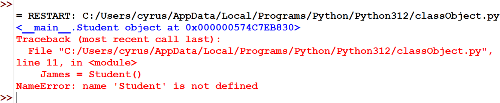
running the code will cause an exception error that shows missing of an object student as shown
The del keyword can also be used to delete objects like dictionaries, items in a list, tuples and even user-defined objects.
elif
Used to include multiple conditional expressions after the if condition or between the if and else conditions.
marks = int(input("marks: "))

grade="no marks"

if marks <=20:

    grade="fail"

elif marks <=40:

    grade = "D"

elif marks <=60:

    grade = "C"

elif marks<80:

    grade ="B"

elif marks <=100:

    grade = "A"

else:

    grade = "Invalid!"

print(grade)
else
It is used in conditional statements like if statements and is used to decide what to do if a condition is false.
x =30
if x % 2 ==0:
  print(i, "divisible by 2"
else:
  print(i, "not divisible by 2")
try
It is used in try-except block and it defines a block of code that is tested for errors, if nor errors is detected, the code in try block is executed, otherwise it is passed to the except block. Different error types can be defined in the except block.
def quotient(a,b):

    try:

        quot = a / b

        print(a, "divided by", b, "is", quot)

    except ZeroDivisionError:

        print("Division by zero is not allowed in this system")

    except TypeError:

        print("the division values not acceptable")

    finally:

        # This code will always be executed

        print("we could be having infinity as the answer but we have modified the denominator")

        b = b+1

        ourQuout = a//b

        print("Maybe you could like our suggested answer:;",ourQuout)
except
used in try-except block and defines a block of code that should run if the try block raises an error. Except pairs with try where try block is executed where there is no exception error but when there is an error that prevents that block to execute, the control is transferred to except block.
def quotient(a,b):

    try:

        quot = a / b

        print(a, "divided by", b, "is", quot)

    except zeroDivisionError:

        print("Division by zero is not allowed in this system")


quotient(32,5)
finally
it defines a block which will always be executed after leaving a try-except statement if some exception was not handled by the except block. It helps in deallocating the system resources.
def quotient(a,b):

    try:

        quot = a / b

        print(a, "divided by", b, "is", quot)

    except zeroDivisionError:

        print("Division by zero is not allowed in this system")

    finally:

        # This code will always be executed

        print("we could be having infinity as the answer but we have modified the denominator")

        b = b+1

        ourQuout = a//b

        print("Maybe you could like our suggested answer:;",ourQuout)
for
It is used to create a loop helping a program to iterate through sequence of items like a list, tuple and dictionary etc.
myNumbers = [0,1,2,3,4,5,6,7,8,9]

sum = 0

for i in myNumbers:

    sum +=i

print("The sum equals: ",sum)
from
used to import a specified section of a python module. generally used with import, from is used to import particular functionality from the module imported. For instance the code code below will import sqrt method from the math module
import math

from math import sqrt

myNumber = math.sqrt(80)

print(myNumber)
#120
global
It is used to allow programmer modify a variable outside of the current scope. consider the code below.
x = 2000

def reduce():

    while x<=0:

        x -=2

    print(x)

reduce()
When run, the code produces the error shown
The error is because the x referenced in the while block is not defined as far as the python interpreter is concerned. The x defined outside the while block is out of reach of the while block, hence it is considered non-existence.
we can rewrite x inside the loop with the word global to tell the block that it should use the x that was defined outside it. The modified code will now run
x = 2000

def reduce():

    global x

    while  x<=0:

        x -=2

    print(x)

reduce()
if
it is used to test a condition and if condition evaluates to true, the code in the if block is executed.
If is usually referred to as a conditional statement because it is used to execute a block of code only when a specific condition is fulfilled. consider the code below:
number =5

if number % 2 ==0:

    print("it is an even number")
when the code above is run, nothing will happen and no output will be on the screen. This is because the condition that the number be fully divisible by two is not me.
import
used to refer a code from another module. For example we be referring a pow function which is in math module. To use the pow function which is defined somewhere else, we must import the module that has defined it. I have used the pow function to define a function that accept a single parameter and square it.
import math

def squareNo(n):

    squared = math.pow(n,2)

    print(squared)
in
It is a word used in checking existence of a value in list, range or a string. It returns true if a certain element is present in a python object and false otherwise.
Numbers =[1,2,3,13,2,4,12,11,2,5,2,5,2,8,7,2,3,2,9]

x =1

while x <=len(Numbers):

    if 2 in Numbers:

        print(2)

    x +=1
is
Used to test if two variables belong to the same object. It returns true if two objects are the same.
a=[1,2,3,4,5,6,7]

a=[1,2,3,4,5,6,7]

print(a is a)
output: True
x= 20

y=20.0

print(x is y)
output: False
lambda
Used to create small anonymous functions that can take any number of arguments but can only have one expression. Anonymous functions means a function without a name.
import math


number = int(input("Enter a number: "))

root = lambda number: math.sqrt(number)

print(root(number))
In the above code, we define a function which is assigned a variable name root. the lambda function calls the squareroot function of math class
nonlocal
In python, variables can be declared in three different scopes:
Local scope
global scope
nonlocal scope
A function defined within a function and can only accessed within it is called a local variable.
A variable declared outside of a function such that it can be accessed inside or outside of the function is referred to as a global variable.
nonlocal keyword is used to work with variables inside nested functions where the variables should not belong to the inner function.
Example code:
def outsum():
    x=-2
    sum = 0
    while x <5:
        print(x)
        sum +=x
        x +=1
    print("sum is: ",sum)
    print("*********************")

    def innersum():
        x=0
        print("We are doing the inner thing now")
        nonlocal sum
        while x <=5:
            sum +=x *2
            x+=1
        print("The inner arithmetic is:",sum)
    innersum()
not
used in conditional statements or other Boolean expressions to invert the Boolean value or expression. not will convert the True evaluation to False and vise versa
x=0
print(x)
print(not x)

#0
#True
or
It is a logical operator used to combine conditional statements returning true if one of the statements evaluates to True.
Example:
y = (2>-2 or -3 > 3)
T = (-4 > 4 or -5 > -5)
print(y)
print(T)

#True
#False
pass
used as a placeholder for future code.
def summation():
    pass
raise
It is used to raise an exceptions or errors where it stops the flow of the program.
a=int(input("Enter numerator: "))
b=int(input("Enter denominator: "))
if (b==0):
    raise Exception("Division by zero is not accepted")
return
It used to end the function call and return the result to the caller. The function terminates on seeing the word return giving back whatever is after the return keyword.
Example:
def summation(x,y):
    sum=0
    for i in range(x,y):
        sum +=i
    print(sum)
summation(20,55)
#1295
while
It is used to create a while loop which defines a loop that executes a piece of code until a certain condition becomes false: Like in the code below, the code keep printing “Am staying here!” until when x is added up to 6
x=1
while x < 7:
    print("Am staying here!")
    x =x+1
#Am staying here!
#Am staying here!
#Am staying here!
#Am staying here!
#Am staying here!
#Am staying here!
with
It replaces a try-catch block with a concise shorthand. It is a replacement for the commonly used try/finally error handling statement.
A common example of using with keyword is when reading or writing to a file
with open("governmentStudents.txt","w") as file:
     file. Write(Name, DOB, AGE)
yield
controls the flow of a generator function. It is similar to a return statement used for returning values in python.
when you call a function that has a yield statement, as soon as yield is encountered, the execution of the function halts and returns a generator iterator object instead of simply returning a value
generators allows you handle large datasets with minimal consumption of memory and processing cycles.
def buildList():
    EvenList = [2,4,6,8]
    for i in EvenList:
        yield i*2
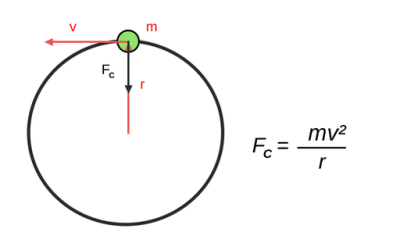
Consider on object m held by a cord om positioned at A. The Object is whirled in a circular motion and after some time Δt, the object is at position B. The velocity of the object in linear direction changes from VA to VB. If there was no force acting on the body, the object will not change directions but will go in a straight line. There must be a force that maintain the body at a constant distance distance from the center o.
Centripetal force Fc refers to the force that keeps a body in circular motion. A body in a circular motion is accelerating and from newton’s second law of motion, there must be a force acting on it to cause acceleration. Centripetal force is usually directed towards the center of the circular path. The Centripetal force is the force responsible for the constant change of direction otherwise the body would naturally follow a straight line if there was no force acting to keep the body in circular motion.
The value of the centripetal force is derived from newton’s second law of motion which states that: the rate of change of momentum of a body is directly proportional to the resultant force in the direction of force.
Momentum means mass multiplied by velocity.
Because velocity of a body in circular motion is changing, it’s momentum must also be changing.
The newton’s second law can be described as F=ma, where a = acceleration and m is the mass.
but the acceleration of the body of the body is given by a= v2/r, where v is the linear speed of the object while it is in circular motion. hence
From definition of angular velocity we had shown that, ω is given by v/r, and hence v=ωr.
it follows that Fc = m(ωr)2/r = mω2r2/r = mω2r .
Tension
If a body is attached to a string and swung around on a horizontal circle, the centripetal force that keeps the body in the circular orbit is kept as tension in the string. For the body to remain in circular motion, the centripetal force is equal to the tensional force.
From the equation Fc = mω2r , it shows that centripetal force is directly proportional to the angular velocity meaning that a larger force will be required to maintain the body in motion if it is swung faster.
Contains information related to marketing campaigns of the user. These are shared with Google AdWords / Google Ads when the Google Ads and Google Analytics accounts are linked together.
90 days
__utma
ID used to identify users and sessions
2 years after last activity
__utmt
Used to monitor number of Google Analytics server requests
10 minutes
__utmb
Used to distinguish new sessions and visits. This cookie is set when the GA.js javascript library is loaded and there is no existing __utmb cookie. The cookie is updated every time data is sent to the Google Analytics server.
30 minutes after last activity
__utmc
Used only with old Urchin versions of Google Analytics and not with GA.js. Was used to distinguish between new sessions and visits at the end of a session.
End of session (browser)
__utmz
Contains information about the traffic source or campaign that directed user to the website. The cookie is set when the GA.js javascript is loaded and updated when data is sent to the Google Anaytics server
6 months after last activity
__utmv
Contains custom information set by the web developer via the _setCustomVar method in Google Analytics. This cookie is updated every time new data is sent to the Google Analytics server.
2 years after last activity
__utmx
Used to determine whether a user is included in an A / B or Multivariate test.
18 months
_ga
ID used to identify users
2 years
_gali
Used by Google Analytics to determine which links on a page are being clicked
30 seconds
_ga_
ID used to identify users
2 years
_gid
ID used to identify users for 24 hours after last activity
24 hours
_gat
Used to monitor number of Google Analytics server requests when using Google Tag Manager