
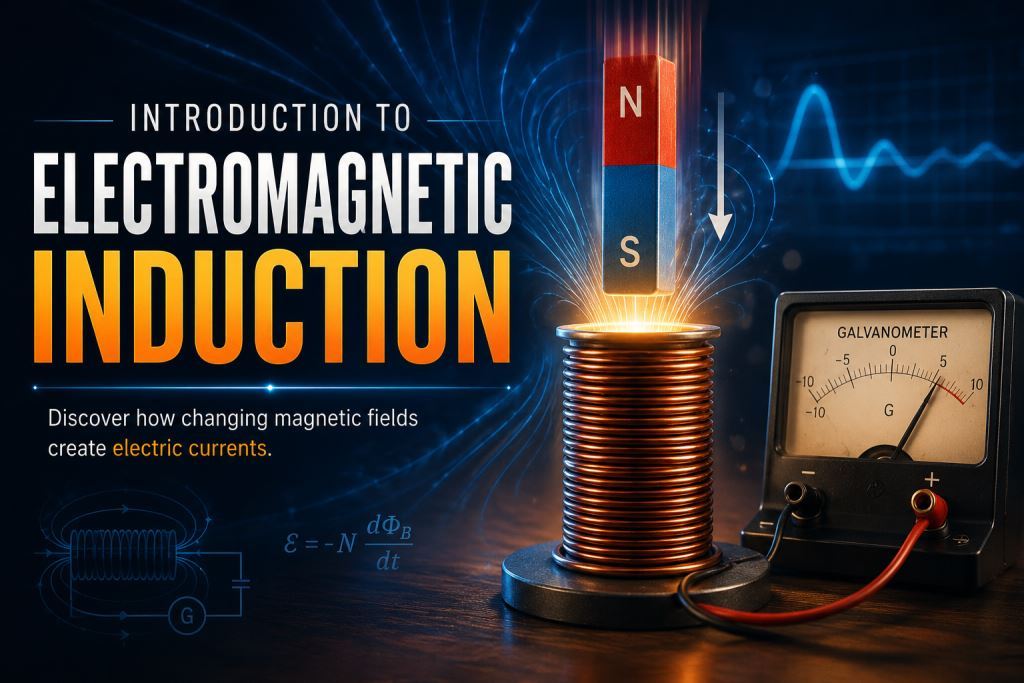
Electromagnetic induction is one of the fundamental principles of electromagnetism and explains how electrical energy can be produced from a changing magnetic field. Discovered by Michael Faraday in the 19th century, the phenomenon occurs when the magnetic flux through a conductor changes, inducing an electromotive force (emf) and, when the circuit is closed, an electric current. This principle forms the basis of many technologies we use today, including electric generators, transformers, induction motors, and wireless charging systems. Understanding electromagnetic induction provides an important foundation for studying how mechanical and magnetic energy can be converted into electrical energy.
Introduction to electromagnetic force

Factors affecting magnitude of the induced e.m.f

The Lenz’s law

Direction of current in straight conductor

Mutual induction

Transformers

When direct current (DC) is supplied, the magnetic field remains constant after a brief moment, so no continuous e.m.f. is induced in the secondary coil
useful Transformer Equations

The figure shows two coils of wire. one connected to a dc source and next to it connected to the galvanometer. click to read more
Exam questions on electromagnetic induction

Exam questions may require candidates to explain how an induced current is produced, determine the direction of induced current using Fleming’s Right-Hand Rule, interpret diagrams of magnets and coils, and describe applications such as electric generators, transformers, and induction coils. click to read more
Leave a Reply